
Published: November 23, 2026.
Proposed property tax increases vary widely across Dakota County, with some homeowners facing double-digit increases while others could see reductions. County officials cite unfunded mandates, rising costs, and shifting state and federal expenses as communities prepare for public budget hearings.
DAKOTA COUNTY, MINNESOTA: Homeowners across Dakota County are receiving their proposed 2027 property tax statements, offering an early look at what they could owe next year as county officials, cities, and school districts finalize their budgets. For many residents, the news is another year of higher property taxes. However, the size of those increases varies significantly depending on where a homeowner lives, their property value, and the taxing districts serving their community.
Dakota County is proposing a 15.9% increase in its county property tax rate, while the county's portion of the tax bill for a median-valued residential homestead is projected to increase 18.4%. But those figures tell only part of the story.
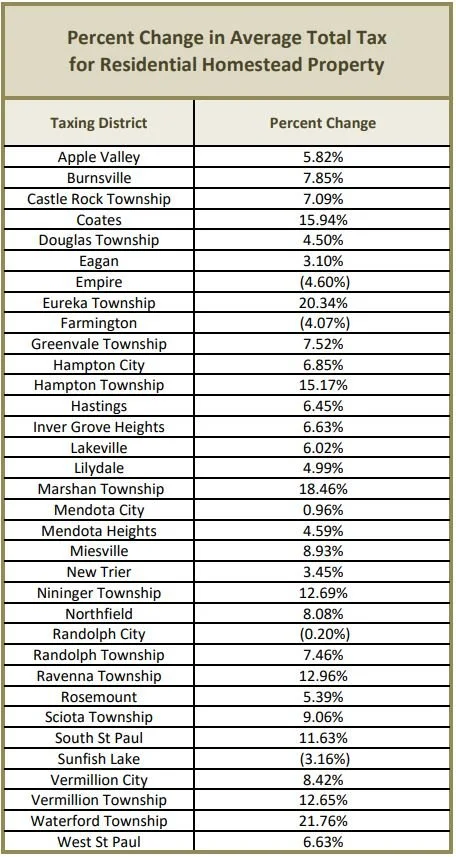
Countywide comparisons show average total residential homestead property taxes increasing by 3.10% in Eagan, 5.82% in Apple Valley, 6.02% in Lakeville, 7.85% in Burnsville and 11.63% in South St. Paul. Meanwhile, homeowners in Farmington, Empire and Sunfish Lake could see average decreases, while several rural townships are facing increases exceeding 15% or even 20%.
The proposed increases come as Dakota County officials say changes in state and federal funding, unfunded mandates, and rising operating expenses are placing additional pressure on local taxpayers. Residents will have opportunities to question those proposals during a series of truth-in-taxation meetings beginning November 30, ahead of the December 28 deadline for local governments to certify their final property tax levies.
Dakota County proposes 15.9% tax rate increase
Dakota County's proposed 2027 property tax rate is 24.380%, compared with the final 2026 rate of 21.031%. That represents a 3.349-percentage-point increase, or approximately 15.9% relative to the previous year's rate.
Despite the increase, Dakota County would still have the lowest county property tax rate among the seven Twin Cities metropolitan counties included in the comparison.
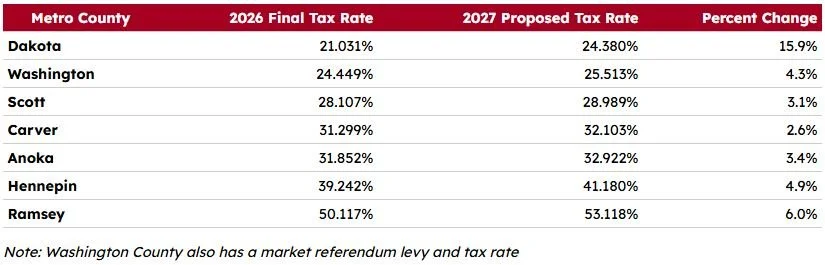
Source: Dakota County proposed 2027 metro county tax rate comparison. Washington County also has a market referendum levy and tax rate.
Although Dakota County's proposed rate remains the lowest, its percentage increase is substantially larger than those proposed by the other six metro counties. The next-largest increase is Ramsey County's 6.0%, followed by Hennepin County at 4.9%.
The county tax rate is only one component of a property's overall tax calculation. It does not represent the percentage of a home's market value that the owner pays in taxes, nor does it include the full tax burden imposed by cities, school districts, and other local governments.
What the increase means for a median-valued homeowner
Dakota County's comparison uses a residential homestead with a median estimated market value of $391,700 for 2027, up from $384,400 in 2026. For that representative property, the county portion of the annual property tax bill would increase from $783 to $927. The $144 annual increase works out to approximately $12 per month.
Even with that increase, Dakota County estimates its county tax would remain $369 below the seven-county metropolitan average of $1,296 for an equivalently valued residential property. These estimates compare county taxes using the same representative property value. They are not estimates of a homeowner's entire annual property tax bill.
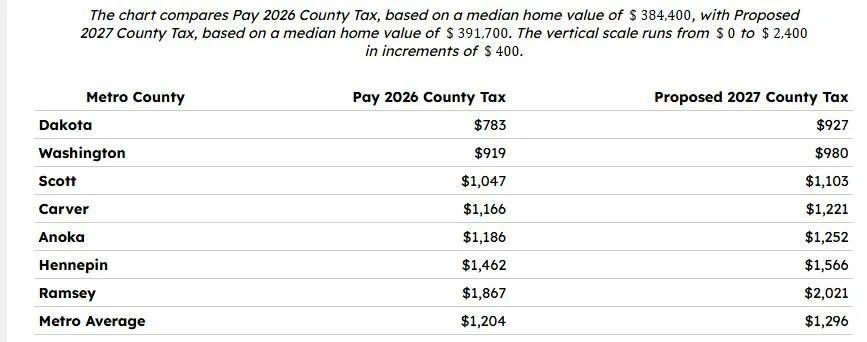
Actual tax bills also depend on a property's taxable value, classification, applicable exemptions or exclusions, and the levies established by other taxing authorities.
Why Dakota County says taxes need to increase
Dakota County officials attribute much of the pressure on the proposed 2027 budget to costs beyond the county's direct control. According to information distributed with proposed property tax notices, Minnesota requires counties to provide more than 100 mandated services, but state funding does not fully cover their costs.
The county estimates that 66% of its property tax revenue supports state-mandated services. County officials also report that changes in state and federal funding will shift more than $7 million in additional expenses to Dakota County in 2027.
According to the county, many of those shifts do not create new services or expand existing programs. Instead, they require local taxpayers to cover expenses previously supported by other levels of government. Rising costs in five mandated programs are expected to add nearly $4 million in additional expenses. Together, those pressures amount to approximately $11 million in increased or shifted costs.
Dakota County says it has reduced spending by more than $20 million over two years to help address its budget challenges. Even with the proposed levy increase, the county projects that it will maintain the lowest county property tax rate, lowest levy per resident, and smallest workforce relative to population among the seven metropolitan counties.
Those comparisons are county projections, not independent measures of service quality or efficiency.
Where Dakota County property tax dollars go
Property taxes support a broad range of county responsibilities, including public safety, corrections, social services, public health, libraries, transportation, and government operations. Dakota County's 2026 budgeted levy spending breaks down how those funds are allocated.
Public safety and corrections account for the largest share, approximately 32%, or $59.1 million.
Social services represent another 24%, or $43.9 million, while internal services, including information technology, finance, and facilities, account for approximately 18%, or $32.7 million.
Combined, those three categories represent nearly three-quarters of the county's budgeted property tax levy spending.
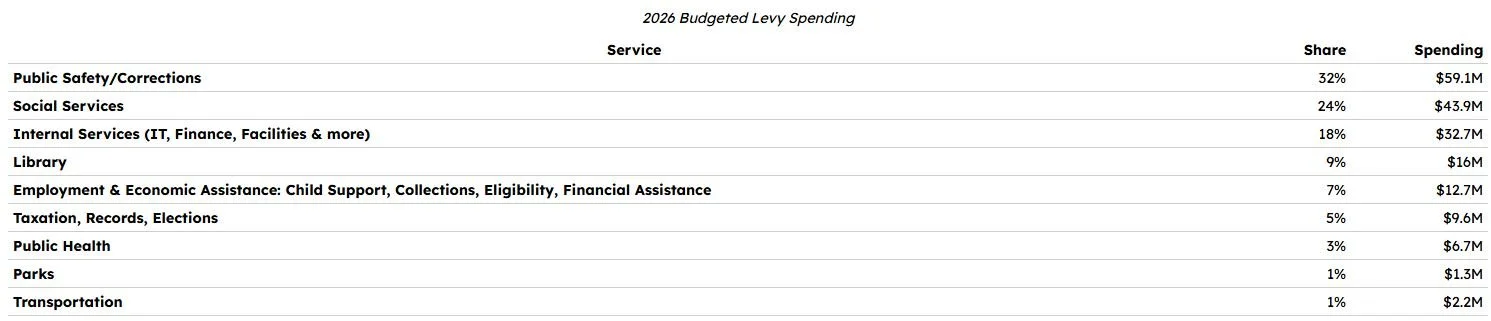
Source: 2026 Budgeted Levy Spending
The county also allocates approximately $16 million to libraries, $12.7 million to employment and economic assistance programs, $9.6 million to taxation, records and elections, and $6.7 million to public health. These figures represent 2026 budgeted levy spending, not the final allocation of the proposed 2027 budget.
The county receives only a fraction of property tax collections
Although Dakota County is proposing a substantial increase in its own tax rate, county government receives a relatively small portion of the property taxes collected across its communities. According to the county's adopted 2026 levy figures, school districts receive the largest share of property tax collections, followed by cities.
This means that changes to school district budgets, municipal spending, debt payments, and special taxing districts can significantly influence the total amount a homeowner pays, even when the county's share remains comparatively low.
For homeowners, understanding the difference between the county's proposed increase and the overall tax bill is essential.
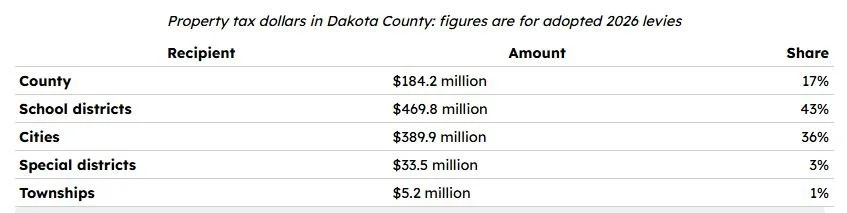
Source: Property tax dollars in Dakota County: figures are for adopted 2026 levies
A one-dollar bill is divided into five colored sections proportional to the property tax shares: county in red, school districts in blue, cities in orange, special districts in green, and townships in gray. The bill depicts George Washington and bears the words ‘The United States of America’ and ‘One Dollar.’
Property tax increases vary widely across Dakota County
While Dakota County's proposed county tax rate increase is 15.9%, the projected changes in total residential property taxes differ significantly across its cities and townships. The county's analysis of average total residential homestead taxes shows that some communities could see modest increases, while others could face substantial ones.
The figure in the next section below reflects changes between final 2026 taxes and proposed 2027 taxes. The comparison excludes properties with more than $15,000 in new construction, properties with multiple classifications, land-only parcels, and properties within tax increment financing districts. The figure represents average changes by taxing district. They should not be interpreted as the exact increase or decrease every homeowner in that community will experience.
Rural townships face some of the largest increases
Several of the county's largest projected increases are concentrated in rural townships. Waterford Township has the largest average increase in total residential homestead taxes at 21.76%, followed by Eureka Township at 20.34% and Marshan Township at 18.46%. Coates is projected to increase by 15.94%, while Hampton Township could see a 15.17% increase. Other communities with double-digit increases include Ravenna Township, Nininger Township, Vermillion Township, and South St. Paul.
By comparison, Eagan's projected average increase of 3.10% is among the smallest positive increases in the county. Four taxing districts show projected decreases: Empire, Farmington, Sunfish Lake and Randolph.
These variations illustrate how local government budgets, school district boundaries and changes in property valuations can produce different tax outcomes within the same county.
Why two homeowners in the same city may see different increases
A homeowner's total property tax bill depends on several taxing authorities, not just Dakota County. Those authorities can include the county, city or township, school district, and special taxing districts. In addition, changes in a property's assessed value can affect its share of the overall tax burden.
Dakota County's more detailed residential homestead comparison in the first image below shows how homeowners in the same city can face different projected increases depending on their school district. For example, a median-valued home in Burnsville assigned to School District 194 has a projected total property tax increase of 10.44%, compared with 7.59% for a median-valued Burnsville home in School District 196.
In Lakeville, a median-valued home in School District 194 could see an 8.54% increase, while a median-valued home in School District 192 could see a 5.70% decrease. The county's figures are based on representative median-valued homes, rather than tracking the actual tax changes of individual properties.
The comparison underscores an important point: a communitywide average does not necessarily reflect a homeowner's experience in a particular school district.
Rising home values are another factor
Property tax increases are not driven solely by decisions to raise local government levies. Changes in estimated market values can also affect a property's share of the overall tax burden. Dakota County's analysis, in the tables below, shows considerable variation in median residential homestead values across the county.
In Apple Valley, the median estimated market value increased 1.93%, while Burnsville saw a 2.60% increase and Lakeville a 2.02% increase. Eagan experienced a much smaller increase of approximately 0.27%, while Rosemount's median value rose 1.93%.
Some rural areas experienced significantly larger increases. Waterford Township's median estimated market value increased 15.37%, Castle Rock Township's increased 14.91%, and Eureka Township's increased 14.45%. Mendota also recorded a substantial increase of 12.73%. By contrast, estimated median values declined in Hastings, Douglas Township, and Randolph Township.
A higher estimated market value does not automatically translate into an equivalent percentage increase in property taxes. The final bill depends on taxable value, applicable exclusions, local levies, and how property values change relative to other properties.
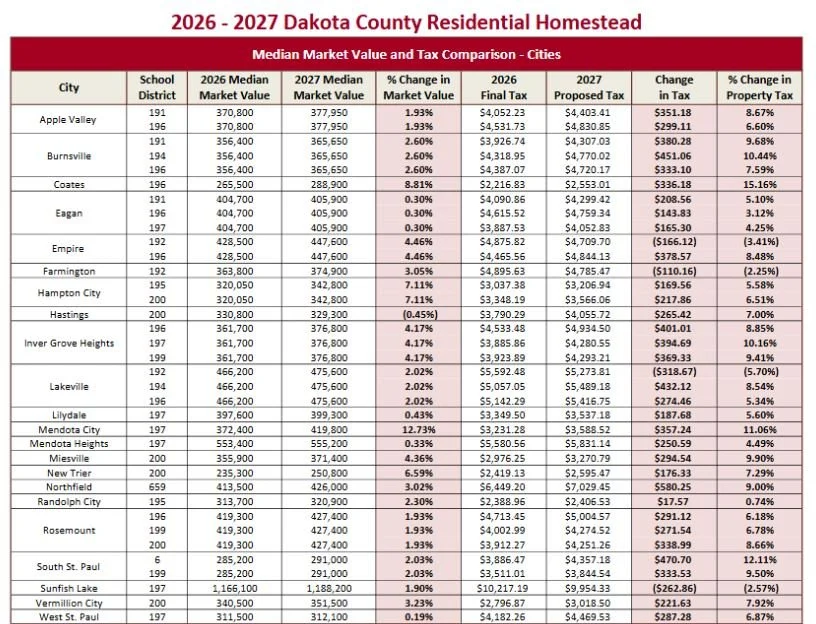
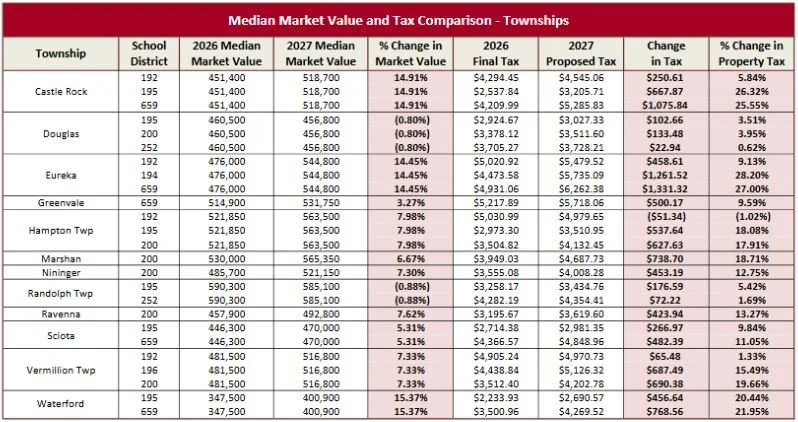
Two comparison tables showing 2026 and 2027 median market values, as well as property tax changes, for Dakota County residential homesteads in cities and townships.
Apple Valley: Street maintenance and park improvements contribute to higher taxes
Apple Valley officials say the city's proposed 2027 budget is focused on preserving existing infrastructure, maintaining streets, and funding improvements to parks and public buildings. The City Council approved its preliminary budget on September 10, 2026.
Under the proposal, Apple Valley's property tax levy would increase approximately 8.93%, from $44.67 million in 2026 to $48.65 million in 2027. For a median-valued home, the city's portion of property taxes is projected to increase by approximately $172 annually, or $14.33 per month.
That represents an increase of approximately 10.16% in city taxes, bringing the annual city portion to $1,871. The increase is separate from changes imposed by Dakota County, school districts, and other taxing authorities.
Street maintenance receives additional funding
Apple Valley plans to increase funding for its Street Maintenance Program by $350,000, bringing the annual allocation to $4.95 million. Unlike many communities that levy special assessments on properties benefiting from street reconstruction or maintenance, Apple Valley includes those costs in its general property tax levy.
City officials say the approach distributes street maintenance costs across the community rather than charging additional assessments to individual benefiting properties. Since the program began in 2012, Apple Valley has maintained approximately 118 miles of streets.
For the median-valued home used in the city's budget comparison, approximately $183 of the proposed 2027 city property tax bill would support street maintenance.
Park improvements and debt payments
Apple Valley is also continuing investments voters approved through the 2023 park referendum. Bonds issued in 2024, 2025 and 2026 are helping finance improvements to parks and public facilities. The city estimates that debt service on park bonds will account for about $239 of the median-valued home's annual 2027 city property tax bill, including previously issued bonds.
The proposed budget includes approximately $7.66 million for debt service, an increase of $969,349, or 14.5%, from 2026. The city's general fund levy would increase 8.1% to approximately $35.96 million. Apple Valley's proposed 2027 budget allocates the largest portion of the representative homeowner's city tax bill to police services, at approximately $553 annually, followed by parks and recreation at $220 and public works at $203.
Residents can learn more about the proposal on the Apple Valley website linked here: City of Apple Valley 2027 Budget Brief.
Lakeville: Growing population, school expansion and infrastructure needs
Lakeville's proposed 2027 budget reflects continued population growth and increasing demand for municipal services. The city's population has grown from approximately 60,965 residents in 2016 to an estimated 78,810 in 2026, an increase of roughly 29% over the decade. City officials also report approximately $1.7 billion in new construction over the past five years and $2.8 billion over the past decade.
According to Lakeville's proposed budget information, the median-valued home increased from approximately $466,250 in 2026 to $476,100 in 2027. For that representative property, the city portion of the property tax bill is projected to increase from $1,522 to $1,609, an increase of $87 annually. The city estimates that approximately $854 of the annual city tax bill for a median-valued home supports public safety, with another $298 for general government, $238 for public works and $219 for parks and recreation.
Public safety accounts for approximately 52% of Lakeville's 2026 general fund expenditures.
Lakeville also expects its municipal liquor operations to contribute approximately $2 million toward public purposes in 2027, including equipment purchases, debt service, and community events.
Lakeville Area Schools proposes 8.46% levy increase
School District 194, which serves much of Lakeville and portions of surrounding communities, is proposing an 8.46% increase in its 2027 property tax levy. District officials say 5.71 percentage points of the increase are associated with new middle school expansions. The remaining 2.75 percentage points support other district needs and costs the district describes as closely aligned with inflation.
According to the district's budget materials, property taxes account for approximately 27% of its fiscal year 2027 general fund revenue, while state funding provides 67%. The district's proposed property tax levy allocations include 74% for the general fund, 24% for debt service, and 2% for community education. Enrollment is also expected to grow, from approximately 12,130 students during the 2026–2027 school year to a projected 12,550 by 2030–2031.
Lakeville Area Schools has scheduled a public hearing for December 15th, 2026, at 6 p.m. at the district office.
The meeting will also be broadcast on the district's YouTube channel. Additional information is available at isd194.org/Pay27.
Hastings: Proposed budget includes investments in public safety, roads and water infrastructure
Hastings officials have approved a preliminary 2027 city budget totaling approximately $70.4 million. The proposal includes a property tax levy of $23.5 million, representing an 8.77% increase over 2026. For a median-valued home assessed at approximately $329,400, the city estimates the municipal portion of property taxes would increase by $159 annually, or about $13.23 per month.
City officials say the proposed budget reflects several priorities, including public safety, road maintenance, water infrastructure improvements and staffing needs. Among the projects identified for 2027 are continued construction of the Western Water Treatment Plant and the second phase of lead-service-line replacements. The city also plans improvements along Pleasant Drive, continued road maintenance, inclusive park improvements, and renovations to parks and trails.
Public safety accounts for the largest share of Hastings' identified spending distribution at 43%, followed by parks and recreation at 15%, administrative operations at 13% and public works at 10%.
Hastings has scheduled its truth-in-taxation hearing for December 7th, 2026, at 7 p.m. at City Hall. Additional budget information is available at hastingsmn.gov/budget.
Understanding the difference between a levy increase and a tax increase
One of the most important distinctions for homeowners is the difference between a government's property tax levy, its tax rate, and the amount appearing on an individual property tax bill.
A property tax levy is the total amount of money a local government intends to collect through property taxes. When a city announces an 8% levy increase, that does not necessarily mean every homeowner's tax bill will rise by 8%. New construction, changes in property values, school district boundaries, and how taxable property is distributed can all affect how a levy increase translates into individual tax bills.
For example, new homes and commercial developments may expand the tax base, potentially distributing some of the tax burden across additional properties.
Conversely, if a property's taxable value rises faster than comparable properties, its share of the tax burden may increase even without an equivalent increase in government spending. Homeowners should therefore compare the proposed 2027 tax amount on their individual statements with the final amount paid in 2026 rather than relying exclusively on countywide or citywide percentages.
How property values are determined
Dakota County's property assessment process begins well before residents receive their proposed tax statements. The county uses open-market property sales to estimate market values for the following assessment year. For taxes payable in 2027, the county analyzed qualifying property sales from October 1, 2024, to September 30, 2025. Those sales helped establish estimated market values effective January 2, 2026.
Property owners received valuation notices in March 2026, with opportunities to appeal their estimated market values during the spring. Proposed 2027 tax statements are being distributed in November 2026. Final tax statements are expected in March 2027, with property tax payments generally due in two installments during the spring and fall.
This timeline is important because the property values used to calculate 2027 taxes were established months before the proposed tax statements were mailed. Residents who believe their assessed market value is inaccurate should contact Dakota County Assessing Services to learn about the applicable review or appeal process. The regular spring 2026 valuation appeal period has already passed.
You can reach the Dakota County assessing office at 651-438-4200 with additional questions about the process.
Homeowners may qualify for property tax relief
Dakota County also encourages residents to explore available property tax relief programs that could reduce their financial burden. Depending on eligibility, homeowners may qualify for programs such as the Minnesota Homestead classification, property tax refunds, senior citizen property tax deferral, disability-related homestead provisions, and benefits for qualifying disabled veterans.
Other programs may provide relief for qualifying agricultural properties, properties affected by disasters, or certain tax-exempt properties. The availability and amount of relief depend on the particular program and the property owner's circumstances. Residents should review eligibility requirements through Dakota County or the Minnesota Department of Revenue rather than assuming they automatically qualify.
More information is available through the county's official website at dakotacountymn.gov.
Residents can weigh in before final property taxes are approved
The proposed tax notices arriving in mailboxes this month are not final bills. Local governments and school districts must hold public meetings to discuss their proposed budgets and property tax levies before final adoption. These truth-in-taxation meetings provide residents an opportunity to learn why taxes are changing, review spending priorities, ask questions, and offer comments.
Dakota County has also published a schedule of meetings beginning November 30th and continuing through December 21st, 2026. Additional hearings are scheduled for school districts throughout the county.
Among them are School District 191 on December 10 at 6:30 p.m., School District 196 on December 14 at 6 p.m., School District 194 on December 15 at 6 p.m., and School District 200 on December 16 at 6 p.m.
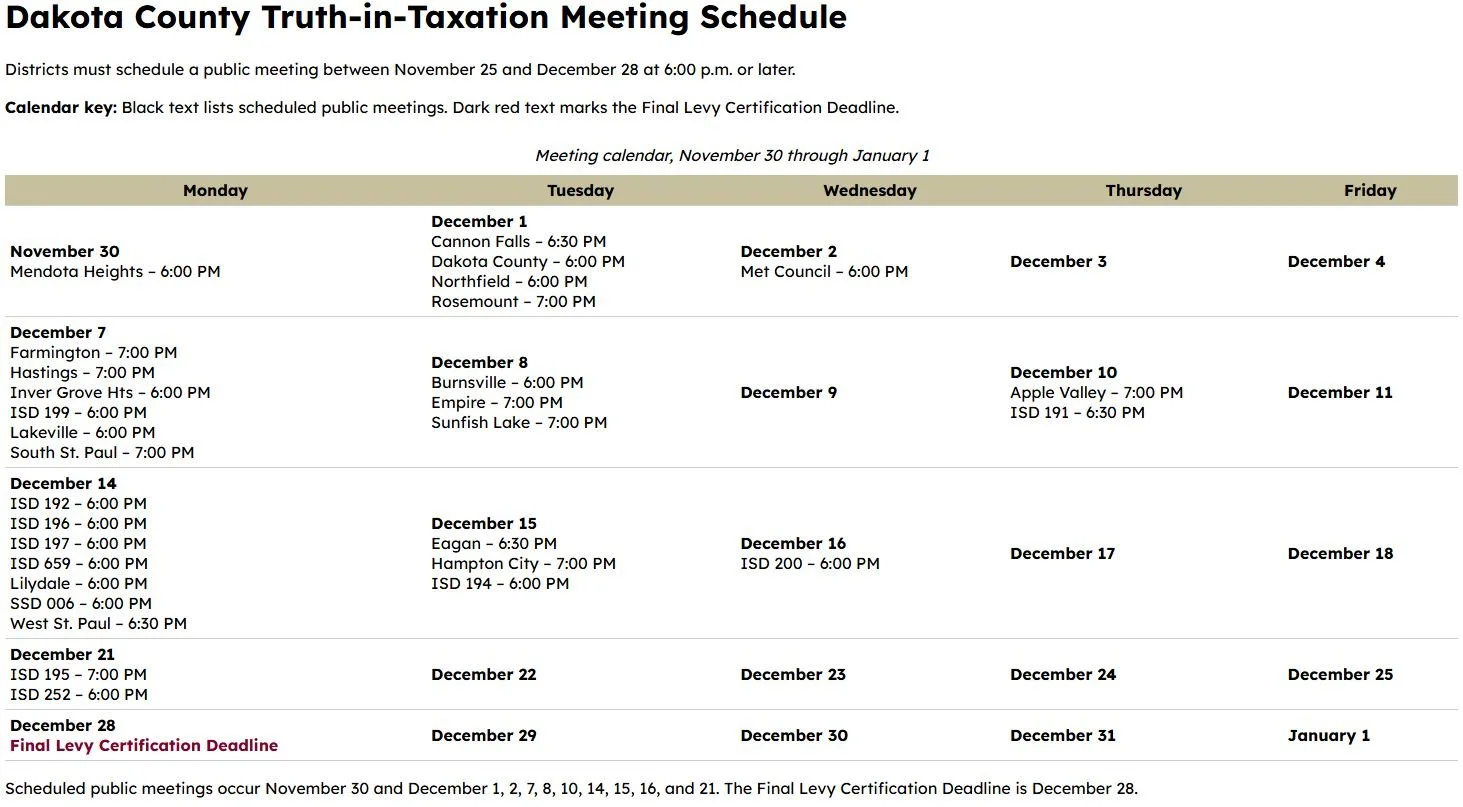
Residents should verify meeting locations and any schedule changes directly with their city, county, or school district before attending. Local taxing authorities must certify their final property tax levies by December 28th.
While final levies can differ from preliminary proposals, the notices give homeowners a chance to understand the potential impact before those decisions are made.
Final tax bills will not be known until 2027
Dakota County's proposed 2027 tax figures illustrate the growing financial pressure facing both local governments and property owners. The county says state and federal funding changes, mandated programs, and rising costs are contributing to its proposed tax increase, while cities and school districts are weighing infrastructure improvements, public safety needs, education expenses, and long-term debt obligations.
For residents, the impact will be far from uniform. Some communities are projected to experience relatively small changes, while others could face double-digit increases. Individual homeowners may see substantially different results even within the same city. Despite Dakota County's comparatively low tax rate among metropolitan counties, the proposed increase in its county portion will add to the overall property tax burden for many households.
With public hearings scheduled throughout December, residents still have an opportunity to examine the proposals and provide feedback before final decisions are made.
The bottom line: Proposed 2027 property taxes are increasing across much of Dakota County, but the actual impact on individual homeowners depends on where they live, their property's taxable value, and the budgets approved by the multiple taxing authorities serving their community.
Final property tax statements are expected to be mailed in March 2027.
Reporting sources: Dakota County proposed 2027 property tax comparisons, residential homestead valuation tables, 2026 adopted levy information, budget and assessment materials, Apple Valley's proposed 2027 budget, Lakeville's proposed 2027 city budget, Lakeville Area Schools' 2027 tax levy materials, Hastings' proposed 2027 budget and Dakota County's truth-in-taxation meeting calendar.
