
Lakeville Area Schools Reviews Attendance Area Changes to Address Overcrowding and Growth
Published: December 23, 2025.
LAKEVILLE, MINNESOTA— Administrators with Lakeville Area Schools (ISD 194) are proposing comprehensive K–8 attendance area boundary changes beginning with the 2026–27 school year, citing uneven enrollment, rapid residential growth in certain neighborhoods, and the need for long-term capacity planning.
The first recommendation proposal was presented to the school board on December 16, 2025, with approval expected to be considered at the January 13, 2026, meeting. As discussions have continued, board members have raised several concerns about long-term scalability, state-law constraints, and specific neighborhood impacts, particularly at the middle school level.
Why Attendance Area Changes Are Being Proposed
District officials say boundary adjustments are necessary due to uneven enrollment across schools.
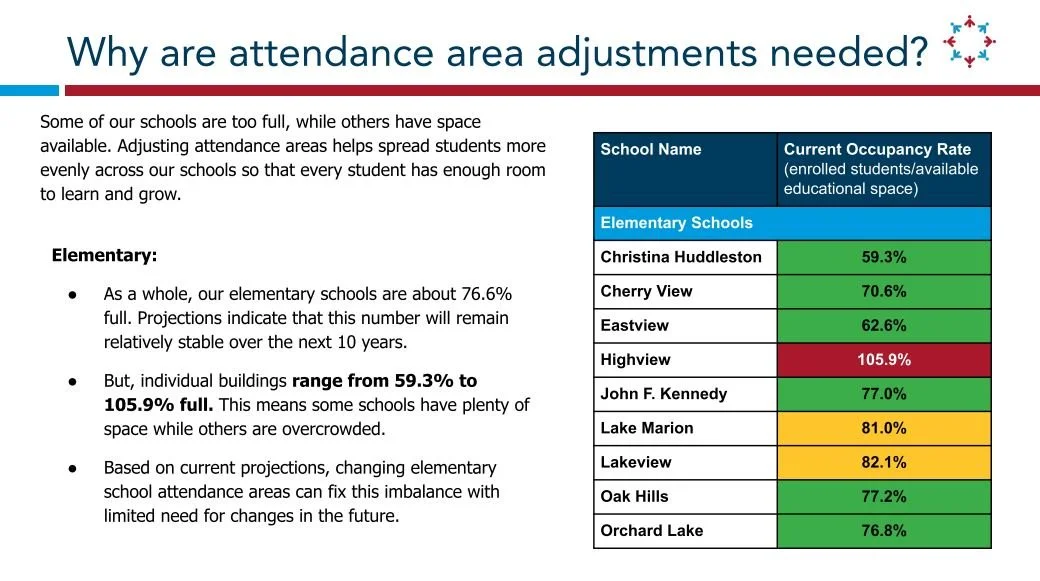
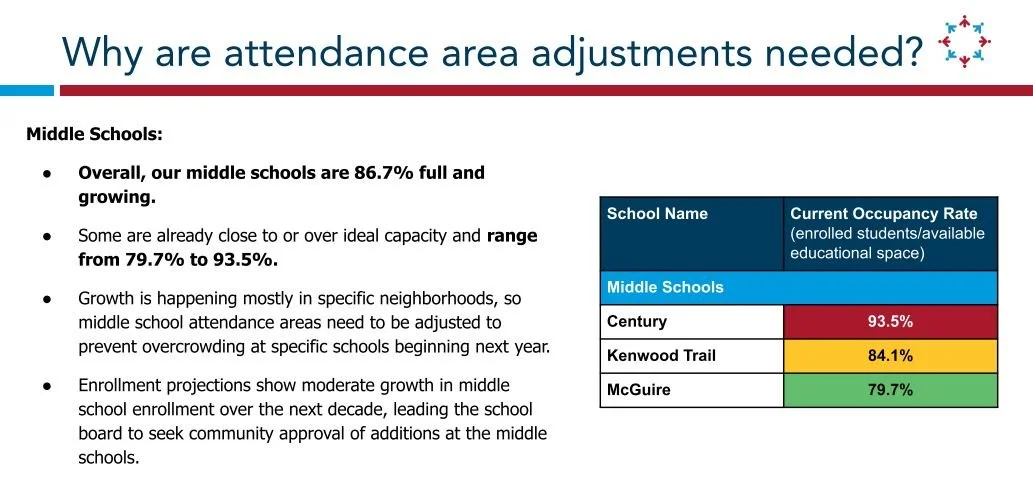
District-wide, elementary schools are approximately 76.6% full, but individual buildings range from 58.7% to 105.6% capacity. Middle schools are currently 86.7% full and growing, with particular schools ranging from 80.2% to 93.7% capacity.
Administrators emphasized that 85% capacity is a critical threshold. Once a school exceeds that level, it must begin identifying and repurposing non-traditional spaces, such as multi-purpose rooms or collaboration areas, to serve as classrooms for students who cannot be placed in standard instructional spaces.
District leaders say teaching students in repurposed spaces is not sustainable in the long term and underscores the need to address capacity imbalances before schools exceed that threshold.
A Patchwork of Boundaries Created Over Time
For more than a decade, Lakeville Area Schools assigned new housing developments to schools one neighborhood at a time without redrawing existing boundaries. While this minimized short-term disruption, administrators say it created a fragmented “patchwork” that no longer aligns with current enrollment and growth patterns.
The last district-wide boundary change occurred in the 2024–25 school year with the opening of Highview Elementary School. Even then, district leaders acknowledged additional adjustments would likely be needed as growth continued, growth that ultimately occurred faster than expected.
How Attendance Area Decisions Are Made
This fall, the district convened an interdisciplinary work group of principals and district administrators to review enrollment data, housing development trends, and building capacity.
The group evaluated multiple boundary scenarios using enrollment projections, historical attendance patterns, and operational considerations. Principals provided input on how overcrowding affects staffing, scheduling, student services, and the need to convert non-classroom spaces for instructional use.
Guiding principles include:
Maintaining racial and socio-economic diversity
Keeping attendance areas logical and geographically connected
Preserving neighborhoods when possible
Considering special education needs
Minimizing student movement, especially repeated moves
Middle School Map Draws Board Scrutiny
Directors discussed the proposed middle school attendance map, which has reportedly prompted numerous emails from families affected by the changes. Directors specifically questioned the proposed reassignment of students from the Legacy and Berres Ridge neighborhoods. Under the current configuration, students from those areas attend Kenwood Trail Middle School. Under the proposed map, they would attend McGuire Middle School instead.
Directors raised concerns that this shift would separate students from peers they have attended school with for several years and would place them on different high school trajectories, effectively mixing students who have not attended school together for the previous three years.
Directors questioned why those two neighborhoods were selected and whether the number of students impacted could be reduced.
District Explains the “Calculus” Behind the Middle School Shift
District office staff explained that the “calculus” behind the adjustment was driven by geography and transportation feasibility on the western side of the district.
Administrators said they pushed the boundary as far north as reasonably possible to balance enrollment and plan for anticipated growth. Going farther north, they said, would have required busing students past Kenwood Trail Middle School to reach McGuire, which staff felt was not appropriate.
By stopping where they did, district officials said they were able to capture enough students to balance enrollment numbers and account for future capacity needs without routing students past another middle school.
Board Questions High School Alignment
Several directors expressed concern that the current proposal could effectively turn the middle school into a “split school”, feeding both Lakeville North and Lakeville South high schools.
Directors said they would prefer to explore options that keep students aligned with the high school they were initially expected to attend, rather than reshuffling middle school boundaries in a way that disrupts long-term feeder patterns.
At the same time, one director cautioned against making boundary decisions solely in response to neighborhood feedback, noting that similar issues arose during the previous round of boundary changes.
Board Reiterates Concerns About the Overall Model
Director Brian Thompson again voiced concerns about the current maps and the planning framework behind them, saying he is not aligned with the proposal as presented. Thompson said his primary concern is geographic logic and long-term sustainability, arguing that students should not be required to pass one school to attend another whenever possible.
“We just want to make it geographically logical for our kids to go to school,” Thompson said. “If they’ve got to drive past a middle school or an elementary school to get to their school, that just doesn’t make sense to me.”
Thompson also questioned whether legal requirements truly prevent the district from prioritizing neighborhood schools.
“I’m not sure if this is accurate or not, but I’ll defer to administration,” he said. “I don’t believe there is a legal state statute that says we have to have a certain percentage of this or that. If kids can go to their neighborhood school, that’s what we should be striving for.”
He reiterated that, in his view, the current model is not designed to scale for growth and does not sufficiently prioritize capacity-first planning.
Director Pushback on Funding and Legal Reality
Director Carbone clarified that while Achievement & Integration (A&I) requirements may not mandate specific attendance thresholds, compliance is directly tied to funding. That director noted that the district receives approximately $3.5 million annually in A&I funding and warned that failing to meet A&I expectations could jeopardize that funding.
Director Biran questioned whether the district is currently using those funds effectively, noting that some programs, such as AVID, have been discontinued and suggesting the board revisit whether A&I funding is producing measurable results.
Limits of a Purely Geographic Model
Director Cameron stated that, regardless of how boundaries are drawn, some students will always have to pass through another school to reach their assigned building. They noted this can occur due to special education programming, magnet or choice options, or simply because many district schools are located along the same corridor.
Cameron cautioned that imposing a strict “no driving past a school” rule could make boundary planning nearly impossible to complete.
How Many Students Would Be Affected
District staff also provided a more precise breakdown of the number of students impacted under the current proposal:
Elementary Schools
605 total students would move
228 of those students are classified as “multiple movers.”
The largest concentration of moves is associated with Highview Elementary School
Middle Schools
223 total students would move
24 of those students are classified as multiple movers
District officials said these numbers are a key factor in ongoing discussions, particularly as the board weighs stability versus long-term capacity needs.
Community Feedback and Next Steps
District leaders acknowledged that attendance area changes are disruptive for families and said the board has not yet reached consensus on the proposal.
Community members may provide feedback by emailing schoolboard@isd194.org, participating in Public Comment at a school board meeting, or attending the district’s in-person informational session:
January 6, 2026 | 4:30–5:30 p.m.
Kenwood Trail Middle School Auditorium
Advanced Registration Is required by January 5, 2026 — register here.
Additional revisions, alternative scenarios, or clarifications may be shared as the school board continues deliberations ahead of a final vote. You can watch the School Board Meeting from December 16, 2025, regarding these changes below.
The presentation shown during this meeting is available to view here.
Written by: Will Wight
Cover photo from the presentation on the December 16, 2025 School Board Meeting.
