
Published: November 16, 2026
Minnesota pollution regulators say the battery recycling facility violated multiple environmental permits in 2024 and 2025. Nearly $200,000 in penalties will support community projects in Dakota County, while the company faces new monitoring and public accountability requirements.
EAGAN, MINNESOTA - Gopher Resource, a lead-acid battery recycling company operating in Eagan, has been fined $490,000 for multiple environmental violations involving excessive lead emissions, contaminated stormwater runoff, and unauthorized stormwater discharges, according to an announcement Monday, November 16, 2026, from the Minnesota Pollution Control Agency (MPCA).
The violations, which occurred throughout 2024 and early 2025, involved the company's air quality, industrial stormwater, and hazardous waste permits. State regulators determined that the facility allowed lead-contaminated materials and exposed processing equipment to contribute to polluted stormwater runoff, discharged approximately 180,000 gallons of stormwater during two separate rain events, and exceeded federal air quality standards for lead emissions. In addition to the financial penalty, Gopher Resource must implement corrective measures to strengthen environmental protections, improve transparency, and increase communication with residents in Eagan, Inver Grove Heights, and surrounding communities.
The enforcement action also includes a direct financial benefit for Dakota County residents, with $196,000 of the penalty designated for community improvement projects overseen by Dakota County Public Health.
The latest violations follow a history of lead air quality concerns at the Eagan facility dating back to at least 2007. The surrounding area previously failed to meet federal lead air quality standards before corrective measures were implemented and the EPA approved a determination of compliance in 2015.
Environmental Violations Identified in 2024 and 2025
According to the MPCA, Gopher Resource violated several conditions of its environmental permits during operations at its Eagan battery recycling facility.
The agency identified three primary areas of noncompliance involving stormwater management, lead contamination, and air quality monitoring.
Unauthorized Stormwater Discharges
During two separate rain events in 2024, approximately 180,000 gallons of stormwater were discharged from a stormwater pond at the facility. The MPCA identified these discharges as permit violations but emphasized that the incidents did not affect drinking water supplies.
Industrial stormwater permits regulate runoff from facilities where rainwater or melting snow may contact industrial equipment, chemicals, waste materials, or other potential pollutants.
Lead-Contaminated Stormwater Runoff
Regulators also determined that exposed processing equipment and lead-contaminated scrap materials at the facility contributed to lead-contaminated stormwater runoff. Because Gopher Resource processes lead-acid batteries, the facility handles materials that require careful management to prevent contamination of surrounding soil, water, and air.
After discovering the stormwater violations in 2024, the MPCA issued an administrative order requiring Gopher Resource to take corrective actions to address the contamination.
The agency said the $490,000 enforcement settlement announced Monday includes civil penalties associated with those violations.
Excessive Lead Emissions and Reporting Violations
The MPCA also identified air quality violations involving elevated lead emissions between January and March 2025. According to the agency, the facility's emissions exceeded the National Ambient Air Quality Standard for lead during that period.
Federal air quality standards establish limits on certain pollutants, including lead, to protect public health and the environment. Regulators additionally determined that Gopher Resource failed to notify the MPCA within 24 hours after discovering the source of the elevated lead emissions, as required under its permit.
The failure to provide timely notification was identified as a separate compliance issue associated with the excessive emissions.
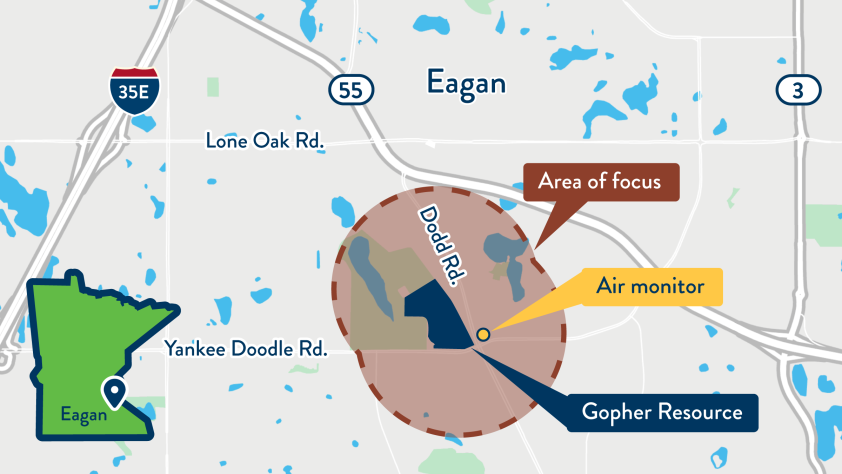
Timeline: Gopher Resource's History of Lead Air Quality Compliance
The environmental violations identified in 2024 and 2025 follow nearly two decades of state air quality monitoring and regulatory oversight involving Gopher Resource's Eagan facility.
According to the Minnesota Pollution Control Agency, the facility previously experienced elevated lead concentrations that resulted in the surrounding area being designated as not meeting federal air quality standards. The company later implemented additional pollution controls, and federal regulators determined the area had returned to compliance.
The following timeline highlights significant developments in the facility's environmental compliance history:
2006: The MPCA began monitoring ambient air quality for lead near Gopher Resource's Eagan facility.
2007–2009: MPCA air monitoring showed that lead concentrations near the facility did not meet federal air quality standards. As a result, the agency designated the surrounding area as a lead nonattainment area, indicating that it was not meeting the applicable federal standard.
2009: Gopher Resource implemented additional lead pollution controls intended to reduce emissions and bring the area into compliance with federal air quality requirements.
August 24, 2015: The U.S. Environmental Protection Agency (EPA) approved the MPCA's determination that the area surrounding Gopher Resource had attained federal lead air quality standards. The determination was based on three years of quality-assured air-monitoring data showing compliance.
January–March 2025: MPCA air monitoring recorded elevated lead concentrations near the facility, resulting in another exceedance of federal lead air quality standards.
May 29, 2025: The MPCA issued a formal notice of violation to Gopher Resource for exceeding federal lead air quality standards.
November 16, 2026: The MPCA announced a $490,000 penalty against Gopher Resource for violations of its air, industrial stormwater, and hazardous waste permits. The enforcement action also required additional air monitoring, stronger environmental controls, and expanded community engagement.
The timeline shows the facility has faced multiple periods of regulatory scrutiny over lead emissions, including an earlier period of noncompliance followed by corrective action and a federal determination that the area had returned to compliance. The MPCA reports that the source of the elevated lead levels identified in early 2025 was addressed and that subsequent monitoring data from the surrounding area have not shown higher-than-normal lead levels.
The latest enforcement action establishes additional requirements to strengthen oversight, identify potential emissions problems earlier, and give nearby residents greater access to environmental monitoring information.
State Says Source of Elevated Lead Levels Has Been Addressed
Despite the violations, the MPCA reports that the source of the elevated lead emissions has since been addressed. According to the agency, an inspection conducted at the Gopher Resource facility in spring 2025 confirmed that the source of the elevated lead levels had been corrected.
The MPCA also stated that monitoring data collected from the area surrounding the facility have not shown higher-than-normal lead levels. Those findings provide additional context regarding current monitoring conditions following the violations identified earlier in 2025. However, the agency is requiring additional monitoring equipment and stricter compliance procedures to help identify and address potential future emissions.
Lead is a toxic metal that can affect human health, particularly among children and pregnant individuals. Exposure can affect neurological development and other bodily systems, making the prevention of environmental lead contamination an important public health priority. The MPCA's findings of elevated emissions do not, by themselves, establish that nearby residents experienced harmful levels of personal exposure. The agency has not reported higher-than-normal lead levels in monitoring data from the surrounding area.
Gopher Resource Required to Strengthen Environmental Monitoring
As part of the enforcement action, Gopher Resource must implement several new environmental compliance measures. One of the most significant requirements involves expanding the facility's ambient air monitoring network. The company must install and operate two additional lead air monitors and make the monitoring results publicly available through a website updated weekly. The new monitors are intended to provide additional information about lead concentrations in the air surrounding the facility and support earlier identification of potential problems.
The MPCA is also requiring Gopher Resource to implement a tiered compliance system that establishes specific actions when lead monitoring measurements reach designated thresholds.
First-Level Response Requirements
Gopher Resource must begin plant investigation measures if monitoring indicates either of the following conditions:
Lead concentrations reach or exceed 0.075 micrograms per cubic meter (µg/m³).
The highest daily lead reading exceeds 0.15 µg/m³ for three consecutive days.
These thresholds are intended to trigger additional investigations before elevated lead concentrations become prolonged.
Second-Level Response Requirements
A more comprehensive investigation and notification to the MPCA will be required if:
Lead monitoring reaches 0.10 µg/m³ under the applicable compliance criteria.
The elevated daily monitoring conditions described above continue for 21 consecutive days.
Under those circumstances, the facility must notify state regulators and conduct a more extensive investigation into the potential source of the elevated emissions.
These enforcement thresholds are facility-specific response requirements and should not be confused with the federal lead air quality standard, which is based on a rolling three-month average.
New Air Permit Required for Eagan Facility
Gopher Resource must also apply for a new air emissions permit incorporating stronger protections for human health and the environment. The facility currently operates under an air permit the MPCA issued in December 2022.
State regulators say the updated permitting process will provide an opportunity to review the facility's operations and establish additional requirements intended to prevent future violations. As part of that process, the MPCA will invite public comments on the draft air permit before making a final permitting decision.
Residents and other interested parties will have an opportunity to review the proposed requirements and provide feedback. The MPCA issues and enforces the facility's environmental permits, which regulate air emissions, industrial stormwater discharges, and hazardous waste management.
The agency also conducts regular inspections to determine whether Gopher Resource is operating in compliance with applicable environmental regulations.
Company Must Improve Communication With Nearby Communities
Beyond environmental monitoring and permitting changes, Gopher Resource must establish a formal community communications program. The requirements are intended to make information about the facility's operations more accessible to residents and provide clearer channels for reporting concerns.
Under the enforcement agreement, Gopher Resource must:
Establish a dedicated community contact to communicate with residents.
Create a community hotline for residents to report concerns, with follow-up required within 48 hours of receiving a complaint.
Develop a community relations webpage to share relevant facility information and updates.
Hold community meetings twice a year with residents from Eagan, Inver Grove Heights, and surrounding communities.
Provide at least 30 minutes at each community meeting for attendee questions.
Publish recorded meeting minutes on the company's website.
Develop an odor management plan to address concerns related to odors associated with facility operations.
The requirements expand the company's public communication obligations, particularly regarding complaints, environmental monitoring, and ongoing community engagement. The twice-yearly meetings will provide residents with recurring opportunities to raise concerns, ask questions, and receive information about the facility's environmental compliance activities.
Dakota County Public Health to Receive $196,000
A significant portion of the financial penalty will be directed back to the community affected by the violations. Of the $490,000 assessed against Gopher Resource, $196,000 (40%) will go to Dakota County Public Health for projects benefiting area residents. The allocation is required under legislation passed by the Minnesota Legislature in 2023.
Under the law, when the MPCA collects civil penalties of $250,000 or more for environmental permit violations, 40% of the penalty must go to the community affected by the pollution. The money must be used for projects that benefit residents, with oversight from the appropriate local health board.
Dakota County Public Health will seek input from community members to help determine how to spend the funds. The MPCA has not yet announced specific projects that will receive funding.
The remaining $294,000 of the penalty is subject to the state's applicable environmental penalty funding provisions.
MPCA Announces Virtual Community Meeting for November 18th
Residents interested in learning more about the violations and the corrective actions required of Gopher Resource will have an opportunity to hear directly from state environmental regulators later this week.
The MPCA has scheduled a virtual community meeting for Wednesday, November 18, 2026.
Meeting Information:
Date: Wednesday, November 18, 2026
Time: 6:00–7:30 p.m.
Location: Virtual meeting
Host: Minnesota Pollution Control Agency
Topic: Gopher Resource environmental violations, enforcement requirements, and corrective actions
The meeting will provide additional information about the enforcement action and the measures Gopher Resource must implement to address the violations. Residents can find more information about the meeting on the MPCA's official community meeting webpage.
MPCA Enforcement Actions Total More Than $25 Million Since 2019
The Gopher Resource penalty is part of the MPCA's broader enforcement responsibilities involving industrial facilities and other regulated operations across Minnesota. According to the agency, it has issued more than 8,800 enforcement actions since 2019, resulting in penalties totaling more than $25 million.
When determining financial penalties, regulators consider several factors, including the seriousness of the violation, the potential harm to public health or the environment, the facility's history of noncompliance, and any economic benefit gained by failing to follow environmental regulations.
The agency says its enforcement program is intended to ensure that regulated facilities meet environmental standards and address violations when they occur. Environmental penalties also serve as a financial consequence for companies that fail to meet permitting requirements.
What Happens Next?
Gopher Resource must now fulfill the corrective action requirements outlined in the MPCA's enforcement agreement. Those measures include pursuing a new air permit, installing additional monitoring equipment, developing an odor management plan, expanding community communications, and implementing the tiered lead emissions response system.
Dakota County Public Health will also begin gathering community input on how to allocate the $196,000 designated for projects benefiting affected residents. Meanwhile, the MPCA will continue overseeing environmental compliance at the Eagan facility.
The agency has stated that the previously identified source of elevated lead emissions has been addressed and that monitoring data from the surrounding area have not shown higher-than-normal lead levels.
Residents will have additional opportunities to learn about the facility's environmental requirements through the November 18 virtual meeting, future community meetings hosted by Gopher Resource, and the public comment process associated with the company's updated air permit.
Additional information about the enforcement action is available through the MPCA's November 16 news release and the agency's official website at www.pca.state.mn.us.
Written by: Will Wight
