
U.S. Border Czar Tom Homan Announces End of Operation Metro Surge in Minnesota
Captured by: Holden Smith
Published: February 12th, 2026
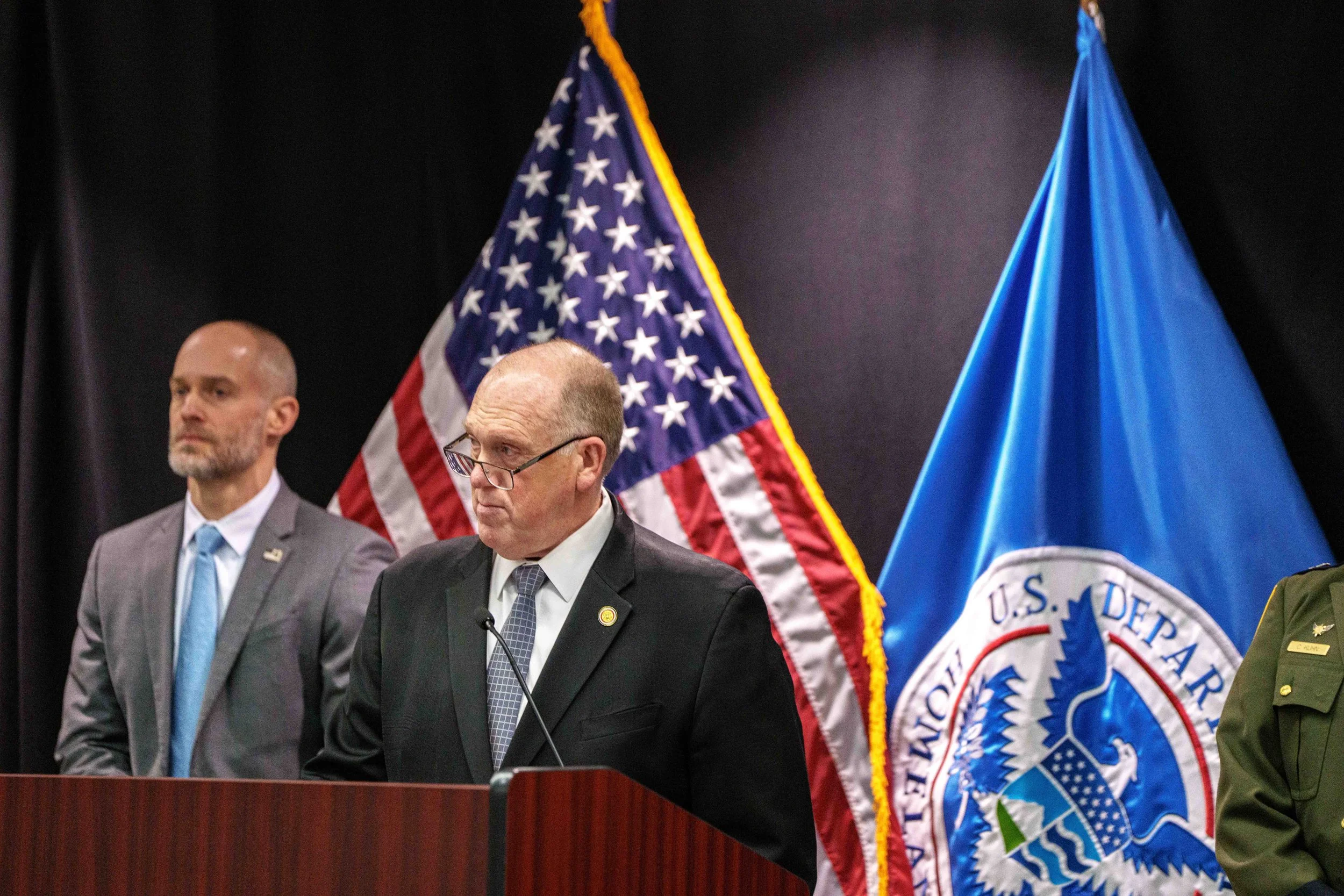
MINNEAPOLIS, MINNESOTA: Trump administration Border Czar Tom Homan announced this morning that a large-scale federal immigration enforcement operation in Minnesota, referred to as “Operation Metro Surge,” is coming to a close, with a significant drawdown of personnel already underway.
Speaking at a press conference, Homan said the surge operation led to thousands of arrests statewide and credited increased coordination with state and local law enforcement agencies for what he described as improved public safety outcomes.
“The Twin Cities of Minnesota in general are and will continue to be much safer for the communities here because of what we have accomplished,” Homan said.
Arrests, Enforcement Priorities, and Public Safety Claims
Homan stated that ICE arrested more than 4,000 individuals during the operation, including people he described as “public safety threats,” such as those with prior convictions for violent crimes and sexual offenses. He emphasized that the administration is prioritizing individuals with criminal convictions, but also reiterated that immigration enforcement applies to anyone in the country without legal authorization.
“Prioritizing public safety threats and national security threats doesn’t mean we forget about everybody else,” Homan said. “We will enforce immigration law against all persons in the United States illegally.”
Context on Enforcement Policy
Under federal law, ICE is authorized to arrest and detain individuals who are in the U.S. without lawful status or who violate immigration law. However, enforcement priorities have shifted significantly between administrations.
The Trump administration has emphasized broader enforcement and mass deportation strategies.
Previous administrations, including those of Obama and Biden, issued guidance prioritizing individuals with serious criminal histories or recent border crossings.
Immigration advocates argue that wide-scale enforcement operations can create fear in immigrant communities and discourage crime reporting. Federal officials counter that targeting individuals in custody, particularly in jails, is safer for officers and communities.
Jail Coordination and “Sanctuary” Debate
A key focus of Homan’s remarks centered on coordination between ICE and Minnesota county jails. When individuals are booked into jail, their fingerprints are automatically run through federal databases. If ICE identifies someone as potentially removable under immigration law, the agency may issue a detainer request, asking to be notified before release and, in some cases, to hold the individual for up to 48 hours.
However, ICE detainers are civil immigration requests, not criminal warrants signed by a judge. Many Minnesota counties do not hold individuals beyond their scheduled release time without a judicial warrant due to constitutional concerns and potential liability. Instead, jails may notify ICE of an inmate’s release date and allow federal agents to assume custody upon release.
Homan said ICE is now receiving more consistent notifications during the surge operation, allowing agents to make arrests inside secure jail facilities rather than conducting at-large arrests in neighborhoods.
“Arresting a public safety threat in the safety and security of the jail is safer for the alien, safer for the officer, and safer for the community,” Homan said.
Minnesota does not have a formal statewide “sanctuary” law, though local policies vary by county. Legal experts note that holding someone past their lawful release time without a judicial warrant may violate the Fourth Amendment and expose local governments to lawsuits. Homan claimed Minnesota is now “less than a sanctuary state for criminals,” though no changes to state law were announced during the press conference.
Allegations of Arrests in Schools, Hospitals, and Churches
Homan pushed back against reports and complaints alleging ICE made arrests inside sensitive locations such as schools, hospitals, or churches.
“ICE has not arrested anybody inside a hospital. We have not arrested anybody inside an elementary school. We have not arrested anybody inside a church,” he said.
Historically, ICE has operated under “sensitive locations” guidance, limiting enforcement at schools, hospitals, and places of worship except in specific circumstances. That policy has changed across administrations and can be modified by executive direction.
Homan added that such locations are “not off the table” if a significant public safety or national security threat is involved.
Civil rights organizations in Minnesota have reported community fears surrounding enforcement operations, though no verified cases were cited at the press conference confirming arrests inside those specific protected spaces during this surge.
Response to Protests and Arrests of “Agitators”
Homan also addressed confrontations between ICE agents and protesters during the operation. He stated that more than 200 individuals have been arrested nationwide under 18 U.S.C. § 111, which makes it a federal crime to assault or impede federal officers.
He praised Minnesota law enforcement agencies for responding more quickly to unlawful assembly situations in recent weeks and said “Quick Response Force” deployments have declined as protest activity has decreased.
“We will not tolerate unlawful actions committed by agitators,” Homan said. “If you break the law, we’re going to arrest you.”
Local officials have emphasized that while peaceful protest is protected under the First Amendment, violence, obstruction of emergency vehicles, and assault of officers are not.
Claim of 3,364 Missing Children Located
Homan stated that ICE located 3,364 missing unaccompanied immigrant children in Minnesota during the operation.
It is important to clarify that:
Nationally, concerns have been raised in recent years about tracking and follow-up with unaccompanied minors released to sponsors.
However, there has been no independent public data released confirming that 3,364 missing children were located specifically in Minnesota during this operation.
Federal reporting on unaccompanied minors typically comes from the Department of Health and Human Services (HHS), not ICE alone.
As of publication, no separate documentation detailing those Minnesota-specific figures has been publicly released.
Drawdown of Operation Metro Surge
Homan confirmed that President Trump has approved ending the surge operation, with personnel reassigned to other parts of the country or their home bases.
“Operation Metro Surge is ending. A significant drawdown has already been underway this week,” he said.
A smaller federal footprint will remain in Minnesota temporarily to:
Complete pending investigations.
Continue standard immigration enforcement.
Monitor protest activity.
Homan said he will remain in Minnesota for a short time to oversee the transition.
Broader Political Context
Immigration enforcement remains one of the most polarizing issues in national politics. Homan framed the operation as fulfilling campaign promises of “mass deportation” and stricter enforcement under President Trump’s leadership, describing the border as “the most secure in American history.”
Border security statistics are debated. While encounters at the southern border fluctuate monthly and annually, data from U.S. Customs and Border Protection show that apprehensions vary with policy changes, migration trends, and global conditions.
Critics argue that broad enforcement strategies risk sweeping in nonviolent individuals and destabilizing communities. Supporters contend that strong enforcement deters illegal entry and enhances public safety.
What Comes Next for Minnesota
With the surge concluding, ICE operations in Minnesota will return to what Homan described as a “normal footprint.” Enforcement actions will continue, though without the expanded surge staffing levels.
Local officials have not announced new statewide policy changes regarding immigration cooperation but confirmed continued dialogue with federal authorities.
The long-term impact of the surge, including arrest totals, removals, prosecutions, and community effects, will likely become clearer in the coming months as additional data is released.
For now, federal officials say the mission in Minnesota has achieved its objectives. Community advocates and civil rights groups say they will continue to closely monitor enforcement practices.
Governor Tim Walz’s Comments in Separate Press Conference
Following Homan’s announcement that the ICE surge operation was concluding, Tim Walz held a separate press conference offering a sharply different assessment of the operation’s impact. Walz said the state was “cautiously optimistic” that what he described as “untrained and aggressive agents” would be leaving Minnesota, but argued that the surge caused “deep damage” to communities. He cited what he called generational trauma, economic harm to small businesses, especially immigrant-owned small businesses, and unanswered questions surrounding enforcement actions. Walz also referenced ongoing concerns about the deaths of Renee Good and Alex, saying Minnesotans deserve clarity about investigative processes and accountability. While federal officials declared the operation a success, Walz said his administration is focused on recovery efforts and evaluating long-term impacts.
Walz and state economic officials announced plans to stabilize affected businesses, particularly in immigrant communities that reported sharp declines in foot traffic and revenue during the surge. The governor launched a February “Shop Local” campaign and proposed a $10 million small-business relief program consisting of partially forgivable, zero-interest loans over three years. Under the proposal, businesses with annual revenues between $200,000 and $4 million could apply, with up to 50% of the loan eligible for forgiveness after one year if they demonstrate substantial economic impact tied to federal enforcement activity. State officials said they are continuing to assess the financial toll and indicated Minnesota may seek federal reimbursement for damages they believe resulted from the operation.
Written by Will Wight
Photos captured by: Holden Smith
