
Published: October 24th 2026.
ROSEMOUNT, MN: The Rosemount City Council voted 4-0 on October 20th, 2026, to establish Industrial Development District No. 2 and authorize the Rosemount Port Authority to issue up to $75 million in general obligation bonds for the city's Built to Play initiative, following public hearings that raised questions about the financing process, property taxes, recreational priorities, and long-term costs.
The decision advances a multi-year investment in recreational facilities, including a new two-sheet ice arena, improvements to Central Park and Erickson Park, additional baseball and softball fields, and playground upgrades. The council's action followed a separate Port Authority meeting at which commissioners moved to adopt the industrial development district and its associated development plan.
Although the council authorized a financing framework, it issued no bonds after the October 20th vote, and the action did not finalize construction contracts or individual project designs. Additional approvals and financial decisions are expected to begin in 2027. The proposed improvements currently carry an estimated $62.6 million in construction and equipment costs. The broader financing plan anticipates about $69.6 million in expenditures, while the $75 million authorization sets the maximum borrowing ceiling.
During the public hearing, residents offered differing views on the proposal. Some questioned the decision to use Port Authority financing rather than a voter referendum, while others defended the investment as necessary to accommodate Rosemount's growing population and support local economic development. Following the meeting, the City of Rosemount provided written responses to questions from Limitless Media News addressing the financing structure, estimated costs, ice arena operations, property tax impacts, and the city's separate drinking water treatment plans.
Council Approves Development District and Financing Framework
The October 20th action establishes the legal framework through which the Rosemount Port Authority intends to finance the Built to Play initiative. Industrial Development District No. 2 is intended to connect the proposed recreational improvements with broader economic development objectives, including attracting visitors, encouraging commercial investment, and improving community amenities.
According to the city's presentation, port authorities have powers to acquire land, build facilities, purchase equipment, conduct property transactions, and finance projects through general obligation bonds, revenue bonds, and other mechanisms. City officials argued that recreational facilities can serve economic development purposes by attracting tournaments, festivals, and other events that generate spending at local businesses.
During the council discussion, officials emphasized that the October 20th actions were procedural and did not finalize the recreational projects. The final construction plans, borrowing amounts, and bond terms will require additional decisions.
After public comment and council discussion, Council Member Paul Essler moved to approve the development district, its associated plan, and Ordinance 2026-06.
The motion passed 4-0. The mayor subsequently reiterated that the council had not actually issued the bonds.
Why Did Rosemount Choose Port Authority Financing Instead of a Referendum?
One of the most significant issues raised during public comment was the city's decision to proceed without a voter-approved bond referendum. Several residents questioned whether the financing structure fit recreational improvements, particularly given the size of the proposed investment.
Speakers referenced unsuccessful recreational funding referendums in 2008 and 2016 and argued that residents should have another opportunity to vote directly on the borrowing. One speaker questioned whether the city had demonstrated sufficient statutory authority to classify the proposed recreational improvements as industrial development expenditures. The resident argued that establishing a development district does not automatically make every expenditure within that district eligible under state law.
Others raised concerns about the long-term financial commitments tied to the proposed borrowing.
City Explains Its Decision
In response to an inquiry from Limitless Media News and following the public comment period during the council meeting, Rosemount officials said the City Council and Port Authority have the authority to approve the financing under applicable state statutes. The city explained that Built to Play aligns with its strategic plan and the Port Authority's economic development vision.
Officials said the City Council chose this approach to advance the projects in a timely, coordinated manner. During the October 20th meeting, staff also explained that the city had obtained a legal opinion from specialized bond counsel addressing the Port Authority's authority to issue the proposed bonds.
The city maintained that recreational facilities supporting economic development objectives fall within the Port Authority's statutory powers.
How Port Authority Bonds Differ From Traditional City Bonds
According to the city's presentation, Port Authority general obligation bonds are treated differently from certain bonds municipalities issue directly. Officials explained that Port Authority bonds fall outside certain statutory debt and levy limitations that would otherwise apply to city-issued bonds. However, the proposed bonds would still be backed by Rosemount's full faith and credit.
That means the city's financial resources and taxing authority would support repayment, even though the Port Authority would issue the bonds. The city's bond counsel has outlined the legal basis for the arrangement, while some residents continue to question whether the approach is appropriate.
The objections raised during public comment do not, by themselves, establish that the financing structure violates state law.
Proposed Projects Total $62.6 Million in Construction and Equipment Costs
The city provided a breakdown of the current estimated costs of the six major Built to Play components during its October 20 presentation.
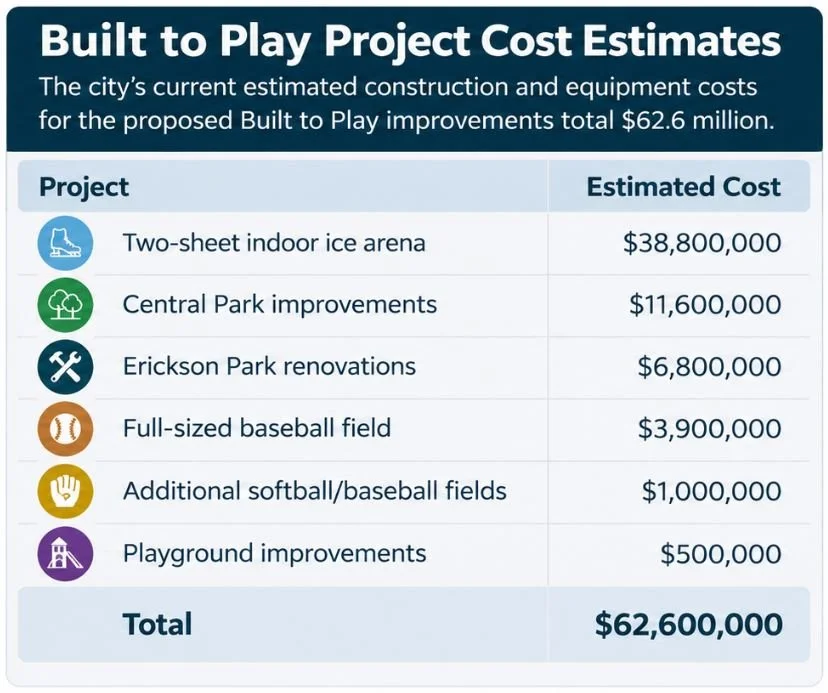
The proposed indoor ice arena accounts for about 62% of the estimated construction and equipment costs. Central Park improvements would include a larger splash pad, an accessible destination playground, additional green space, sun shelters, expanded parking, and a community gathering facility. Erickson Park improvements would modernize existing athletic facilities and address accessibility and parking needs.
The city also intends to expand baseball and softball opportunities for youth and adult participants. Officials have emphasized that the figures are estimates and may change as designs are finalized and competitive construction bids are received.
Why Is the Bond Authorization $75 Million?
The difference between the $62.6 million construction estimate and the proposed $75 million borrowing ceiling has been a central question surrounding the initiative. The city's development plan identifies approximately $69.6 million in anticipated expenditures, including construction and equipment costs as well as financing-related expenses.
Those additional expenses include bond issuance costs, legal services, credit rating fees, underwriting expenses, and capitalized interest. The development district's initial budget identifies $1.5 million in issuance and transaction costs and $5.5 million in capitalized interest. Capitalized interest allows certain interest payments to be made from bond proceeds during the early stages of financing. The proposed $75 million authorization provides flexibility if construction costs, financing conditions, or other expenses change.
In its written response to Limitless Media News, the city described the difference between expected financing costs and the maximum authorization as standard municipal bonding practice. Officials explained that setting a not-to-exceed amount lets projects move through the financing process without restarting certain authorization procedures if costs shift.
The city said it expects publicly bid projects to remain consistent with preliminary estimates and fall within the authorized amount.
The $75 million figure is a borrowing ceiling, not the amount already borrowed or a final estimate of the debt that will be issued.
Total Principal and Interest Costs Remain Unavailable
Limitless Media News also asked the city to estimate the total principal and interest taxpayers could be responsible for over the anticipated 29-year repayment period. The city's written response explained the borrowing authorization but did not provide a total principal-and-interest repayment figure.
That figure will depend on the actual amount borrowed, interest rates when bonds are sold, repayment schedules, and other financing terms. As a result, the information provided does not yet establish the full long-term cost of the proposed debt.
What Will Built to Play Cost Homeowners?
The city has outlined a preliminary financing plan that would phase in additional property taxes over six years, beginning in 2028. The estimates are based on a median-valued Rosemount home of approximately $415,000 in 2027.
Under the city's published illustration, the additional annual property tax impact would increase by $75 each year for the first four years, then by $20 each year for the final two years.
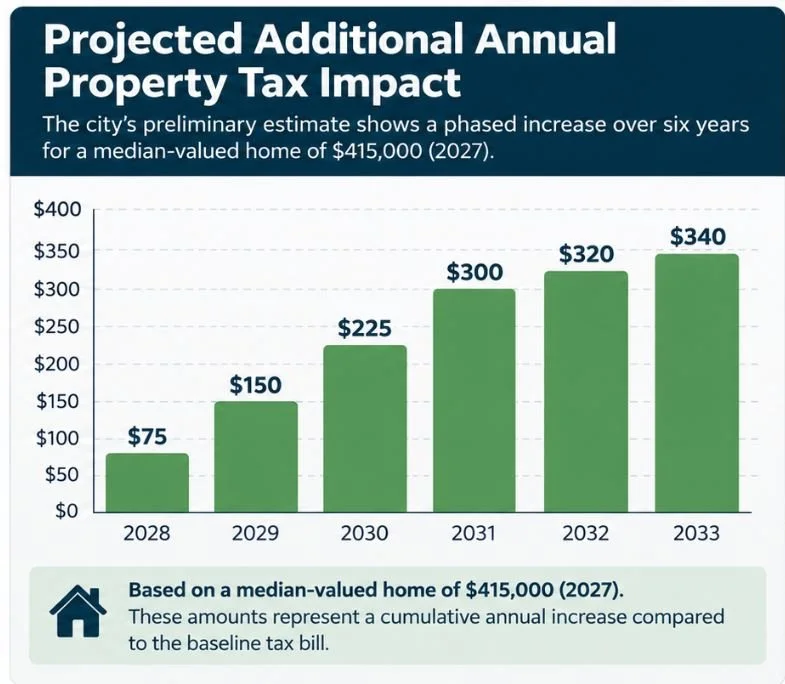
By the sixth year, the illustrative increase would reach $340 annually, or approximately $28.33 per month. These amounts represent increases over the baseline tax bill, not separate annual charges to be added together.
The estimates also include a separate investment in fire department improvements.
City Clarifies the Tax Projection
In response to questions from Limitless Media News, city officials confirmed that the projected impacts are based on the city's median-valued home. Officials explained that using a median valuation provides a consistent baseline for illustrating the proposed increases. The city did not provide a detailed comparison showing anticipated increases for properties at different valuations.
Actual tax impacts could vary depending on property values, classifications, future assessments, and other tax changes. The city also emphasized that the figures remain preliminary. Bond issuances are expected to occur in phases, and the final tax impacts will depend on financing conditions and actual project costs.
The published $340 illustration should therefore be understood as a planning estimate, not a guarantee that individual tax bills will increase by exactly that amount.
Fire Department Improvements Included in Tax Projections
The city's property tax illustration includes both Built to Play and approximately $14.2 million in separate fire department investments. Those improvements include renovations to Fire Station 2, the purchase of a new fire apparatus, and updated firefighting equipment. The work is intended in part to accommodate additional full-time firefighters supported by a federal SAFER grant.
During the council meeting, officials clarified that the fire department improvements and Built to Play are financed separately. The fire department investments are proceeding through a traditional city bonding process, while Built to Play would use Port Authority bonds. However, because the projects are expected to affect property taxes during the same general period, the city has combined their projected impacts in public presentations.
For example, officials indicated that an initial $75 annual increase could include about $50 for fire department improvements and $25 for Built to Play. That allocation could vary in later years.
Some residents questioned whether combining the projects' financial impacts made it more difficult to understand the cost of each initiative. Officials said the combined presentation was intended to provide a clearer picture of the overall anticipated impact on homeowners.
Will the New Ice Arena Cover Its Operating Expenses?
The proposed two-sheet indoor ice arena, estimated to cost $38.8 million, has generated substantial discussion about its anticipated operating costs and financial sustainability.
During public comment, residents questioned whether the facility would generate sufficient revenue to cover expenses such as staffing, utilities, maintenance, equipment replacement, and other ongoing obligations.
Some also questioned whether the city would need to provide additional financial support if operating expenses exceeded revenue.
City Expects User Fees to Cover Annual Operations
In a written response to Limitless Media News, city officials said they are confident that the new facility's annual operations will be supported through user fees and other revenue. The city based that expectation partly on approximately 30 years of experience operating the existing Rosemount Community Center ice rink. Officials also said they are working with athletic organizations, businesses, and community partners to develop additional funding opportunities.
During the council meeting, Parks and Recreation staff explained that they are still developing preliminary operating budgets. Staff discussed the existing rink's operating experience as a reference point but acknowledged that a detailed budget for the new two-sheet facility has not been finalized.
Officials also noted that a newly constructed facility would initially have newer equipment and infrastructure, potentially reducing certain replacement expenses during its early years. However, capital maintenance and replacement needs would increase as the building ages.
Operating Revenue Is Not the Same as Construction Debt Repayment
An important distinction remains between generating enough revenue to operate the facility and generating enough revenue to repay its construction costs. The city has said it is confident user fees and other revenue will cover annual operating expenses.
That does not mean the city has demonstrated that the arena will pay for its own $38.8 million construction cost.
Construction debt would be part of the broader financing plan backed by the city's taxing authority. The city's response did not include a detailed financial feasibility report establishing projected annual revenue, operating expenses, long-term capital replacement costs, or the amount of arena revenue available for debt repayment. Consequently, the city's expectation of operating self-sufficiency should not be interpreted as confirmation that the facility will be financially self-supporting when construction debt and long-term capital expenses are included.
City Pursuing Grants and Sponsorships
The city also confirmed that it is exploring outside funding opportunities. Potential sources include state grants, business sponsorships, partnerships with athletic organizations, and naming rights.
During the council meeting, Parks and Recreation staff discussed existing partnerships for scoreboard sponsorships and other recreational amenities. Officials indicated that similar arrangements could support the proposed ice arena and other Built to Play projects. However, the city acknowledged that outside contributions are not expected to cover a substantial portion of the overall construction costs.
Importantly, officials stated that the preliminary $75 annual tax impact assumes no outside financial contributions. The city characterized that assumption as a conservative approach to illustrating the potential taxpayer burden.
Additional contributions could offset certain expenses, but the amount and ultimate financial effect of those contributions remain unclear.
Residents Raise Concerns About Referendum and Long-Term Costs
The October 20th public hearing included significant criticism of the financing approach. Some residents argued that the city should seek voter approval before undertaking a major long-term financial commitment. Others questioned whether the Port Authority financing structure fit recreational facilities and whether the proposed economic development benefits were sufficiently demonstrated.
Several speakers also expressed concern about the cumulative property tax impact over the repayment period. Some questioned how the projected increases would affect retirees, households with fixed incomes, and residents already facing rising costs. Others raised concerns about how the additional tax burden could influence support for future school funding referendums or other public investments.
The concerns reflected broader questions about how Rosemount should balance recreational amenities with other infrastructure needs and long-term financial obligations.
Other Residents Support the Investment
Not all residents opposed Built to Play. Several speakers defended the proposed improvements as necessary to accommodate Rosemount's continued growth.
Supporters emphasized the age of existing athletic facilities, increasing demand for youth sports, and the potential economic benefits of attracting tournaments and other visitors. Some residents argued that recreational facilities provide benefits extending beyond athletics, including opportunities for community engagement, youth development, and local business activity. Others defended elected officials' role in making long-term municipal investment decisions.
The public testimony illustrated that support for recreational improvements and support for the city's financing approach were not necessarily the same issue. Some residents supported the projects while questioning the borrowing method, while others defended both the projects and the city's approach.
Council Member Defends Economic Development Benefits
Before the vote, Council Member Paul Essler explained why he considered Built to Play an economic development investment. Essler argued that recreational facilities can attract tournaments, festivals, and other events that bring visitors into Rosemount. Those visitors, he said, could spend money at local restaurants and retailers, potentially encouraging additional commercial development.
He also suggested that expanded recreational opportunities could make Rosemount more attractive to prospective residents. Essler referenced the unsuccessful 2016 recreational referendum and the closure of The Pond ice facility as examples of changing recreational needs. He argued that delaying improvements could raise construction costs due to inflation.
The council member also emphasized the personal and social benefits of youth athletics, including teamwork, leadership, and community connections. While the city expects recreational improvements to support economic development, the materials reviewed do not specify the amount of additional economic activity or tax revenue from the projects.
Questions Raised About Recreational Access and Planning
The public hearing also included concerns about whether the proposed facilities would adequately serve residents who do not participate in organized youth athletics. A Parks and Recreation Commission representative suggested considering additional amenities such as an indoor walking track, basketball and volleyball courts, and recreational spaces for seniors. The speaker also raised concerns about communication between advisory commission members, city staff, and council members.
During the council discussion, Parks and Recreation staff explained that some of the suggested amenities are already available at Hope Fieldhouse, a privately operated facility. Staff expressed concern that constructing similar municipal facilities could duplicate existing services. Council members also discussed the importance of considering advisory commission recommendations as planning continues.
The discussion highlighted questions about how the city should balance organized sports facilities with recreational opportunities for the broader community.
City Clarifies Drinking Water Treatment Plans
Another significant issue raised during public comment involved Rosemount's drinking water infrastructure. Some residents questioned whether the city should prioritize water treatment improvements before committing to recreational investments.
In response to questions from Limitless Media News, city officials clarified that immediate water treatment planning focuses on gross alpha radioactivity.
Gross Alpha is the City's Current Treatment Focus
The city explained that its current treatment planning is driven by gross alpha rather than specifically by radium or PFAS. Gross alpha measures alpha-emitting radioactive substances in water. The clarification concerns the immediate reason for the city's planned treatment improvements. It should not be interpreted as establishing that Rosemount has no other water quality concerns or that it has ruled out other contaminants.
According to city officials, Rosemount has been working with state agencies for several months to evaluate treatment options. During the council meeting, staff discussed the engineering, regulatory, and financial considerations involved in selecting an appropriate treatment approach. The City Council is expected to make a final decision on treatment options in November 2026.
Water Treatment Uses Separate Funding
The city emphasized that the municipal water utility, rather than the property tax levy supporting Built to Play, funds water treatment improvements. Officials said the water utility has accumulated substantial reserves for the treatment project. Utility funding would cover additional costs.
The city stated that it does not anticipate extraordinary changes to annual water rates as a result of the planned treatment improvements. However, that expectation is not a guarantee that water rates will remain unchanged. Final costs and future rates will depend on the selected treatment approach and other utility financial considerations. The city also confirmed that Built to Play will not delay the drinking water treatment project.
Officials emphasized that the two initiatives use separate funding mechanisms and follow different planning processes.
City Addresses Communication and Transparency Concerns
During the public hearing, several residents questioned whether the city had clearly communicated the proposed financing structure and cumulative property tax impacts. Some argued that presenting increases as individual $75 and $20 amounts could make the overall financial commitment difficult to understand.
Council members acknowledged concerns about the clarity of the city's communications. Staff said the upcoming quarterly newsletter would include a detailed explanation of the financing arrangements for Built to Play, fire department improvements, and drinking water treatment.
Officials also said the information would be available on the city's website. Additional public open houses are expected as individual Built to Play projects advance. The city emphasized that the October 20th vote did not finalize project designs and that residents would have further opportunities to provide feedback.
City Rejects Separate Data Center Claim
During the council discussion, officials also addressed a separate claim raised during public comment regarding another potential Meta data center. City staff stated that no applications or approvals existed for a second data center.
The clarification addressed questions about transparency and broader development activity in Rosemount. The issue was separate from the Built to Play financing decision.
Council Votes 4-0 Following Public Discussion
Following the public hearing, council members discussed the proposal and acknowledged the differing views expressed by residents. Some comments recognized the financial pressures facing homeowners and the importance of continued public communication. Council members also defended the broader objective of investing in community amenities and encouraging economic development.
Essler moved to establish Industrial Development District No. 2, approve its development plan, and adopt Ordinance 2026-06 authorizing the Port Authority to issue general obligation bonds. The motion passed 4-0. The mayor subsequently clarified that the action established the financing authority but did not issue bonds or finalize construction contracts.
What Happens Next?
Rosemount's preliminary schedule anticipates the first bond sale process beginning in early 2027. The city has identified February 2, 2027, as the anticipated date to set the sale of the first series of Port Authority general obligation bonds. A subsequent meeting on March 2, 2027, is expected to consider awarding that sale.
The city tentatively plans additional bond issuances for 2028 and 2029. All dates remain subject to change.
The city must also continue project design, construction bidding, and other required approvals before proceeding with individual improvements. The final amount borrowed has not been established, and the city is not required to issue the entire $75 million authorized by the ordinance.
Several financial questions remain, including the total principal and interest repayment obligations, detailed operating and capital replacement projections for the ice arena, and the final property tax impacts as the financing plan advances. The October 20th vote marks a major procedural milestone for Built to Play, but significant financial and construction decisions remain.
Limitless Media News will continue monitoring the initiative, including future bond approvals, project costs, taxpayer impacts, and additional opportunities for public participation.
Written by: Will Wight
Cover Photo Credit: Cover photo taken from the City of Rosemount City Council meeting on YouTube.
