
Published: November 21, 2026.
City officials approve a $2 million water blending system for 2027 while moving forward with plans for a potential $36 million to $54 million water treatment facility.
ROSEMOUNT, MN: The Rosemount City Council has unanimously approved a two-phase approach to address elevated levels of naturally occurring gross alpha radiation detected in one of the city's municipal drinking water wells, advancing a relatively inexpensive short-term solution while preparing for a potentially multimillion-dollar water treatment facility.
At its November 17, 2026, meeting, the City Council voted 3-0 to proceed with designing and implementing a water blending system connecting municipal Wells #8 and #9. The council also directed city staff to begin designing a larger water treatment facility that could provide additional water quality protections for decades. The decision follows approximately nine months of testing, engineering evaluations, discussions with state regulatory agencies, public engagement, and recommendations from the city's Utility Commission.
The immediate solution, estimated to cost approximately $2 million, would combine water from two municipal wells to reduce gross alpha concentrations to levels that meet state drinking water standards. Construction is expected to begin during summer 2027, with the city targeting completion by the end of that year. Meanwhile, city officials will begin designing a potential water treatment facility estimated to cost between $36 million and $54 million. Although the council authorized the design process, it has not committed to constructing the facility.
Public Works Director Nick Egger emphasized that the city's approach is intended to address the existing water quality concern while maintaining flexibility for future infrastructure investments.
What Prompted Rosemount's Water Quality Concerns?
The issue first emerged in January 2026, when testing by the Minnesota Department of Health (MDH) showed that gross alpha radiation concentrations in Rosemount's municipal Well #8 exceeded the federal drinking water standard.
According to Egger, the well recorded a running annual average of 16.3 picocuries per liter, exceeding the regulatory limit of 15 picocuries per liter. Gross alpha measures the overall amount of alpha radiation emitted by certain radioactive materials present in water. These materials can occur naturally when groundwater comes into contact with rock and soil containing radioactive elements, including radium.
Rosemount obtains its drinking water from the Jordan Aquifer, an underground groundwater formation commonly used by municipal water systems throughout the Twin Cities metropolitan area. While the elevated measurements required regulatory action, state health officials did not classify the situation as an immediate emergency.
"The Department of Health doesn't call this an emergency, but does require us to provide a response, issue a notice, and submit a plan of action," Egger explained during his presentation.
Gross alpha is considered a chronic drinking water contaminant, meaning the main health concerns involve prolonged exposure rather than the immediate effects of drinking a single glass of water. Egger explained that the health risks associated with elevated concentrations generally involve exposure over many years or decades.
The Minnesota Department of Health also previously informed city officials that several other municipal water supplies in the region experienced increasing gross alpha measurements during 2025.
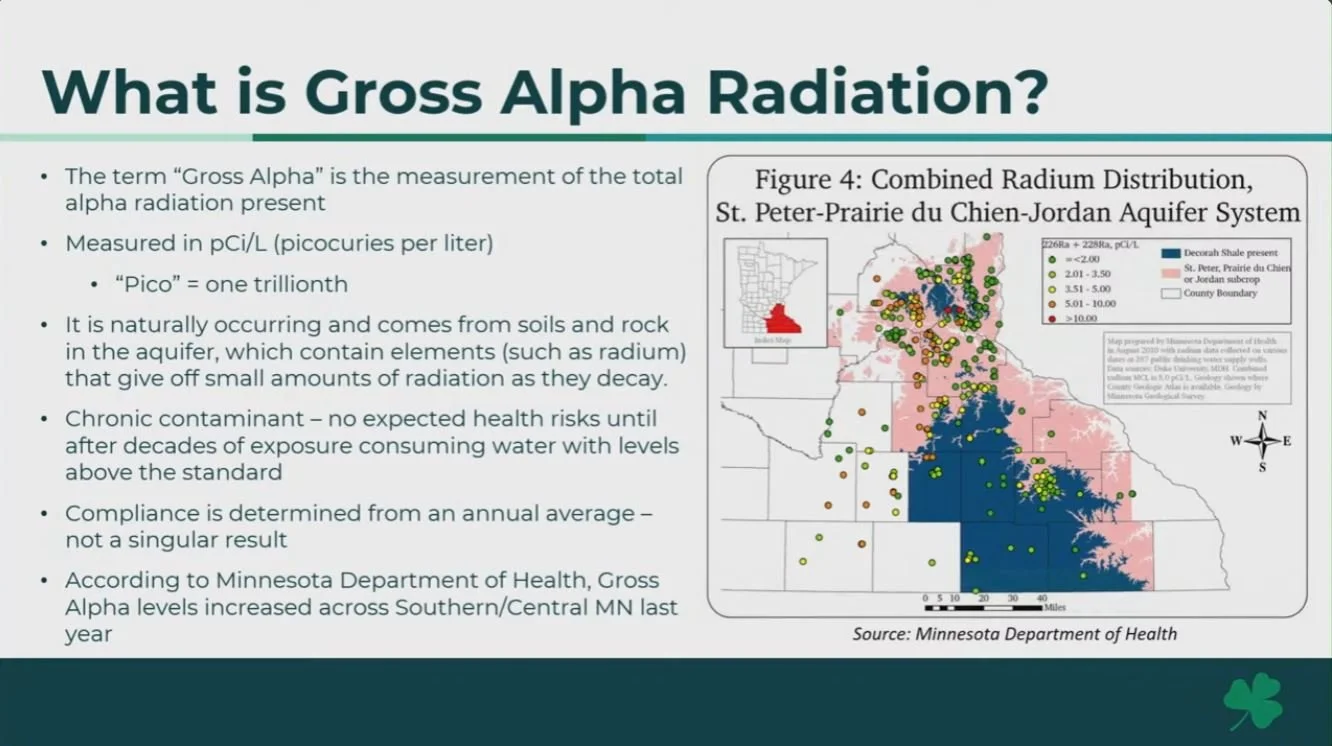
Image Credit: City of Rosemount City Council Meeting/YouTube.
Recent Testing Shows Improvement, but Action Is Still Required
Although Well #8 initially exceeded the regulatory standard, subsequent testing has shown improvement. During the council meeting, Egger reported that the city's September sampling results measured gross alpha concentrations of approximately 13 picocuries per liter in Well #8. That measurement represented an increase from the June sample, but the well's running average had fallen below the regulatory threshold.
Despite the improvement, the Minnesota Department of Health is requiring Rosemount to continue implementing a corrective solution under its existing compliance agreement. The city has also significantly reduced its reliance on Well #8. Historically, the well supplied approximately 14% to 15% of Rosemount's annual municipal water production. However, following the elevated testing results, city officials substantially restricted its use.
According to Egger:
Well #8 accounted for approximately 5% of the city's total water production during 2026 through the time of the meeting.
Since the city issued its public notice in February, the well contributed less than 3% of total water production.
The city operated the well primarily when necessary to meet increased summertime irrigation demand.
Well #8 had not been operated for routine water supply purposes since September 3, although it was briefly activated September 14 to collect a required water sample.
The city plans to continue operating Well #8 minimally until the new blending system becomes operational.
Phase One: $2 Million Blending System Expected in 2027
The first phase of Rosemount's approved approach involves constructing a water blending system connecting Wells #8 and #9. The two wells are located approximately 2,000 feet apart along Shannon Parkway. Under the proposed design, a new water main would connect the wells, allowing water from Well #8 to be transported to the Well #9 facility.
Equipment installed at Well #9 would then control the mixing of water from both sources before distributing the blended water into the municipal system. The concept relies on Well #9's historically lower gross alpha concentrations to reduce the overall radiation concentration in the combined water supply. Egger said gross alpha measurements in Well #9 have generally remained below 10 picocuries per liter, although concentrations can fluctuate.
By blending water from the two sources, engineers expect to achieve concentrations that comply with the 15-picocurie-per-liter drinking water standard. The blending approach emerged as the least expensive solution among several alternatives evaluated by city engineers and consultants.
The city's anticipated project schedule includes:
December 2026: Begin design and engineering.
Summer 2027: Begin construction and installation.
End of 2027: Target completion and operation.
The project is estimated to cost approximately $2 million. One additional advantage is that the connecting water main could eventually become part of a larger transmission system serving a future water treatment facility. However, the blending solution has limitations.
Egger acknowledged that gross alpha concentrations in Well #9 could increase in the future, potentially reducing blending's effectiveness as a long-term solution. If concentrations in both wells increased significantly, the city could face additional challenges maintaining compliant water quality. That uncertainty is one reason officials are also pursuing the second phase of their plan.
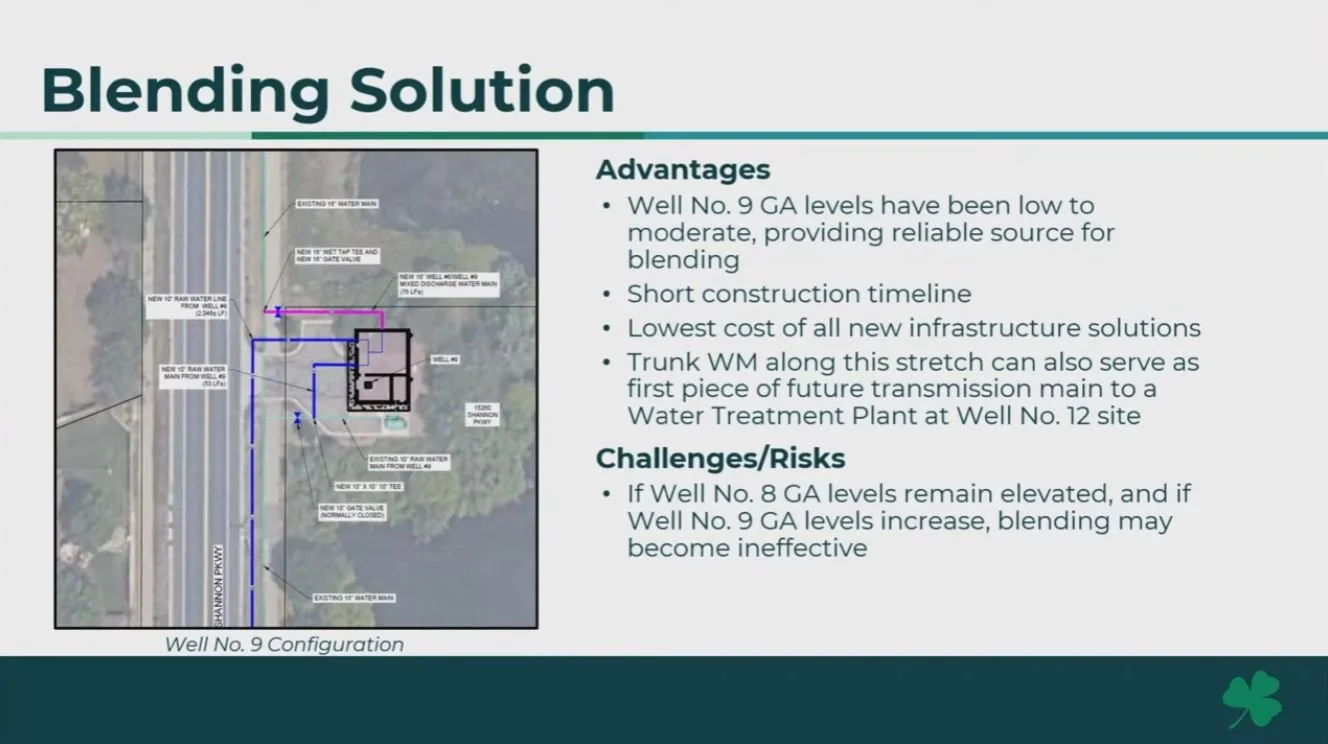
Image Credit: City of Rosemount City Council Meeting/YouTube.
Phase Two: Designing a Potential $36 Million to $54 Million Water Treatment Plant
Alongside the blending project, Rosemount will begin the formal design process for a municipal water treatment facility. The proposed facility would be located near Well #12 in the city's business and industrial park along Boulder Avenue near Business Parkway. Unlike the blending system, which would combine water from two wells, the treatment plant could serve four municipal wells: Wells #7, #8, #9, and #12.
The project would require approximately two miles of connecting water mains, including infrastructure extending along Shannon Parkway, County Road 42 and toward the east side of Highway 3. City engineers have evaluated gravity filtration and pressure filtration as potential treatment technologies.
Both approaches could reduce gross alpha concentrations while providing additional treatment benefits.
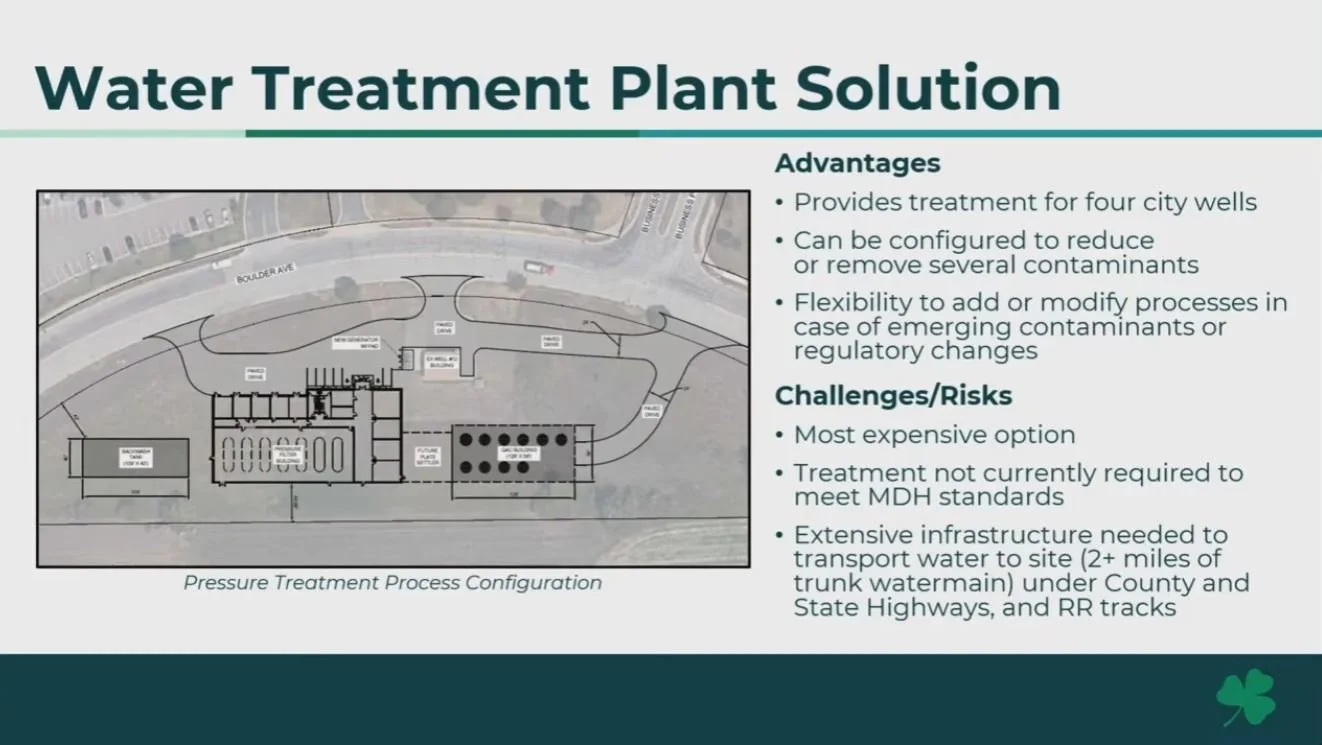
Image Credit: City of Rosemount City Council Meeting/YouTube.
Additional Benefits Beyond Gross Alpha
A treatment plant could also reduce iron and manganese concentrations in Rosemount's drinking water. Although the city is not currently required to treat those substances under the regulatory requirements discussed at the meeting, some council members expressed interest in the broader benefits of centralized water treatment.
One council member raised concerns about manganese and the city's distribution of water filters or pitchers to certain residents. Council members also discussed designing a facility that could accommodate additional treatment technologies if new water quality challenges emerge. Among those concerns are per- and polyfluoroalkyl substances, commonly known as PFAS, which have prompted water treatment investments in several Minnesota communities.
Officials did not indicate that Rosemount currently needs PFAS treatment at the proposed facility. Instead, council members discussed the value of infrastructure that could be adapted if future treatment becomes necessary. The proposed plant could provide the city with greater flexibility to respond to changing water quality standards and emerging contaminants.
Construction Would Take Several Years
The water treatment facility would represent a substantially larger and more complicated undertaking than the blending system. Egger estimated that completing the facility's design would take approximately 18 to 24 months.
If the council ultimately approves construction, building the facility could require another two to three years. The overall timeline could therefore extend approximately three to four years or longer from initial design through construction and operation. Importantly, the two projects would advance simultaneously. That means proceeding with the blending system in 2027 would not delay planning for a future treatment plant.
The council will make a separate decision on whether to construct the treatment facility after receiving more detailed engineering plans, updated cost estimates, and financing recommendations.
How Would Rosemount Pay for a $40 Million Water Treatment Facility?
One of the most extensive discussions during the November 17th meeting centered on the financial implications of building a large water treatment plant. Council members questioned how the city could fund a project that could cost tens of millions of dollars without imposing high additional costs on residents.
During the discussion, city financial staff reported that Rosemount currently maintains approximately $29 million across two utility-related funds. City officials explained that the reserves have accumulated through a combination of utility payments and development-related charges.
Those balances include:
A Consumption Rates Utility Billing fund used to pay day-to-day, year-to-year operating expenses, at around $18 million.
A Development-related trunk fund of $11 million
For a combined balance of $29 million.
However, officials emphasized that the entire amount is not necessarily available for construction of a water treatment plant. The reserves also support ongoing operations, infrastructure maintenance, and future system expansion - the day-to-day, year-to-year operating expenses that we previously mentioned. Rosemount's existing utility rate structure includes funding for future capital improvements, allowing the city to gradually accumulate resources for major infrastructure investments. Egger said the possibility of constructing a water treatment facility has already been incorporated into the city's long-range financial planning.
As a result, he does not anticipate the project would require significant additional adjustments to water rates beyond those already accounted for in existing financial projections. Nevertheless, council members pressed staff for a clearer explanation of how the project would ultimately be financed.
One concern involved how much of the city's reserves should be committed to a treatment plant while preserving adequate funding for other infrastructure needs. Officials discussed using cash reserves, financing, and state or federal assistance to cover construction costs. Of that almost $30 million reserve the city has built up, city officials estimate roughly $10-12 million could go toward a project like this and allow them to pay for it in full. None of that is set in stone, though, as many variables go into the overall cost model the city uses to project future project costs. Officials said the remainder of that cost would again hopefully come from state and federal assistance. City staff also plan to investigate low-interest financing opportunities through the Minnesota Public Facilities Authority.
However, eligibility for such financing is not guaranteed, and projects are evaluated through a ranking process that considers factors including financial need and the urgency of the proposed infrastructure improvements. Because the state has not classified Rosemount's gross alpha issue as an immediate emergency requiring a treatment plant, officials acknowledged uncertainty about how the project might rank for financial assistance.
Other Major Water Infrastructure Projects Are Coming
The city must also prepare for other expensive water system improvements as Rosemount continues to grow. During the meeting, Egger identified two anticipated investments:
A future municipal well: Rosemount recently completed Well #17 at a cost of approximately $3.5 million. Another well may be needed within roughly the next decade.
A new water tower: The city anticipates eventually constructing a water tower with approximately 2 million gallons of storage capacity, larger than its existing towers. The estimated cost is between $6 million and $8 million.
Together, similar future projects could represent approximately $10 million or more in additional infrastructure spending. Council members emphasized the need to consider those obligations before committing a substantial portion of the city's financial reserves to a treatment plant.
Council Members Weigh Cost Against Long-Term Water Quality Needs
The council discussion reflected broad support for improving water quality, alongside concerns about the cost and long-term necessity of a treatment plant. Council member Essler emphasized that constructing a facility costing $35 million to $40 million should not be an automatic decision simply because Rosemount is growing, and noted that city officials had previously asked whether population growth from about 30,000 residents to 40,000 or 50,000 would inevitably require building a treatment plant in a joint session with the Utility Commission, and the answer was not necessarily. The council member argued that residents deserve a thorough evaluation of alternatives before the city commits to such a substantial investment.
Other council members expressed stronger support for eventually constructing a treatment facility, citing public confidence in drinking water quality and the potential benefits of additional treatment capabilities. One member said residents had expressed a desire for a more permanent water treatment solution, even if that required a larger financial commitment.
The discussion also acknowledged that the city's lengthy evaluation process was necessary to understand the technical and financial implications of each option. Council members praised public works staff, engineering consultants, and the Utility Commission for evaluating alternatives and incorporating public feedback.
Absent Council Member Also Supports the Approach
City Administrator Martin also read a statement submitted by Council Member Fresky, who was absent because of work-related travel. Fresky supported installing the blending system in 2027 while advancing the design of a potential treatment plant.
Her statement emphasized the need to determine exactly which contaminants the facility should treat and to pursue financing and grant opportunities during the design process. She also noted that Rosemount has planned for a treatment facility for some time and should ensure that any eventual investment provides the best solution for the community.
Utility Commission Recommended Both Solutions
The council's decision closely followed recommendations made by the Rosemount Utility Commission during its September meeting. After reviewing engineering alternatives and financing considerations, the commission recommended moving forward with the blending system as quickly as possible.
Commission members also encouraged the city to begin designing a water treatment facility so that construction could proceed more quickly if ultimately authorized. City staff supported those recommendations.
The council's November 17th action formally directs staff to proceed with engineering and bidding for the blending system while beginning the more extensive design process for a treatment plant and its supporting infrastructure.
Timeline: How Rosemount Reached Its Decision
January 2026: Testing identifies a running annual average of 16.3 picocuries per liter in Well #8, exceeding the 15-picocurie drinking water standard.
February 2026: The city begins evaluating potential solutions with engineering consultant Short Elliott Hendrickson. The city distributes required public notices to water customers and substantially reduces its use of Well #8.
April 2026: Rosemount submits a corrective action plan to the Minnesota Department of Health outlining possible solutions, including deactivating or replacing Well #8, blending water supplies, or constructing a treatment plant.
May 2026: The city enters into a compliance agreement with the Minnesota Department of Health.
June 18, 2026: Approximately 100 residents attend a public information meeting at the Steeple Center. Representatives from state agencies, Dakota County, and engineering consultants participate.
August 2026: The City Council and Utility Commission hold a joint meeting to review potential solutions and financing scenarios.
September 2026: The Utility Commission recommends proceeding with a blending system while preparing designs for a future water treatment plant. Later sampling in September shows a gross alpha concentration of approximately 13 picocuries per liter in Well #8.
November 17, 2026: The City Council votes unanimously, 3-0, to approve the two-phase approach.
December 2026: Design work for the blending system is scheduled to begin.
Early 2027: The city expects to begin designing the potential water treatment facility.
Summer 2027: Construction of the blending system is expected to begin.
Late 2027: The city hopes to have the blending system operational.
What Happens Next?
With the council's approval, Rosemount will move into the engineering and design stages of both projects. The blending system is the city's immediate priority and is intended to bring water from Well #8 into compliance by mixing it with water from Well #9. Meanwhile, engineering work on the larger treatment facility will help officials determine its potential treatment capabilities, infrastructure requirements, construction costs, and financing options.
The city has emphasized that beginning design work does not guarantee construction of the treatment plant. A future council decision will determine whether Rosemount proceeds with that investment. In the meantime, the city will continue monitoring gross alpha concentrations and limiting use of Well #8 as necessary.
Rosemount officials also plan to provide quarterly updates through the city's water quality webpage and municipal newsletter. Residents can find additional information, previous testing updates, and project documents through the City of Rosemount's official announcement.
The November 17th decision represents a significant step in addressing Rosemount's drinking water concerns, providing a relatively quick solution while allowing city leaders to continue evaluating whether a much larger treatment facility is necessary for the community's long-term water supply.
Written by: Will Wight
Cover Photo Credit: Cover photo taken from the City of Rosemount City Council meeting on YouTube.
