
South St. Paul Awarded $3.48 Million to Replace 1,040 Lead Service Lines
Published: September 4, 2026.
SOUTH ST. PAUL, MINNESOTA: More than 1,000 lead service lines in South St. Paul are slated for replacement through a nearly $3.5 million award from the Minnesota Public Facilities Authority as the city continues a broader effort to remove lead service lines from its drinking water system.
The Minnesota Public Facilities Authority, or MPFA, awarded the City of South Saint Paul $3,483,451 on June 2, 2026, specifically for the replacement of 1,040 lead service lines. The work is identified by the Minnesota Department of Health as project 1190020-04. South St. Paul was also among the communities highlighted in a broader MPFA announcement on September 3, 2026, detailing $88.6 million in loans and grants for 12 wastewater and drinking water infrastructure projects in nine Minnesota cities.
Those investments include projects expected to replace nearly 4,000 lead service lines across South St. Paul, Saint Paul and Duluth.
$3.48 Million Award Targets South St. Paul Lead Lines
According to MPFA award records, the entire $3,483,451 awarded to South St. Paul is associated with project costs for the city's 1,040 lead service line replacements. The funding is part of the Lead Service Line Replacement Program, which operates through Minnesota's Drinking Water State Revolving Fund.
The Lead Service Line Replacement Program provides funding specifically for the removal of lead service lines from public drinking water systems. Funding comes from state appropriations along with federal funding provided through the Infrastructure Investment and Jobs Act of 2021. Minnesota's Drinking Water State Revolving Fund is jointly administered by the Minnesota Department of Health and MPFA. In addition to state resources, the fund is supported by federal capitalization grants from the U.S. Environmental Protection Agency and MPFA revenue bond proceeds.
The MPFA provides low-interest loans as well as principal-forgiveness grants based on affordability criteria. Money repaid through loans returns to the revolving fund and can then finance additional drinking water projects.
Since the Drinking Water State Revolving Fund began in 1999, it has awarded more than 610 agreements totaling more than $1.5 billion, according to the MPFA. The authority says those investments have generated more than $250 million in interest savings for local governments and taxpayers, along with more than $166 million in principal-forgiveness grants.
South St. Paul Replacement Project Already Underway
The funding supports a citywide lead service line replacement effort already underway in South St. Paul. On May 4, 2026, the South St. Paul City Council awarded a construction contract to Bituminous Roadways, Inc. Material verification work followed in May and early June as the city prepared for this year's replacements. Residents whose properties are included in the project are being contacted by the contractor to schedule work.
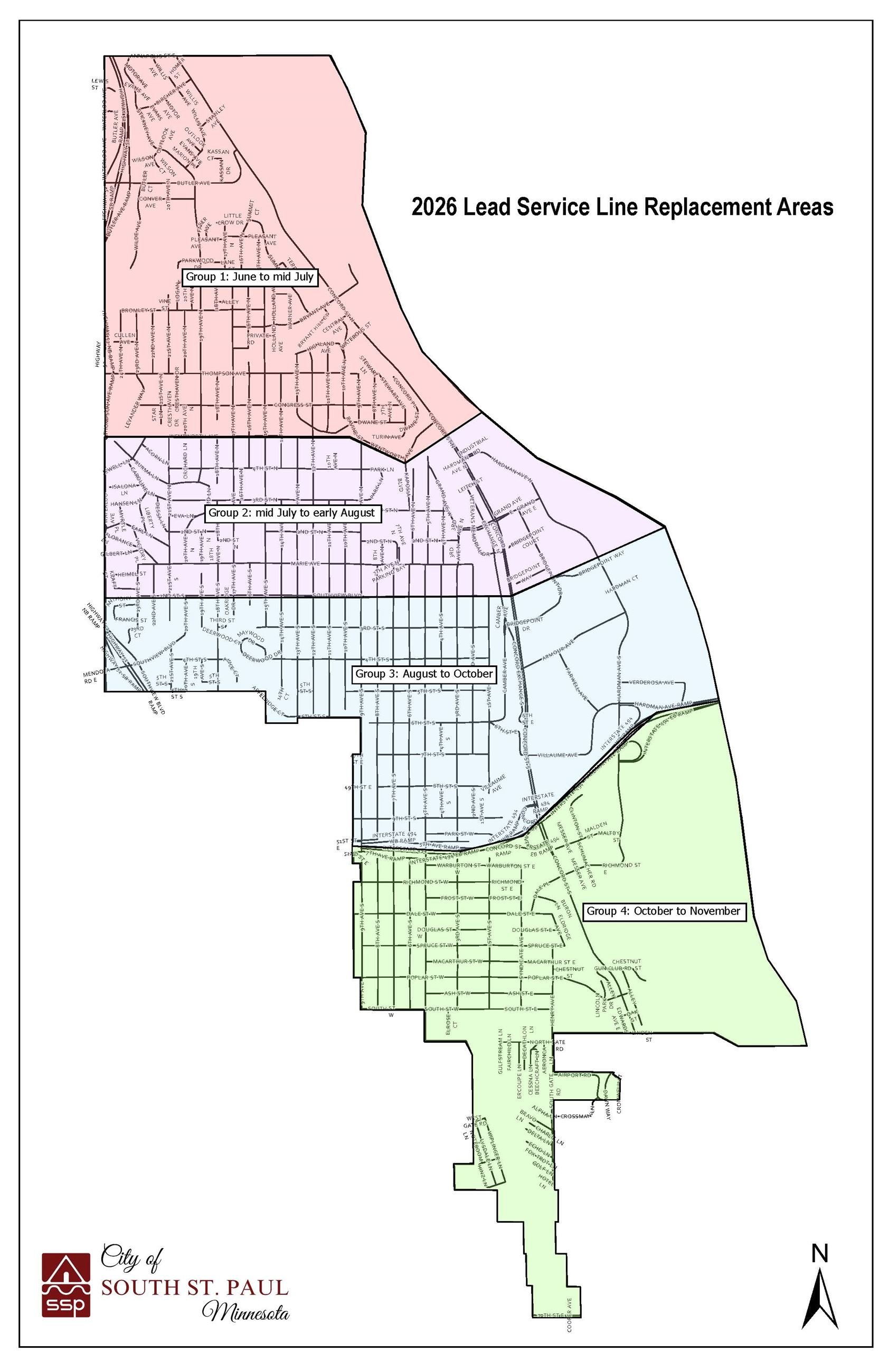
The 2026 project divides South St. Paul into four geographic groups, with crews generally working from north to south.
Group 1 covers the area from the northern city limits to Wentworth Avenue, where work was scheduled from June through mid-July. Group 2 covers Wentworth Avenue to Southview Boulevard, with work scheduled from mid-July through August.
Group 3 covers Southview Boulevard to Interstate 494, with replacements scheduled from August through October. The final group covers the area from I-494 to the city's southern limits, with work scheduled from October through November.
The city notes that construction schedules remain weather-dependent and are subject to change.
Program Could Mean No Cost for Property Owners
South St. Paul's ongoing program is intended to address both public and privately owned portions of lead service lines. According to the city, new state and federal funding opportunities mean replacement of privately owned lead service lines may be completed at no cost to the property owner, provided the work meets applicable eligibility and construction requirements.
That is particularly significant in South St. Paul because property owners are responsible for the entire water service line extending from their building to the water main. The city hired Short Elliott Hendrickson Inc., or SEH, to assist with service line inspections and prepare engineering drawings for the replacement program.
Neither the Minnesota Department of Health nor the U.S. Environmental Protection Agency currently requires individual South St. Paul property owners to independently remove their lead service lines, according to information provided by the city.
Hundreds of Lead Lines Identified in City Inventory
South St. Paul completed its water service line material inventory and submitted it to the Minnesota Department of Health in fall 2025. As of October 17, 2025, the city's inventory included 743 lead service lines, 175 galvanized lines requiring replacement, and 87 lines for which the material was unknown. Another 6,039 service lines were classified as non-lead.
City staff developed the inventory using property files, construction and maintenance records, information from a 2013 meter report, and surveys submitted by property owners. The MPFA-funded project calls for 1,040 lead service line replacements. That figure is larger than the 743 lines specifically classified as lead in the city's October 2025 inventory, which separately listed galvanized lines requiring replacement and lines of unknown material.
South St. Paul Among Communities Receiving State Water Funding
South St. Paul's award is part of a much larger round of water infrastructure financing announced by the MPFA. The authority announced $88.6 million for 12 drinking water and wastewater projects across nine Minnesota cities, ranging from lead service line replacements to water treatment and sanitary sewer improvements.
Saint Paul received approximately $41.94 million for two projects to replace a combined 2,160 lead service lines with copper lines, while Duluth received approximately $22.08 million for two projects to replace 704 lead service lines with copper lines.
South St. Paul received $3.48 million for its 1,040 replacements.
Other funding went to Amboy for improvements to its water treatment plant; Elbow Lake for sanitary sewer, water distribution, and surface infrastructure upgrades; Marble for a new treatment system addressing iron and manganese; Ortonville for sanitary sewer and water main replacements; Sacred Heart for water treatment and biosolids storage improvements; and Scandia for wastewater treatment improvements.
“Funding from the MPFA is crucial for towns across Minnesota to invest in public infrastructure that protects public health and the environment,” Minnesota Department of Employment and Economic Development Commissioner Matt Varilek said. “Keeping our water clean, drinkable and accessible is a catalyst to economic growth. By investing in the health and well-being of Minnesotans, we are investing in our economy for years to come and helping communities flourish.”
Funding Designed to Protect Drinking Water
Lead typically enters drinking water through corrosion of plumbing materials containing lead, rather than originating in the water supply itself. South St. Paul says it regularly tests water at multiple locations, including schools, and that results have consistently remained below safety thresholds established by the Minnesota Department of Health and Environmental Protection Agency. Replacing lead service lines removes a potential source of lead exposure from the drinking water system altogether.
The Minnesota Public Facilities Authority was created to help communities finance public infrastructure that protects public health and the environment while supporting economic growth. Since its inception in 1987, the MPFA has provided nearly $7.7 billion for public infrastructure programs across Minnesota, with investments reaching almost every community in the state.
For South St. Paul, the June 2 award provides more than $3.48 million toward an effort that will eventually remove more than 1,000 service lines as the city's lead replacement work continues throughout 2026.
Written by: Will Wight
Cover Photo Credit: Lead Service Line Replacement Program 2025 Report
