
Farmington Mayor Announces Resignation Days After Contentious February 2nd Council Meeting Over Proposed Data Center and Public Comment Rules
The above video is a portion of the City of Farmington's City Council Meeting held on Monday, February 2, 2026. This video includes a segment of the city council meeting's public comment section where tensions rose after a comment about a data center and a timer set for public comment, before a recess was taken to calm tensions. You can watch the full City Council meeting provided below.
Published: February 5, 2026.
FARMINGTON, MINNESOTA - The City of Farmington announced late Thursday morning that Mayor Joshua Hoyt has resigned from his position effective immediately, citing the need to focus on his mental health and well-being. The resignation announcement followed a highly charged Farmington City Council meeting on Monday, February 2, 2026, during which residents sharply criticized city leadership over a proposed data center project and the council’s public comment procedures.
The City of Farmington released a statement on Facebook late Thursday morning, February 5, 2026, expressing deep gratitude for Hoyt’s years of service, noting his “passion for our city and support for both residents and staff.” Council Member Lien has been named Acting Mayor, and Hoyt’s resignation will be formally considered at the February 17, 2026, City Council meeting. A March 2, 2026, work session will discuss filling the vacant seat and future leadership roles.
In Hoyt’s resignation letter, he cited the need to step away to focus on his mental health, describing the decision as “difficult” but “necessary.”
Feb. 2 Meeting Erupts Over Data Center, Water Concerns, and Comment Limits
The February 2 council meetings have lately drawn crowds and extended public testimony, as residents weigh in on a proposed data center project that has been under review for more than a year. Speakers raised concerns about water scarcity, noise pollution, procedural fairness, and the city’s five-minute limit on public comments.
Water and Environmental Worries
Former Farmington City Council member and resident David Pritzoff voiced deep reservations about the project’s potential impact on the local aquifer, especially given current water restrictions that limit lawn watering to certain hours and odd-even days.
“These people will be pumping water 24-7, 365 days a year,” Pritzoff said. “That’s just pulling water out of the aquifers like there’s no tomorrow.”
He also warned that such extraction could threaten the trout stream that many in Farmington view as a vital part of the community’s heritage.
“That goes back longer than any of us have been alive,” Pritzoff said. “And you’re willing to throw that down the tubes.”
Noise was another point of contention. Describing a demonstration of what the data center could sound like from a half-mile away, Pritzoff said, “It’s a solid humming noise … If you’re willing to throw that at your residents, you have no mindset as to what’s going on here.”
Calls for Moratorium and a More Extensive Review
Resident Nate Ryan, while expressing personal support for data centers when sited appropriately, argued that the city should enact a moratorium on development at the proposed location to allow more research and environmental review.
“We should build them where they belong — not here,” Ryan said. He also questioned the city’s reliance on an Alternative Urban Areawide Review (AUAR) instead of a full Environmental Impact Statement (EIS), asking, “If you’re so confident in the process, why not require an EIS?”
Ryan suggested that, without a full study, the city could be held liable for issues such as well interference, which he said has caused costly legal battles in other Minnesota communities.
Public Comment Time Limit Sparks Outcry
One of the most heated exchanges of the night centered on a policy limiting public comment to five minutes per speaker, a rule the council adopted after prior meetings ran late due to extended testimony.
Pritzoff called the time limit discriminatory.
“It’s discrimination,” he said. “Some people don’t talk as fast as others … You’re discriminating against those people.”
Mayor Hoyt defended the rule, saying it was adopted to preserve order and maintain decorum.
“As the presider of the meeting, I have the statutory authority to do it,” Hoyt said. “When people come to the podium and abuse it … rules have to be put in place.”
Later in the meeting, Hoyt reiterated that the limit did not infringe on constitutional rights and that flexibility had been shown in prior meetings.
“The First Amendment allows people to come up here and say whatever they want,” he said. “But hard decisions have to be made for the betterment of the majority of the community.”
Meeting Tension Escalates, Ends in Recess
As speakers continued, emotions and tensions flared. One audience member called the mayor a “racist son of a bitch,” prompting Hoyt to take a firm tone while emphasizing free speech protections.
“You can come up here and say whatever you want,” Hoyt said. “That is protected.”
The meeting was eventually recessed by council vote after several interruptions.
Mayor Addresses Public Comment Limits and Misinformation at Close of Meeting
At the close of the February 2 meeting, Mayor Joshua Hoyt addressed the escalating tensions surrounding public comment, the five-minute speaking limit, and claims made from the podium about the proposed data center. Hoyt emphasized that the time limit was not a new policy, explaining that Farmington has long maintained a five-minute guideline for public comments and that flexibility had routinely been exercised in past meetings when speakers remained on topic and decorum was maintained. He noted that speakers in prior meetings had often been allowed additional time, sometimes well beyond five minutes.
Hoyt said the decision to more strictly enforce the time limit during the February 2 meeting followed what he described as a significant breakdown in decorum. According to Hoyt, the council collectively agreed that limits were necessary to keep the meeting orderly after repeated interruptions and extended exchanges. While acknowledging that some residents were frustrated by the enforcement, Hoyt stated that the policy did not infringe on First Amendment rights and was intended solely to ensure that meetings could proceed in an organized and respectful manner.
“I understand some people may not like that,” he said. “They may feel as if it infringes on First Amendment rights, which it does not.”
In his remarks, Hoyt also pushed back against what he characterized as misinformation shared during public comment, particularly regarding the scale, noise, and water use of the proposed data center. He said many claims omitted key facts or overstated potential impacts, and stressed that the city does not act alone in reviewing such projects. Hoyt noted that multiple state and regional agencies, including environmental and water regulators, are involved in evaluating compliance and safety, and reiterated that the project has not received final approval.
“The City Council of Farmington is not the Department of Natural Resources,” Hoyt said. “We are not the Minnesota Pollution Control Agency. There are many agencies that weigh in on regulations that have to be adhered to.”
Despite the heightened emotions displayed during the meeting, Hoyt emphasized that residents retain the right to speak freely during public comment. He said the city does not restrict viewpoints or criticism but must balance open expression with the need to conduct official business. Hoyt concluded by stating that the five-minute public comment limit would remain in place unless the council decided otherwise, adding that difficult decisions are sometimes required in the interest of the broader community.
“The First Amendment allows people to come up here and say whatever they want,” Hoyt said. “You can come up here and say whatever you want — that is protected. At the end of the day, hard decisions have to be made for the betterment of the majority of the community,” Hoyt said. “You don’t have to like it, but it has to be done.”
You can watch the full City Council Meeting below:
Mayor Hoyt’s Resignation and Next Steps
In the days following the meeting, Hoyt submitted his resignation letter, citing the need to focus on his mental health and well-being.
“Serving our community has been one of the greatest honors of my life,” Hoyt wrote in his resignation. “I believe that leadership requires clarity, presence, and well-being — and at this time, I need to prioritize my health.”
The city expressed gratitude for Hoyt’s service and affirmed its commitment to continued transparency and community engagement. Council Member Lien will assume the role of Acting Mayor during the interim. Hoyt’s resignation will be formally addressed at the Feb. 17 council meeting. On March 2, the council will discuss how to fill the vacant position and determine leadership roles going forward.
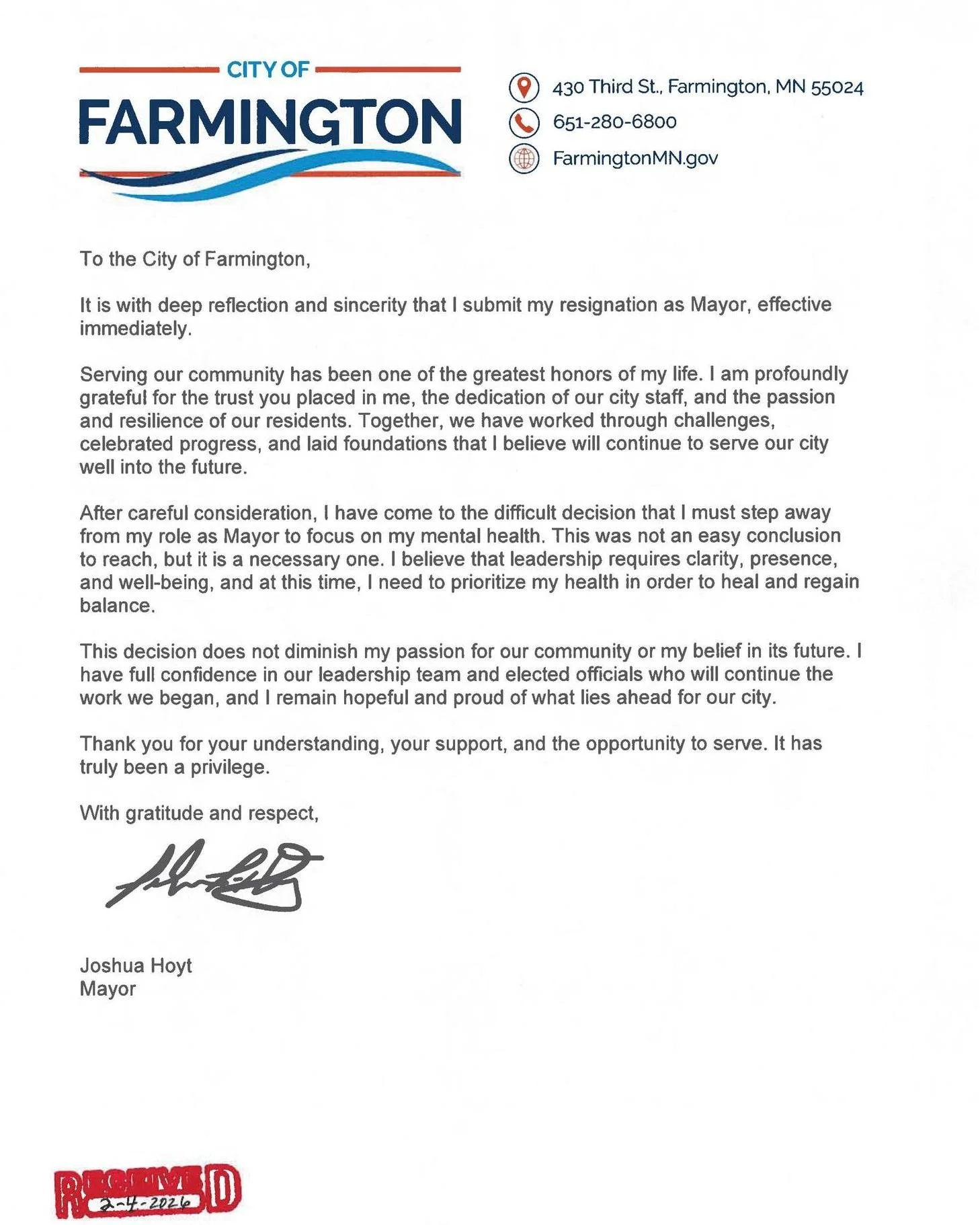
Provided by the City of Farmington.
Written by: Will Wight
Cover Photo from the City of Farmington City Council Meeting on February 2, 2026.
