
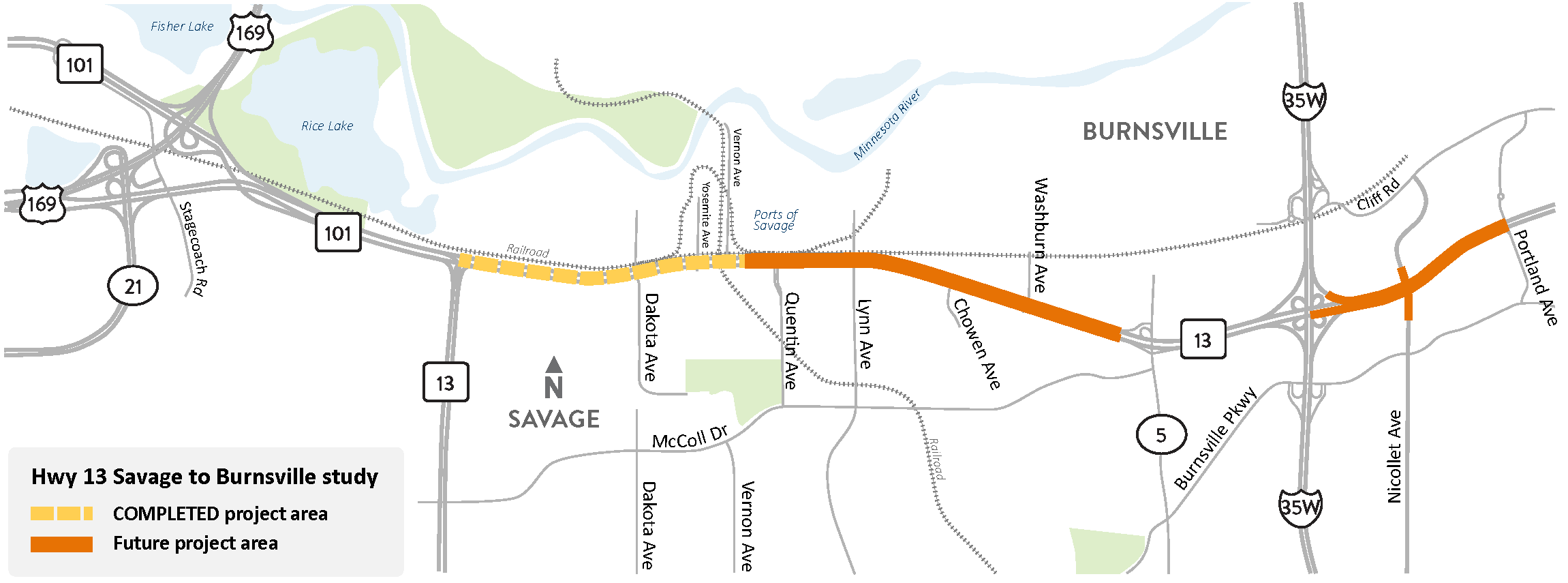
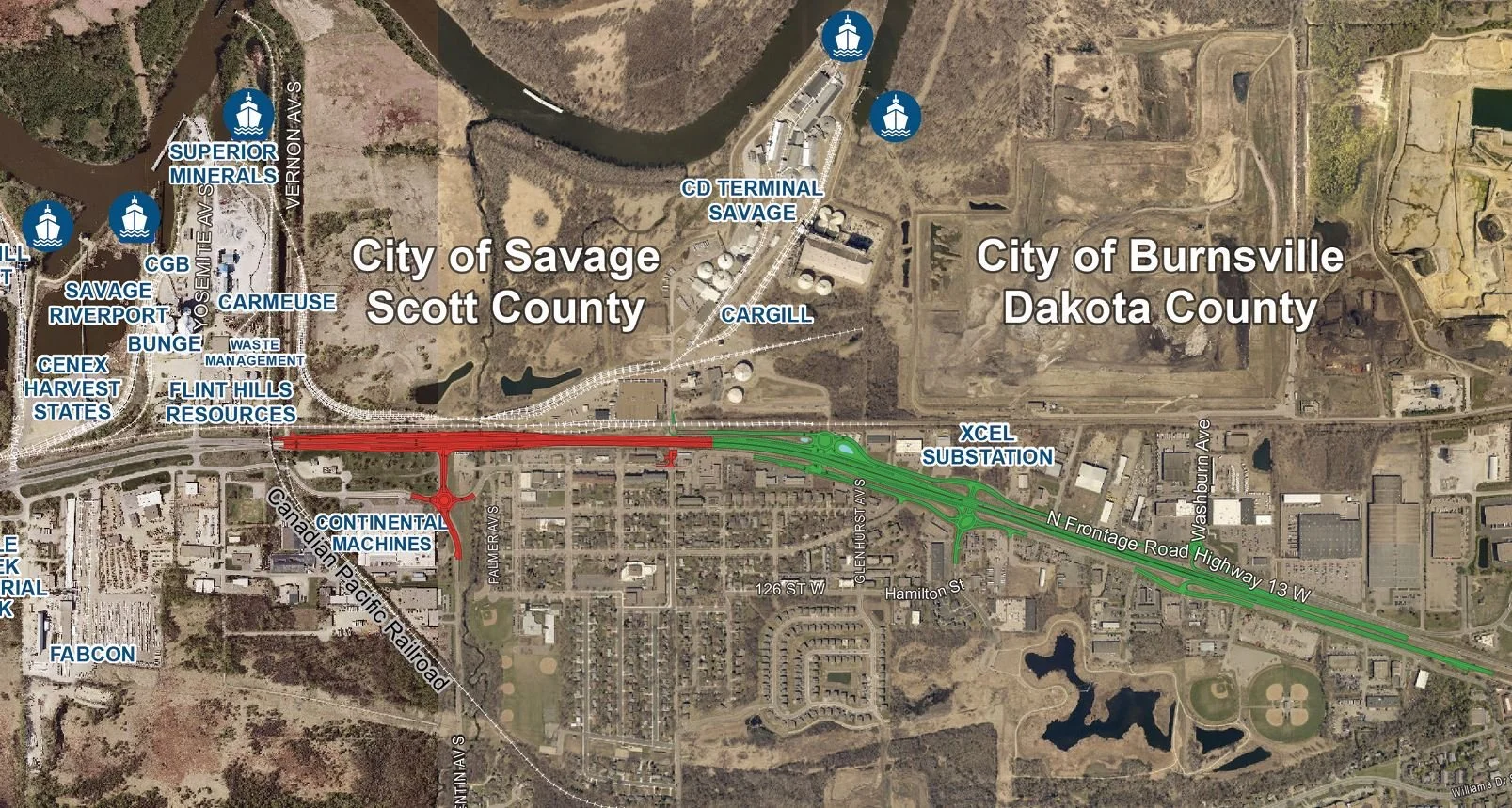
BURNSVILLE/SAVAGE, MINNESOTA – Local and state leaders are working to advance a major infrastructure initiative designed to reshape one of the south metro’s most critical and congested transportation corridors. The Highway 13 River, Rail, and Roads Initiative Project in Scott and Dakota counties and the Nicollet Avenue Mobility Improvement Project in Dakota County aim to enhance safety, improve travel efficiency, and support long-term economic growth across the region by modernizing the heavily traveled Highway 13 corridor between Quentin Avenue and Nicollet Avenue.
Transforming a Critical Freight and Commuter Corridor
The project proposes transforming 3.5 miles of Highway 13 into a four-lane expressway with grade-separated intersections, significantly reducing congestion and crash risks along the route. Highway 13 currently serves as a vital connector between residential neighborhoods, employment centers, and freight routes—linking communities across Savage, Burnsville, and the greater Twin Cities metropolitan area. The upgrades will improve safety for all users, including commuters, truck drivers, and transit riders, while bolstering access to local businesses and regional job centers.
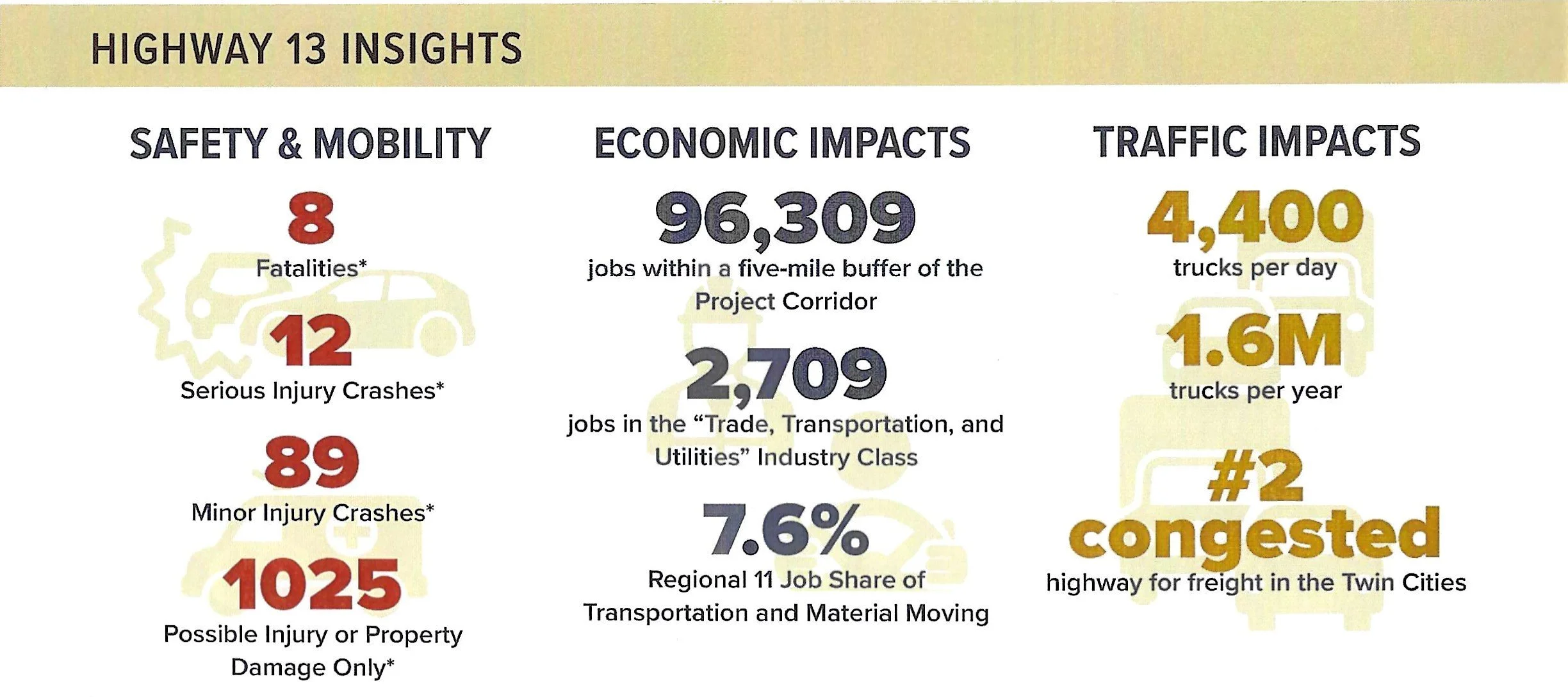
Between 2014 and 2023, the corridor experienced eight fatalities, 12 serious injury crashes, and nearly 100 crashes resulting in injuries, in addition to more than 1,000 property-damage incidents. Project leaders say these statistics highlight the urgent need for improved design and safety measures.
Provided by City of Savage/Scott County Officials.
Funding and Legislative Support
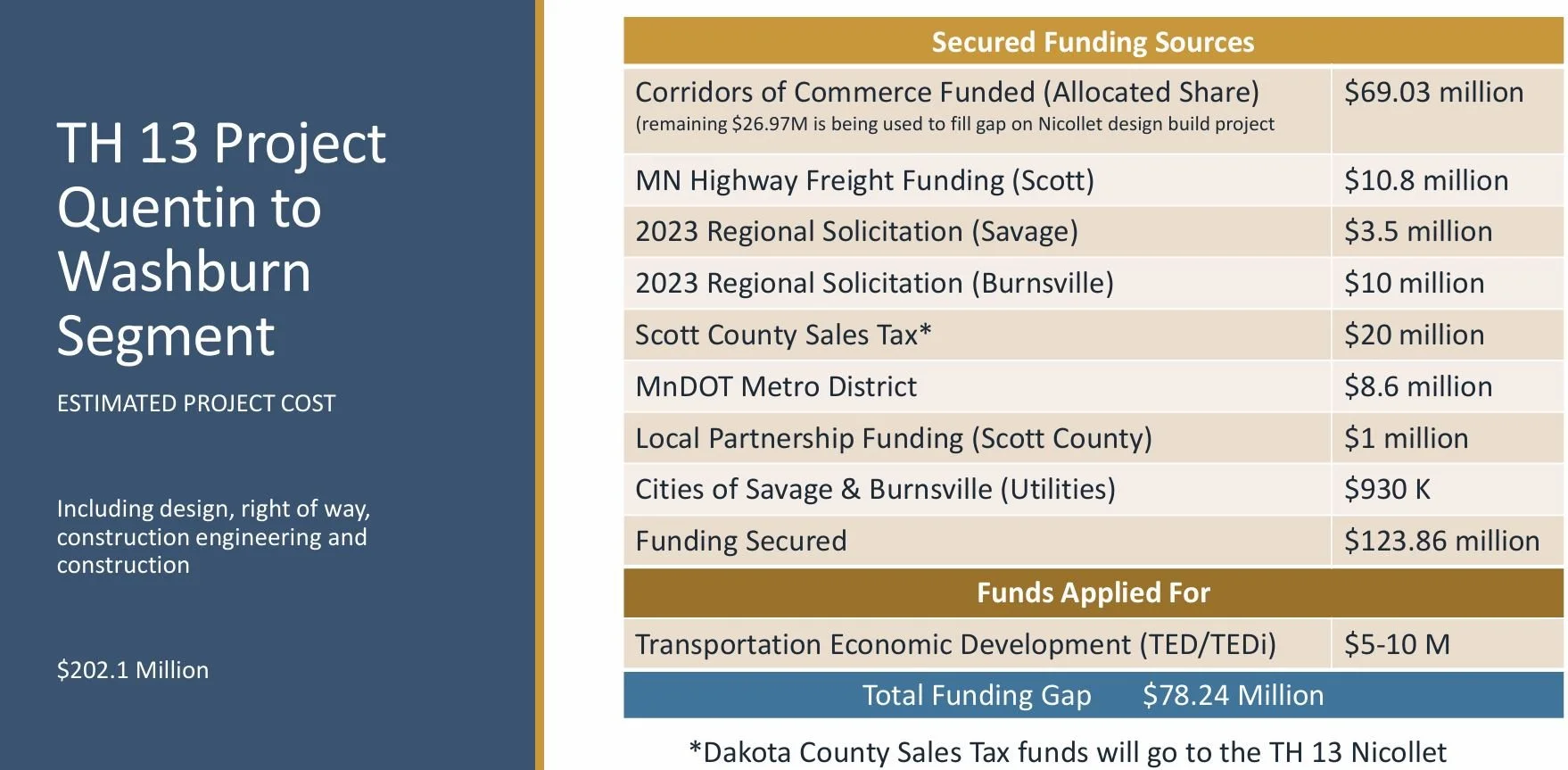
The total estimated cost of the River, Rail, and Roads Initiative is $202.1 million, with $123.86 million already secured from federal, state, and local partners. A $78.24 million funding gap remains, prompting a request for $18.4 million in General Obligation bonds and $50.1 million in Trunk Highway bonds from the Minnesota Legislature. Project officials note that full funding is essential to avoid construction delays and cost increases that could push portions of the work back to 2034, jeopardizing federal grants tied to the project's deadlines.
Provided by the City of Savage and Scott County.
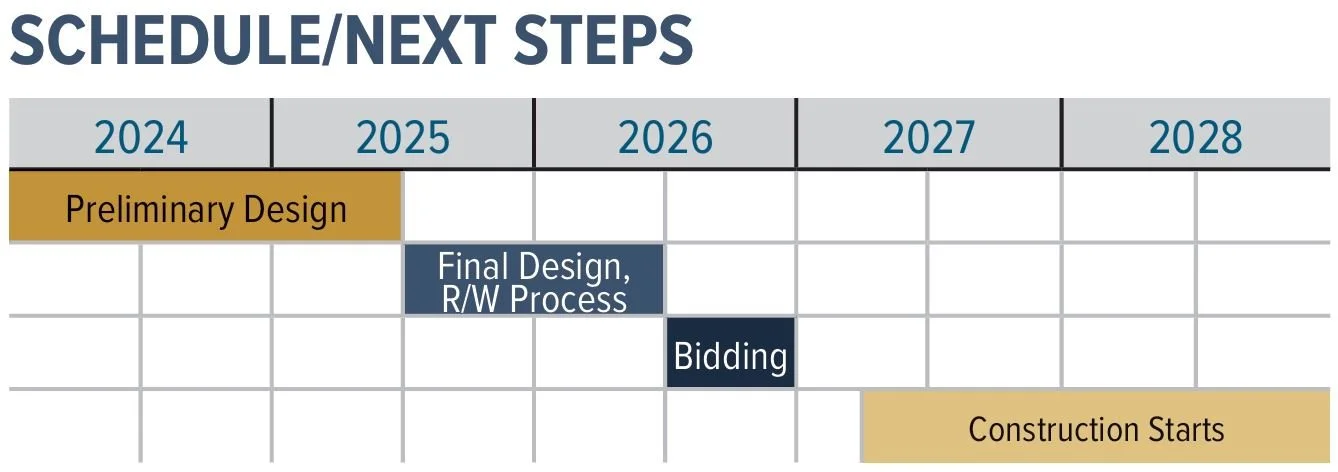
If fully funded, the project would progress through final design and right-of-way work by 2026, with construction beginning in 2027 and continuing through 2028.
Provided by the City of Savage and Scott County.
Economic and Regional Impact
According to officials with the City of Savage, Highway 13 is a major freight corridor that supports over 96,000 jobs within a five-mile radius and handles approximately 4,400 trucks per day, or 1.6 million trucks annually. It ranks as the second-most-congested freight corridor in the Twin Cities metro area, serving industries tied to the Ports of Savage, a key intermodal hub along the Minnesota River. These facilities handle over two million tons of agricultural and industrial materials each year from companies including Cargill, CHS, Flint Hills Resources, and Consolidated Grain and Barge (CGB).
U.S. Senator Amy Klobuchar underscored the project’s importance, calling Highway 13 “a vital arterial route that plays an essential role in supporting commuters, freight movement, and commercial transportation across Minnesota.” She added that improvements will benefit one of the state’s fastest-growing regions while connecting rural and urban communities across the state.

Strengthening Connections Between Burnsville and Savage
The initiative carries particular significance for the Burnsville and Savage business districts, which have long been divided by Highway 13’s safety and congestion issues. The corridor passes through a disadvantaged census tract and connects to two regional transit stations, underscoring the need for multimodal access and equity as a significant design priority. City and county officials from Burnsville, Savage, Scott County, Dakota County, and MnDOT have collaborated closely to ensure the project reflects both local and regional needs.
In addition to roadway improvements, the initiative will enhance access for pedestrians, cyclists, and transit users, key components of the area’s growing multimodal network.
The Nicollet Avenue Mobility Improvement Project: A Key Component in Burnsville
Within Burnsville, a companion effort, the Highway 13 and Nicollet Avenue Mobility Improvement Project, targets one of the region’s most congested and crash-prone intersections. The plan calls for a grade-separated crossing at Nicollet Avenue, replacing the current at-grade intersection. This change is expected to cut crash risks by more than 50% and significantly reduce travel delays for more than 35,000 daily vehicles.
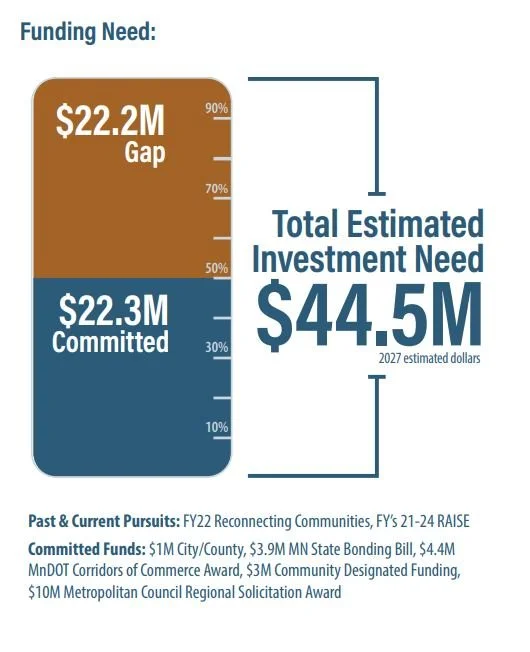
The estimated investment for the Nicollet Avenue improvements is $44.5 million, with $22.3 million already secured from a mix of federal, state, and local partners, leaving a $22.2 million gap. Partners include the City of Burnsville, Dakota County, MnDOT, Metro Transit, and the Metropolitan Council, with additional grant requests pending under federal programs such as RAISE, INFRA, and Reconnecting Communities.
Improving Access, Safety, and Equity
Beyond congestion relief, the Nicollet Avenue project aims to improve pedestrian and bicycle connectivity and enhance stormwater management. Approximately 25% of nearby residents do not own a vehicle, underscoring the need for improved transit access. The area connects to two regional transit hubs and supports over 200,000 jobs along the I-35W corridor and 6,000 jobs along Highway 13.
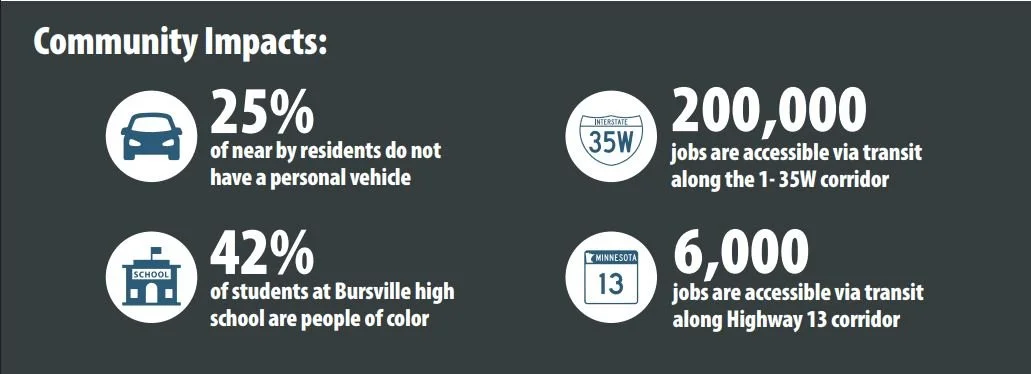
Provided by the City of Burnsville.
The Nicollet Avenue project began in 2019 with corridor studies that ran through 2021. The preliminary design for this project, shown below, was released in 2024, with the final design expected between now (2025) and 2026. If the project receives the funding and final approval, construction is projected to begin around 2027 and continue into 2028.
According to officials, the proposed improvements would include:
A grade-separated crossing (bridge) of Nicollet Avenue over Highway 13.
This will reduce the number of serious crashes at that intersection.
Elimination of a pedestrian interaction with the high-volume/high-speed Highway 13.
This will reduce the number of serious-to-fatal pedestrian crashes in this area.
New and improved local system connections to reduce conflict points, slow local traffic, and improve operations.
Defined gateway to Burnsville’s downtown business district and two adjacent regional transit hubs.
Enhanced stormwater management.
The proposed solution will provide an overall crash reduction of more than 50%.
Once complete, it will enhance access to Burnsville’s downtown district, the MVTA Orange Line Station, and nearby residential and commercial developments—including a new 386-unit mixed-use housing project.
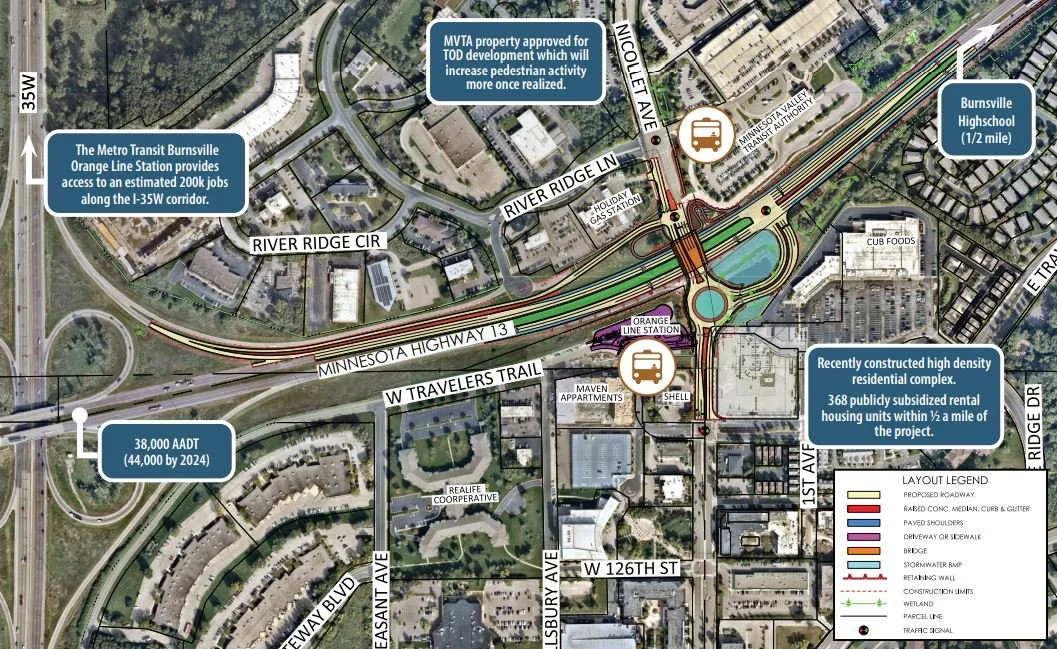
Provided by the City of Burnsville.
A United Effort for the South Metro’s Future
The Highway 13 River, Rail, and Roads Initiative and the Nicollet Avenue Mobility Improvement Project represent a collaborative, forward-looking investment in the future of the south metro. Together, they will reduce crashes, improve freight and commuter efficiency, and unlock new opportunities for economic growth and connectivity across Burnsville, Savage, Scott County, and Dakota County.
During the Minnesota House Capital Investment Committee’s bonding tour on Thursday evening, which you can read more about here, Minnesota House Bonding Committee Toured Burnsville Water Treatment Plant, Highlighting $17.5 Million Rehabilitation Effort to Secure the City’s Water Future, officials from both cities presented the projects to lawmakers, emphasizing their regional importance and readiness for construction once full funding is secured. Both initiatives are widely supported by community members, local businesses, and government partners, and stand poised to reshape one of Minnesota’s most essential transportation corridors for decades to come.

The Federal, State, and County departments and agencies that are supporting this project.
Written by: Will Wight
