
Artemis II Manned Moon Mission Set To Launch Today: Why it Matters
Published: April 1st, 2026
NATIONAL NEWS - FLORIDA: NASA’s Artemis II mission, the first crewed flight of the Artemis program, is targeted to launch today, April 1, 2026, at 5:24 p.m. CDT from Launch Complex 39B at Kennedy Space Center in Florida. The four-person crew consists of NASA astronauts Reid Wiseman as commander, Victor Glover as pilot, and Christina Koch as mission specialist, along with Canadian Space Agency astronaut Jeremy Hansen as mission specialist. The approximately 10-day mission will send the astronauts on a lunar flyby using NASA’s Space Launch System rocket and Orion spacecraft. It is the first crewed mission to these systems and the first time humans have traveled beyond low Earth orbit since Apollo 17 in 1972.
Artemis II matters because it builds directly on the uncrewed Artemis I test flight conducted in 2022 and will demonstrate a broad range of capabilities required for deep-space missions, including the performance of the Space Launch System rocket and Orion spacecraft with a crew aboard for the first time. NASA states that the mission marks a key step toward the long-term return of humans to the Moon and future missions to Mars. Orion is designed to carry and sustain astronauts on lunar missions and serves as a crucial step toward crewed missions to Mars. Under the broader Artemis campaign, NASA is returning humans to the Moon to deliver scientific discovery and economic benefits while preparing for crewed missions to Mars. Artemis II provides the critical data and validation needed before future surface landings and sustained lunar operations.
The Artemis II crew was selected and assigned by NASA and the Canadian Space Agency based on their extensive experience in spaceflight and engineering. Reid Wiseman, a veteran of a previous International Space Station mission, will command the flight. Victor Glover previously served as a pilot on a commercial crew mission to the station. Christina Koch holds the record for the longest single spaceflight by a woman after her 328-day mission aboard the station. Jeremy Hansen, selected as part of Canada’s astronaut class, will become the first Canadian to fly beyond low Earth orbit. All four astronauts have undergone rigorous training specific to the Orion spacecraft and the Artemis II flight profile.
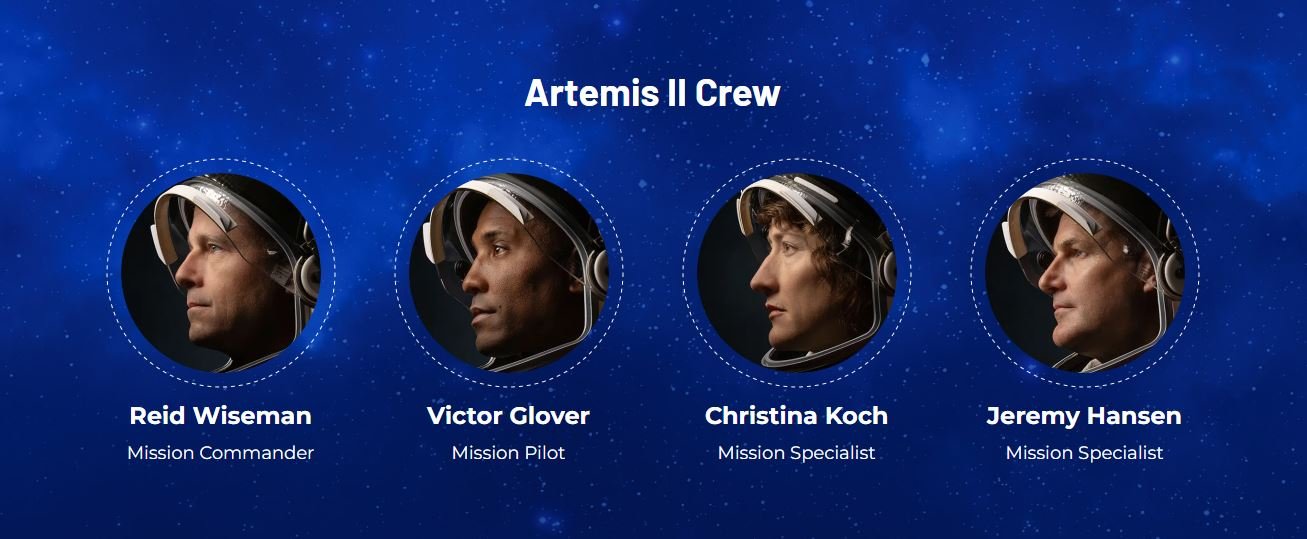
Provided by the Kennedy Space Center.
The mission will unfold in a carefully sequenced series of events. The Space Launch System rocket will generate 8.8 million pounds of thrust at liftoff, propelling Orion and the crew on an approximately 600,000-mile journey. After separating from the rocket’s upper stage, the Orion spacecraft will perform a targeting demonstration near Earth. It will then follow a free-return trajectory around the Moon, coming within about 6,000 miles of the lunar surface before the Moon’s gravity slings the spacecraft back toward Earth. During the voyage, the crew will test Orion’s life-support systems, navigation, communication, and other deep-space capabilities with humans aboard for the first time. The astronauts will also conduct several planned maneuvers to verify the spacecraft’s handling in the unique environment beyond low Earth orbit.
Key Mission Milestones (All times CDT)
April 1, 5:24 p.m.: Targeted liftoff of the SLS rocket (two-hour launch window available)
Within the first 10 minutes: Solid rocket booster separation, core stage engine cutoff, and separation from the upper stage
Within the first few hours: Orion spacecraft separation from the Interim Cryogenic Propulsion Stage, solar array deployment, and proximity operations demonstration
April 2 (approximately 25 hours after launch): Trans-lunar injection burn to send Orion on its path to the Moon
April 6: Lunar flyby with closest approach to the Moon (approximately 6,000 miles from the lunar surface)
April 10, approximately 7:06 p.m.: High-speed atmospheric reentry followed by splashdown in the Pacific Ocean
Throughout the flight, the crew will gather data on how the vehicle performs under real deep-space conditions, including the effects of prolonged exposure to cosmic radiation and the challenges of operating far from Earth. NASA has designed the mission profile to provide engineers with the information required to certify the systems for future crewed lunar landings. The mission will conclude with a high-speed atmospheric reentry at about 30 times the speed of sound, during which Orion’s heat shield must protect the crew from temperatures exceeding 5,000 degrees Fahrenheit. The spacecraft is expected to splash down in the Pacific Ocean, where recovery teams will retrieve the crew and the vehicle for post-flight analysis.
Countdown operations for Artemis II began at 3:44 p.m. CDT on March 30, 2026, and launch teams at Kennedy Space Center have been conducting final preparations, including tanking tests of the rocket’s propellants and checks of ground systems. The launch window today accounts for the precise orbital alignment needed for the lunar flyby trajectory. If any technical or weather-related issues arise, NASA has backup launch opportunities through April 6.
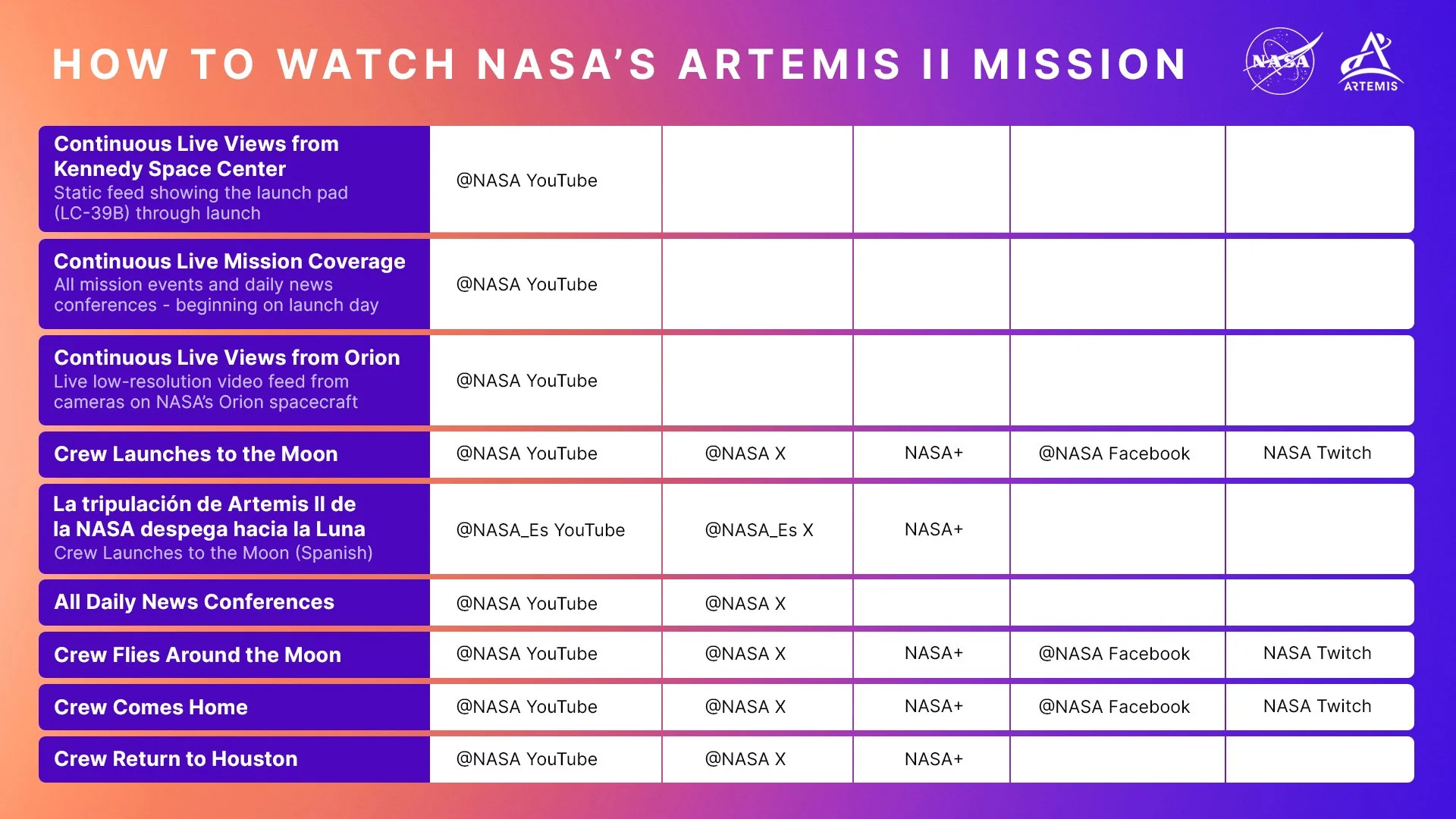
How to Watch the Artemis II Mission, Provided by NASA/Facebook.
Artemis II represents the next concrete milestone in NASA’s plan to establish a sustainable human presence on and around the Moon. By flying a crewed test of the Space Launch System and Orion together, the mission will confirm that the hardware and procedures function as intended before committing to more complex operations such as landing on the lunar surface. The data collected will directly inform the design and execution of Artemis III and subsequent missions, ensuring that future crews can travel safely to the Moon and eventually onward to Mars. All details in this report are drawn exclusively from official NASA announcements and mission documentation.

Provided by NASA/Facebook.
Written By: Bradley Patton
