
Great Lakes Report Shows Stabilization, but Long-Term Environmental Challenges Persist
U.S.–Canada assessment finds progress on pollution and prevention, but nutrients, invasive species, and climate pressures continue to strain the ecosystem.
Published: March 24, 2026
MINNESOTA – A newly released joint report from the United States and Canada finds that the Great Lakes, one of the most important freshwater systems on Earth, are no longer in widespread decline, but are also not significantly improving, with overall conditions rated “fair” and unchanged in recent years.
The State of the Great Lakes 2025 Report, compiled by more than 200 scientists and experts, including the University of Minnesota - Natural Resources Research Institute, provides a comprehensive look at the health of the Great Lakes using nine key environmental indicators. The findings reflect decades of coordinated restoration efforts that have stabilized many long-standing issues, but also highlight persistent and emerging challenges that continue to affect water quality and ecosystem health across the basin.
A Resource of Global Importance
The Great Lakes contain roughly 20% of the world’s surface freshwater and provide drinking water to about 30 million people across the United States and Canada. They also support a vast regional economy tied to shipping, fisheries, agriculture, tourism, and energy production, while holding deep cultural significance for Indigenous communities throughout the basin.
For more than 50 years, the two countries have worked together under the Great Lakes Water Quality Agreement, partnering with Tribal Nations, First Nations, state and provincial governments, and local agencies to protect and restore the system. The report’s findings are based on basin-wide indicators designed to track long-term environmental trends and guide policy decisions.
Minnesota Angle: Lake Superior Remains a Bright Spot
For Minnesota, the report offers encouraging news. Lake Superior is rated “Good” and remains the healthiest of the five Great Lakes, supported by its colder waters, lower development pressures, and extensive forested watershed.
The lake plays a vital role in the state, providing drinking water for communities like Duluth, supporting tourism along the North Shore, and sustaining fisheries that are both economically and culturally important.
However, scientists caution that even Lake Superior is not immune to change. Warming water temperatures, shifting ice cover, and localized water quality concerns are emerging as areas to watch, underscoring the need for continued monitoring and protection.
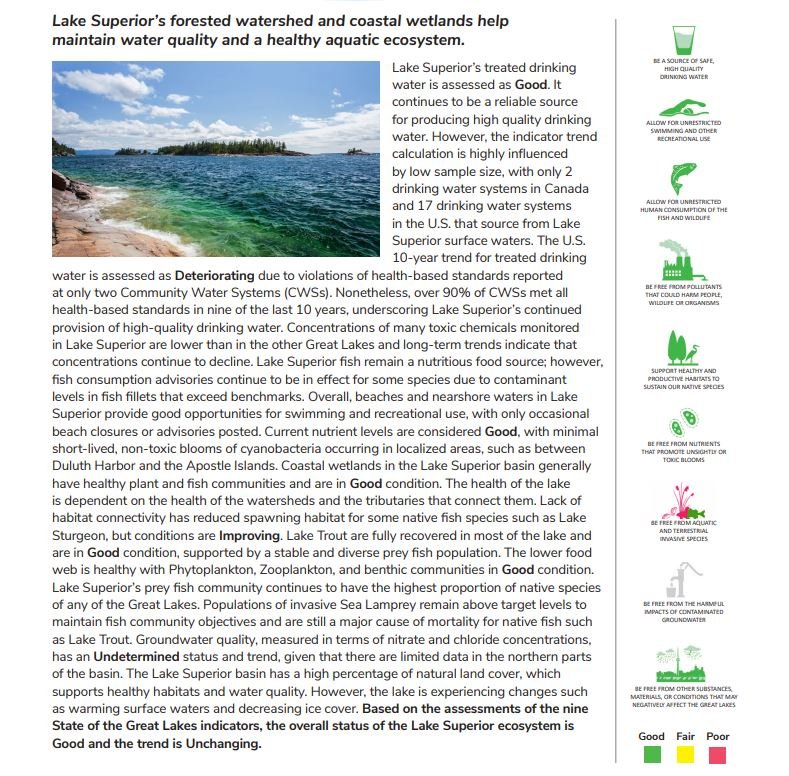
Provided by the State of the Great Lakes 2025 Report.
Drinking Water and Beaches: Strong, but Not Perfect
The report identifies drinking water quality as one of the strongest areas, rated “Good” with an unchanging trend.
Nearly all public water systems drawing from the Great Lakes meet health-based standards, with about 97% compliance in the U.S. and more than 99.9% in Ontario. Still, the report emphasizes that water must be properly treated before it is safe to consume.
Similarly, most Great Lakes beaches remain safe for swimming. From 2020 to 2023, monitored beaches were open and safe for swimming 89% of the time in Canada and 94% in the U.S., though closures still occur due to bacterial contamination from sources such as stormwater runoff, wastewater overflows, and wildlife.
Toxic Chemicals and Fish: Long-Term Gains, Slower Progress
One of the report’s most significant success stories is the long-term reduction of toxic pollutants. Contaminants such as PCBs and mercury have declined dramatically since the 1970s—by more than 90% in some cases, thanks to regulatory action and environmental cleanup efforts.
As a result, the toxic chemicals indicator is rated “Fair,” with trends ranging from stable to improving.
Fish consumption has also improved, with contaminant levels decreasing over time. However, fish advisories remain necessary in many areas due to lingering pollution and emerging contaminants such as PFAS, so unrestricted consumption is still not possible across much of the basin.
Nutrient Pollution: A Persistent and Complex Problem
Despite progress in other areas, nutrient pollution remains one of the most significant ongoing challenges.
The report rates nutrient and algal conditions as “Poor to Fair,” with no improvement trend, largely driven by phosphorus runoff from agriculture, urban development, and stormwater systems.
In Lake Erie, excess nutrients continue to fuel harmful algal blooms and low-oxygen “dead zones,” while other parts of the Great Lakes are experiencing the opposite issue, nutrient levels that are too low to support healthy food webs. Scientists note that this imbalance highlights the complexity of managing nutrients across such a large and diverse watershed.
Habitat and Wildlife: Uneven Conditions Across the Basin
The health of habitats and native species is rated “Fair,” with little overall change.
Conditions vary widely:
Northern areas like Lake Superior remain relatively healthy
More developed regions, particularly around lakes like Erie and Ontario, face ongoing degradation
Challenges include wetland loss, invasive plant species, and development pressure. However, restoration efforts are producing measurable gains, including the recovery of lake trout, lake sturgeon, and walleye populations in several areas.
Invasive Species: Fewer New Arrivals, But Lasting Impacts
The report highlights a critical distinction regarding invasive species. Efforts to prevent new species, especially through stricter shipping regulations, have been successful, with the rate of new introductions rated “Good.”
However, the impact of existing invasive species remains “Poor,” with no improvement trend. Today, the Great Lakes are home to 190 non-native species, including 78 considered invasive, and their cumulative impact has more than doubled since 1950. Species such as sea lamprey continue to prey on native fish, while zebra and quagga mussels have fundamentally altered food webs by filtering out plankton and altering nutrient cycling.
Lake Superior remains the least affected by invasive mussels, but localized populations have begun to appear, raising concerns about future spread.
Climate and Changing Conditions Add New Pressure
The report also points to changing physical conditions as an emerging and increasingly important factor. Warming water temperatures, reduced ice cover, and more frequent extreme weather events are already influencing nutrient runoff, habitat conditions, and ecosystem balance.
While these changes are still being studied, scientists warn they could amplify existing challenges in the years ahead.
The Path Forward
The report makes clear that while the Great Lakes have benefited from decades of coordinated environmental protection, the next phase of progress will be more complex.
Future efforts will need to focus on:
Reducing nutrient runoff
Managing invasive species impacts
Addressing emerging contaminants
Adapting to climate-related changes
Bottom Line
The Great Lakes are no longer in crisis, but they are not fully healthy. The 2025 report shows a system that has stabilized after decades of work, yet still faces persistent pressures that require ongoing attention.
For Minnesota, Lake Superior stands out as a model of relative resilience. But across the basin, the message is clear: continued investment, collaboration, and vigilance will be essential to protect this critical freshwater resource for generations to come.
You can read the full report here: https://binational.net/wp-content/uploads/2026/01/State-of-the-Great-Lakes-2025-Report.pdf
Written by: Will Wight
Cover photo credit: State of the Great Lakes 2025 Report.
