Dakota County Board Approves Letter on ICE Enforcement as Residents Describe Fear, Service and School Disruptions, and Calls for Action
You can watch the full Board of Commissioners Special meeting above.
Published: January 31, 2026.
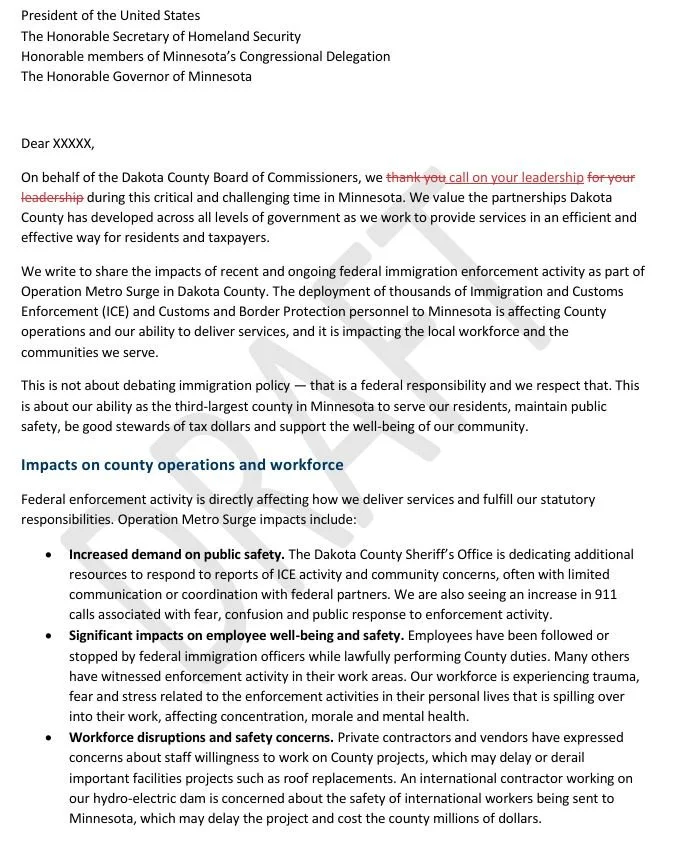
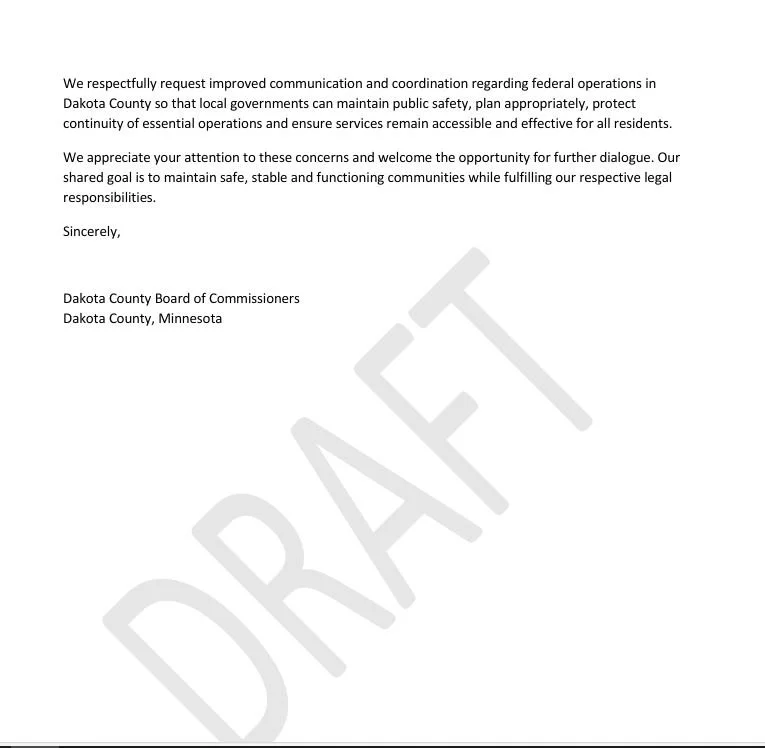
DAKOTA COUNTY, MINNESOTA — The Dakota County Board of Commissioners approved an amended letter during a special meeting on Tuesday, January 27, 2026, calling on Minnesota’s congressional delegation and other federal and state leaders to improve communication and coordination surrounding heightened federal immigration enforcement activity in the county.
The letter, drafted by the Dakota County Communications Department at the direction of the Board, outlines the widespread impacts on county operations, public services, employees, and residents associated with federal immigration enforcement efforts under Operation Metro Surge. While the Board emphasized that immigration policy itself remains a federal responsibility, commissioners stressed that the scale and execution of the current enforcement activity is creating significant disruptions at the local level.
What the Letter Says — and What It Does Not
Several commissioners underscored that the letter’s intent is not to call for an end to immigration enforcement in Minnesota or to eliminate the cooperation that has historically existed between local law enforcement, including the Dakota County Sheriff’s Office, and federal agencies.
Commissioner Mary Liz Holberg (District 6) stated that she supports the letter as written but does not support actions beyond that step at this time. Two commissioners echoed that perspective, noting that immigration enforcement through the Dakota County Sheriff’s Office and long-standing federal partnerships existed well before Operation Metro Surge and had functioned effectively in the past.
Board members clarified that the discussion around “ending Operation Metro Surge” refers specifically to the current surge strategy and lack of coordination, not to ending enforcement by Immigration and Customs Enforcement (ICE) altogether.
Breakdown of Impacts Cited in the Letter
According to the amended letter, the impacts of Operation Metro Surge on Dakota County are extensive and multifaceted:
Public Safety Strain: The Dakota County Sheriff’s Office has experienced an increase in calls related to ICE activity, often without advance notice or coordination with federal partners.
Employee Well-Being: County employees report fear, stress, and trauma after witnessing or encountering federal enforcement activity during work hours.
Workforce and Project Disruptions: Contractors and vendors have expressed reluctance to work on county projects, which could delay and increase costs, including for major infrastructure projects.
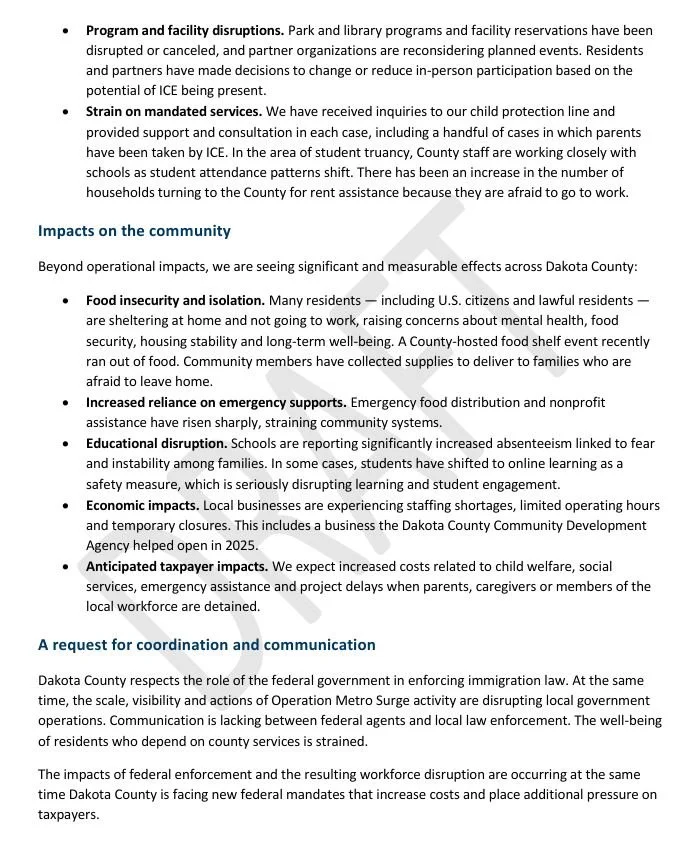
Service and Facility Disruptions: County programs, library and park reservations, and community events have been canceled or scaled back due to fears of enforcement activity.
Mandated Services Under Strain: Child protection inquiries, housing assistance requests, and truancy cases have increased as families avoid work, school, or public spaces.
The letter further highlights food insecurity, mental health concerns, educational disruptions, and anticipated taxpayer costs tied to emergency responses, delayed projects, and expanded social services.
Sheriff’s Office Relationship with Federal Partners
During public comment, residents cited prior board discussions in which the Dakota County Sheriff confirmed that the Sheriff’s Office had once maintained a strong working relationship with federal immigration authorities. According to those remarks, the relationship has deteriorated significantly since Operation Metro Surge began, to the point that local officials struggle to coordinate with their federal counterparts like they once did.
Public Comment: Residents Describe Fear, Disruption, and Urgent Calls for Action
Public comment during the special meeting underscored the depth of fear and disruption residents say they are experiencing across Dakota County, with speakers repeatedly urging the Board to take action beyond issuing a letter.
Lakeville Resident: “What Is This Letter Going to Do?”
A Lakeville resident questioned whether a strongly worded letter would meaningfully change conditions on the ground, describing how fear tied to immigration enforcement has reached even the youngest children. They told commissioners that their daughter, a kindergartener, had reported classmates writing phone numbers on their arms with permanent marker in case their parents were detained before they returned home from school.
“It’s freezing outside,” the resident said. “They might freeze before a neighbor gets home and sees this little kid sitting outside in the cold.”
They asked commissioners to explain what the letter was expected to accomplish beyond the work already being done by local law enforcement.
“We need action,” they said. “Please help me understand what this letter is supposed to do that isn’t already being done — because what’s happening now isn’t working.”
Inver Grove Heights Resident: “Words Are Not Enough”
An Inver Grove Heights resident echoed the Lakeville speaker’s concerns, saying the urgency of the situation requires immediate and tangible action. They argued that waiting additional weeks for further discussion was not acceptable.
“Just because two people aren’t here, we can’t wait another week,” she said. “Every day, things are changing.”
The resident suggested that Dakota County look to policies adopted by neighboring jurisdictions, specifically pointing to Hennepin County’s decision to prohibit the use of county facilities and public spaces as staging or processing areas for civil immigration enforcement.
“There is no such policy in Dakota County,” they said. “That feels like a minimum place we could start.”
They urged the Board to find a middle ground between issuing a vague letter and calling for immigration enforcement to leave the state altogether.
“There has to be something more that shows residents you care and want them safe,” they said.
Apple Valley Resident: Schools Empty, Neighbors Afraid to Answer Doors
An Apple Valley resident described firsthand observations of how fear has altered daily life, particularly for families with young children. She told the Board that she has been assisting with morning school patrols and speaking with bus drivers who have seen a dramatic drop in attendance.
“One bus driver who normally has 25 to 30 kids had five that morning,” she said. “At another bus stop where there are usually a dozen elementary students, there was only one child — brought by their mother.”
She said fear has also affected access to basic necessities. The resident described helping deliver groceries to families who are afraid to leave their homes or answer their doors.
“One of the most heartbreaking moments,” she said, “was when I came back with a second load of groceries and saw the father standing behind his wife and three small children. He said, ‘I’m scared. I’m very scared.’”
She told commissioners that while she supports enforcing immigration laws, she believes current practices represent a sharp departure from how enforcement was previously carried out.
“This is not the country I grew up in,” she said. “And it’s not what I want my grandchildren to grow up in.”
She added that community members have waited too long for action and that recent violence has heightened fears.
“I’m not against enforcement,” she said. “But what is happening now is not how we’ve done it before — and it has to stop.”
Additional Lakeville Resident: “Residents Are Filling in the Gaps”
Another Lakeville resident told the Board they attended a recent town hall hosted by Commissioner Joe Atkins and described a room filled with residents who were scared, angry, and feeling unsafe. She noted that those present were only a fraction of those affected.
“These are the people who could come,” she said. “There are thousands more who don’t feel safe enough to leave their homes.”
She described community members stepping in to fill gaps normally addressed by public services, including grocery delivery, school monitoring, and informal safety patrols.
“We have residents doing school patrols and dropping off groceries because people are too afraid to access services they are entitled to,” she said.
She also expressed concern about ICE activity near schools, alleging that agents attempted to access a school through a delivery entrance and that children had been taken from one school.
“I don’t feel safe leaving my house sometimes,” she said. “And I don’t feel safe for my kids.”
She urged the Board to take decisive action, calling inaction a failure of responsibility.
“I implore you to take action,” she said. “Respectfully, it feels like a dereliction of duty. Words are not enough.”
Chair Halverson Shares Personal Perspective on Fear and Privilege
Dakota County Board Chair Laurie Halverson (District 3) delivered some of the most emotional remarks of the meeting as she responded directly to public testimony describing fear, isolation, and daily disruptions experienced by families across the county.
Holding back tears, Halverson told the audience she had not planned to speak at length on the issue, but felt compelled to do so after hearing residents’ experiences.
“My response — I did not know this was going to come out,” Halverson said, pausing as she became visibly emotional. “When you talk about the fear people have, I live with someone who is a naturalized citizen.”
Halverson explained that the heightened enforcement activity has changed daily life inside her own household. She said their household has taken steps they never imagined needing to take, including keeping immigration documents readily accessible in their vehicles and having difficult conversations about what would happen if she or her family member were stopped.
“I’ve had to have the conversation about what happens if they get stopped,” she said. “And every time he walks to the door, I’m afraid he won’t come back.”
She acknowledged that she has largely remained quiet publicly about those personal experiences out of concern that speaking out could place her loved one at greater risk.
“I have not said much publicly about that, because I am afraid it will make them more of a target,” Halverson said. “I know others who have immigrants in their families who are doing the same thing.”
Halverson also described neighbors who have effectively gone into isolation, not leaving their homes for weeks due to fear of encountering immigration enforcement.
“I have a neighbor who hasn’t left his house in weeks, and that is why,” she said.
She emphasized that her experience, while deeply personal, still comes from a position of privilege.
“I know the fear — and I know the fear from a place of privilege,” Halverson said. “I’m white. I’m an elected official. If he got pulled over, I could call my member of Congress and I know that person would answer.”
She contrasted that with the reality that many residents in Dakota County face.
“And so people who have less privilege, I know that fear is just multiplied,” she said.
Reflecting on the broader meaning of freedom and safety, Halverson shared a memory from her college years involving a foreign exchange student who asked what documents they needed to carry when going out for the first time in the United States.
“Her reaction was, ‘Nah man, you’re in America — we’re free,’” Halverson recalled.
She paused before adding that the contrast between that memory and the current reality weighed heavily on her.
“This is way more than I ever intended to say,” she said. “But I hear you, and I understand the fear the community has.”
Halverson closed by thanking residents for speaking out and urging her colleagues to seriously consider a stronger response, including calls from the community to end Operation Metro Surge.
“That is why I ask colleagues to consider a stronger response, as you have requested,” she said.
Calls for Additional Action on February 3 Agenda
Commissioner Hamann-Roland stated that she intends to request that the February 3, 2026, board agenda include a vote to prohibit ICE from staging or conducting enforcement operations at county service centers. She emphasized that residents rely on those facilities for public health and human services, and that fear of enforcement could lead to missed appointments with life-or-death consequences.
Vote Outcome
At the conclusion of the special meeting, five of the seven commissioners present voted to approve the amended letter. Commissioner Joe Atkins was unable to attend but submitted written confirmation of his support, bringing the total support to six of seven commissioners. One commissioner was absent due to a prior conflict and did not cast a vote.
The letter has been reviewed by both the Dakota County Sheriff and the Dakota County Attorney, who raised no objections.
Next Steps
Residents wishing to comment further on the issue may contact their local commissioner or participate in the open public comment period during the February 3, 2026, Dakota County Board meeting, which begins at 9 AM in the boardroom of the Administration building in Hastings, Minnesota.
You can find the amended draft letter below. It is broken into three parts.