
Published: October 19, 2026
TWIN CITIES, MINNESOTA: Forty-six law enforcement agencies across Minnesota are joining forces in a coordinated effort to address gang-related violence and shootings throughout the Twin Cities metropolitan area, bringing together police departments, county sheriff's offices, state investigators and federal authorities under an expanded intelligence-sharing and investigative framework.
The initiative, announced Monday by the Minnesota Bureau of Criminal Apprehension (BCA), involves law enforcement agencies throughout Hennepin, Ramsey, Dakota, Scott and Anoka counties, along with departments in other parts of Minnesota. The coordinated response follows recent shootings and violent incidents involving loosely organized criminal groups, including shootings at large community gatherings that have raised concerns among law enforcement leaders about the potential for escalating violence.
The initiative will operate under Minnesota's existing Crime Gun Intelligence Center (CGIC), a collaborative investigative model led by the BCA, the Federal Bureau of Investigation (FBI) and the Bureau of Alcohol, Tobacco, Firearms and Explosives (ATF). Rather than immediately establishing an entirely new task force, participating agencies will expand their existing partnerships, dedicate additional investigative resources and increase the frequency of intelligence-sharing meetings. Officials said the collaboration is already underway, although they are still finalizing formal agreements outlining participating agencies' responsibilities.
During Monday's press conference, authorities also discussed the possibility of pursuing federal racketeering charges against individuals involved in organized criminal activity, the limitations of existing gang intelligence databases and the oversight mechanisms intended to distinguish the new initiative from Minnesota's former Metro Gang Strike Force.
Law Enforcement Agencies Across the Twin Cities Participating
The initiative brings together police departments, sheriff's offices and specialized investigative teams serving communities throughout the metropolitan area.
The BCA identified the following participating law enforcement agencies and partners. The bolded names highlight South Metro departments and agencies:
State and Federal Agencies
Minnesota Bureau of Criminal Apprehension
Minnesota State Patrol
Federal Bureau of Investigation
Bureau of Alcohol, Tobacco, Firearms and Explosives
County Sheriff's Offices
Anoka County Sheriff's Office
Dakota County Sheriff's Office
Hennepin County Sheriff's Office
Ramsey County Sheriff's Office
Scott County Sheriff's Office
Municipal, Regional and University Police Departments
Minneapolis Police Department
Minnetonka Police Department
New Brighton Police Department
North St. Paul Police Department
Plymouth Police Department
Ramsey Police Department
Richfield Police Department
Robbinsdale Police Department
Rochester Police Department
Rosemount Police Department
Roseville Police Department
Savage Police Department
Shakopee Police Department
Spring Lake Park Police Department
St. Cloud Police Department
St. Louis Park Police Department
St. Paul Police Department
University of Minnesota Police Department
West Hennepin Public Safety
Apple Valley Police Department
Anoka Police Department
Blaine Police Department
Bloomington Police Department
Brooklyn Park Police Department
Burnsville Police Department
Centennial Lakes Police Department
Columbia Heights Police Department
Coon Rapids Police Department
Crystal Police Department
Eagan Police Department
Eden Prairie Police Department
Edina Police Department
Fridley Police Department
Hopkins Police Department
Lakeville Police Department
Maple Grove Police Department
Maplewood Police Department
Metro Transit Police Department
The initiative also includes coordination with the Hennepin and Ramsey County attorneys' offices and the U.S. Attorney's Office. Other county prosecutors have joined discussions about the effort. The involvement of agencies from across the metropolitan area is intended to address a challenge that law enforcement officials say has become increasingly difficult to investigate within individual jurisdictions.
Criminal groups and individuals suspected of violent offenses may operate across city and county boundaries, making it necessary for investigators to coordinate information about suspects, firearms, vehicles, and related incidents. The new framework is designed to allow agencies to share those details more efficiently and identify connections between investigations that might otherwise remain separate.
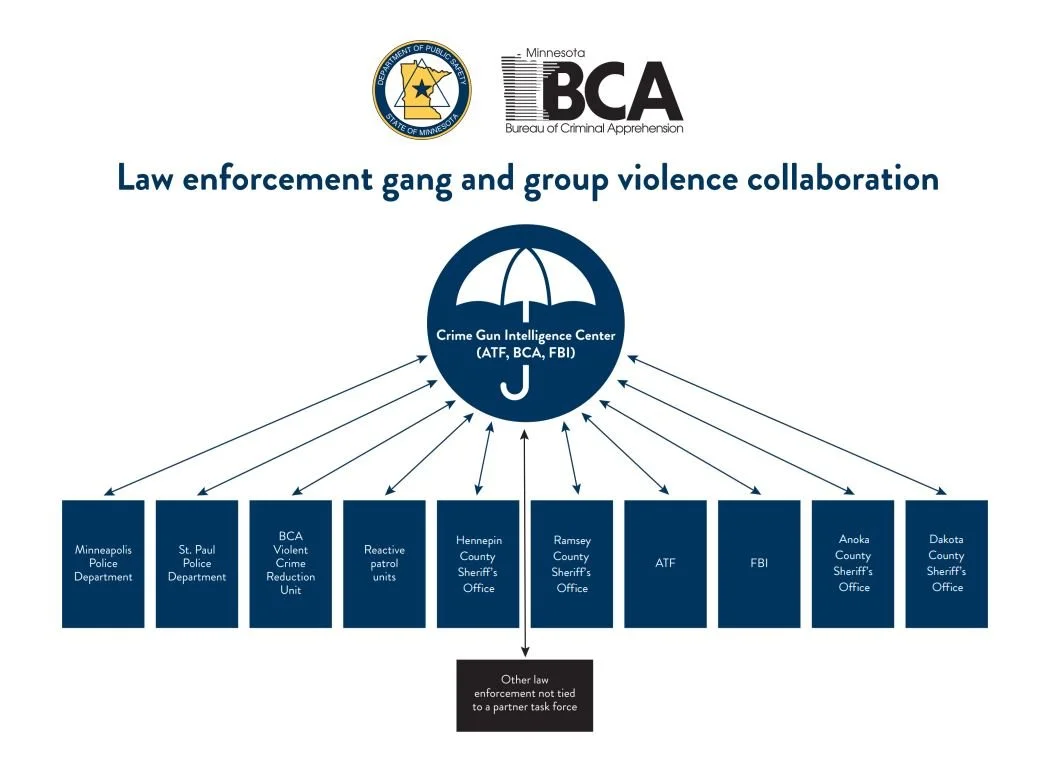
A rough framework between state, local, and federal agencies joins forces to disrupt gang violence and pursue violent offenders.
BCA Says Existing Resources Will Be Expanded Rather Than Replaced
BCA Superintendent Drew Evans said the initiative followed a meeting on Friday, October 16, 2026, involving more than 40 law enforcement agencies. The meeting focused on identifying ways to address recent gang and group violence while building upon investigative resources already operating throughout Minnesota.
Evans said the discussions highlighted the substantial work already being done by county violent crime enforcement teams, specialized police units and federal task forces. Rather than replacing those organizations, officials agreed to bring them together under a more coordinated structure. The effort will operate through the Crime Gun Intelligence Center, which already provides a framework for sharing investigative information and analyzing evidence from firearms-related crimes.
Evans said the center's existing meetings, previously held every two weeks, will increase to weekly meetings. The additional coordination is intended to help participating agencies identify priority investigations, determine which investigative teams should take the lead, and ensure information reaches departments working on related cases.
The BCA superintendent emphasized that the collaboration can begin immediately because it relies on existing personnel, investigative teams, and law enforcement partnerships. However, Evans said officials remain open to establishing a more formal task force if the violence continues or the scope of investigations requires additional resources.
How the Crime Gun Intelligence Center Works
The Crime Gun Intelligence Center is an interagency collaboration focused on collecting, managing, and analyzing evidence associated with firearms-related crimes. Investigators use ballistic evidence, firearms tracing, criminal intelligence, and other investigative information to identify potential connections between shootings and individuals suspected of committing violent offenses.
One of the initiative's central tools is the ATF's National Integrated Ballistic Information Network, commonly known as NIBIN. The system allows investigators to compare ballistic evidence, including cartridge casings recovered at crime scenes, to identify potential links between firearms used in separate incidents. For example, evidence recovered following a shooting in Minneapolis could potentially be connected to evidence from another shooting in Bloomington, Brooklyn Park, Eagan, or another participating jurisdiction.
Those connections can provide investigators with leads that might not be immediately apparent when incidents are investigated independently. The center will also coordinate with the BCA's Violent Crime Reduction Unit, which includes investigators, intelligence analysts, forensic scientists, victim-witness coordinators, and personnel from partner agencies. The BCA's Forensic Intelligence Response Support and Testing model, known as FIRST, uses data-driven investigative methods and expedited evidence processing to help develop leads in firearms-related cases.
Officials said the combined resources will help investigators identify suspected shooters, connect criminal incidents and determine which agencies are best positioned to pursue particular investigations. The objective is not simply to respond to shootings after they occur, but to identify individuals and criminal networks involved in repeated violence before additional incidents take place.
ATF Assigns Dedicated Investigative Teams to Gang Violence and Shootings
Federal authorities announced additional resources to support the initiative. ATF Special Agent in Charge Joe Persails said the agency has restructured its investigative operations to dedicate one enforcement group exclusively to gang-related violence, while another group will focus on shootings. The agency has also brought in additional ATF agents to assist with investigations.
"The violence we've seen in recent weeks is unacceptable," Persails said during Monday's press conference.
He described recent incidents as an escalation of disputes between rival groups, with gunfire occurring at large community gatherings and placing bystanders and entire neighborhoods at risk. Persails said ATF investigators will use NIBIN, firearms tracing, and other federal investigative resources to identify firearms connected to criminal activity and develop leads.
The agency will work alongside local police departments and county investigators to identify individuals suspected of driving the violence. According to Persails, the goal is to build strong criminal cases, disrupt cycles of retaliation and prevent additional shootings.
FBI Confirms Federal Racketeering Charges Are Possible
The FBI will also play a significant role in the expanded collaboration. FBI Special Agent in Charge Christopher Dotson said the agency will contribute federal investigative resources, national intelligence capabilities, and its existing Safe Streets Task Forces. Those resources allow federal investigators to work alongside local agencies on criminal activity that extends across multiple jurisdictions.
Dotson said the FBI's involvement will focus on identifying violent criminal networks and pursuing investigations that may qualify for federal prosecution. During the question-and-answer portion of Monday's press conference, a reporter asked whether authorities were considering charges under the Racketeer Influenced and Corrupt Organizations Act, commonly known as RICO. A federal official confirmed that RICO charges are among the options available to investigators and prosecutors.
"It's on the table," the official said.
The official explained that federal authorities could also pursue conspiracy charges, firearms offenses, and other crimes of violence, depending on the circumstances of individual investigations. RICO is a federal law that allows prosecutors to pursue cases involving alleged patterns of racketeering activity connected to criminal enterprises. Prosecutors can use the statute against organized criminal groups when they establish the required legal elements, including an enterprise and a pattern of qualifying criminal activity.
However, officials did not announce any new RICO prosecutions during Monday's press conference or identify specific individuals who may face charges under the statute. The FBI emphasized that federal investigations will complement the work already being conducted by local and state agencies.
Hennepin County Establishes Specialized Enforcement Team
Hennepin County Sheriff Dawanna Witt announced the creation of the Hennepin Enhanced Enforcement Team, known as HEAT, as part of the regional response. The team brings together experienced investigators, detectives, officers, and analysts from the Hennepin County Sheriff's Office, Minneapolis Police Department, University of Minnesota Police Department, and personnel assigned to federal task forces.
The team will focus on investigating recent gang-related violence, identifying individuals suspected of committing shootings and disrupting criminal activity. Witt said her office has already assigned additional task force resources following recent incidents. She also noted that the sheriff's office has an intelligence analyst specializing in Somali gang activity who has assisted investigations throughout the metropolitan area.
According to Witt, about 56 intelligence analysts from agencies across the metro have increased their coordination and information sharing. The sheriff said other Hennepin County investigative resources, including the Violent Offender Task Force, West Metro Drug Task Force and Hennepin County Auto Theft Task Force, will be available to provide additional assistance when needed. Those task forces include personnel from more than 20 Hennepin County agencies.
Witt said the expanded coordination is intended to help investigators identify patterns of violence, develop information about suspects and prevent further incidents. She cited the arrest and charging of a suspect connected to a shooting at Eden Prairie High School as an example of recent investigative progress. However, Witt warned that authorities must stay focused even as violence declines.
She said criminal activity can reemerge when investigative resources are reduced or law enforcement attention shifts elsewhere.
Minneapolis and St. Paul Shooting Units Will Contribute Intelligence
Two of the Twin Cities' largest police departments will contribute specialized investigative resources through their existing nonfatal shooting units. The Minneapolis Police Department's Gun Intelligence Unit and Firearm Assault Shoot Team will participate in the collaboration. The St. Paul Police Department will contribute resources through its Non-Fatal Shooting Unit and Gang Unit.
These specialized units investigate shootings that do not result in fatalities, including incidents involving multiple suspects, firearms, and potential connections to ongoing criminal activity. Evans said the information these teams develop will be an important component of the expanded intelligence-sharing framework.
By combining information from nonfatal shootings with ballistic evidence and intelligence from other jurisdictions, investigators may be able to identify patterns of retaliatory violence and connect suspects to multiple incidents. Officials said this approach matters because some criminal groups are believed to operate across several cities rather than staying within one neighborhood or jurisdiction.
County Violent Crime Teams Will Support Regional Investigations
Existing Violent Crime Enforcement Teams, commonly referred to as VCETs, will also play a significant role. These multi-jurisdictional teams operate throughout Minnesota and investigate gang activity, drug offenses, and violent criminal conduct. The teams receive funding through the Minnesota Department of Public Safety's Office of Justice Programs and bring together investigators from multiple agencies.
The Dakota County Sheriff's Office will participate through its Violent Crime Enforcement Team.
The Ramsey County Sheriff's Office will contribute its Violent Crime Enforcement Team, Gun Unit, and Apprehension Unit.
The Anoka County Sheriff's Office will participate through its Drug Task Force and Criminal Investigations Division.
The Hennepin County Sheriff's Office will contribute several specialized units, including criminal intelligence resources and violent offender investigators.
The Scott County Sheriff's Office is also a key participating partner.
Evans said these existing teams already have experience conducting complex investigations and coordinating resources across jurisdictions. The new initiative is intended to strengthen those relationships by establishing a more centralized process for sharing intelligence and identifying investigative priorities.
Authorities Address Recent Somali American Gang-Related Violence
During Monday's press conference, law enforcement leaders acknowledged that recent shootings involving individuals associated with Somali American gangs were among the immediate concerns prompting the expanded collaboration. Officials described some of the groups involved as decentralized or hybrid gangs, with changing affiliations and organizational structures.
Evans said investigators have observed groups changing names and allegiances following arrests, injuries, and other developments involving suspected members. That shifting structure can make it difficult for authorities to identify specific organizations or determine how many individuals are involved. However, law enforcement leaders repeatedly emphasized that the individuals suspected of criminal activity represent a relatively small portion of the broader Somali American community.
Evans said the initiative is intended to focus on individuals suspected of committing violent crimes rather than targeting communities based on ethnicity. Bloomington Police Chief Booker Hodges delivered a direct message about the importance of distinguishing criminal conduct from community identity.
"We cannot cast a group of people all in one group," Hodges said.
Hodges compared the current situation to previous periods of gang violence in Minneapolis, warning that authorities have an opportunity to intervene before the problem becomes more widespread. Witt also condemned efforts to blame entire communities for the actions of individuals involved in criminal activity.
"The actions of the individuals do not define the entire community," Witt said.
She emphasized that the new initiative must remain focused on all forms of gang violence, not solely the groups associated with the most recent shootings. Officials said the collaboration will investigate gang and group-related violence regardless of the ethnicity or background of those involved.
Recent Shootings Raise Concerns About Public Safety
Law enforcement leaders pointed to several recent incidents as examples of the violence they are attempting to address. Evans referenced a shooting in Bloomington involving approximately 100 rounds of gunfire, as well as incidents involving firearms at public gatherings. He also discussed concerns surrounding shootings at football games and the possibility of changing event schedules because of public safety threats.
Evans said incidents involving large numbers of shots fired or gunfire near public gatherings demonstrate the need for a coordinated response. Authorities also discussed the availability of firearms and devices commonly referred to as switches, which can illegally convert certain semiautomatic firearms into automatic weapons. Evans said federal firearms investigators will help agencies address these issues.
Officials did not provide a comprehensive breakdown of how many firearms involved in recent shootings were illegally obtained or equipped with conversion devices. They also did not announce a confirmed number of individuals responsible for the recent violence.
Gang Membership Estimates Remain Uncertain
During questions from reporters, officials acknowledged the difficulty of determining how many individuals are currently involved in gang activity throughout Minnesota. Estimates of approximately 2,000 individuals associated with gangs statewide and approximately 300 associated with Somali gangs were discussed during the press conference by Ramsey County Sheriff Bob Fletcher.
However, officials cautioned that those figures are estimates, not confirmed counts from a comprehensive intelligence database. Evans said the BCA maintains a gang database governed by specific criteria established through Minnesota's Violent Crime Coordinating Council. According to Evans, the most recent report identified only 15 individuals meeting the established criteria for inclusion. He explained that the database does not represent a comprehensive count of everyone suspected of participating in gang-related criminal activity.
Some criminal groups operate without traditional leadership structures or identifiable membership, making it difficult to track individuals through conventional gang intelligence systems. Evans said the expanded collaboration will help investigators consolidate information and better understand the scope of the violence.
The BCA is also considering whether it needs a different intelligence system to support those efforts. No specific new database or implementation timeline was announced.
Officials Explain Safeguards Following Metro Gang Strike Force Controversy
The new initiative also prompted questions about Minnesota's former Metro Gang Strike Force, which faced serious controversy over its operations and oversight. During Monday's press conference, a reporter asked how the current collaboration differs from the former enforcement organization and the gang intelligence practices associated with that period.
Evans said Minnesota's law enforcement task force structure has changed significantly since then. He explained that many of the existing task forces participating in the new initiative operate under the oversight of the Violent Crime Coordinating Council. Those task forces have governing boards that oversee operations and are subject to audits and other accountability requirements.
Evans also said the BCA has requested legal guidance from the Minnesota Attorney General's Office to ensure the Crime Gun Intelligence Center complies with applicable laws. In addition, participating agencies will enter into formal memorandums of understanding outlining their responsibilities and the structure of the collaboration. Those agreements are intended to establish consistent expectations for coordination, information sharing and oversight.
Evans said the additional safeguards are designed to provide accountability across the initiative.
BCA Details Gang Database Oversight Requirements
Evans also explained the criteria governing Minnesota's gang intelligence database. According to Evans, the state uses a nine-point framework established through the Violent Crime Coordinating Council. An individual must meet at least three of those criteria to qualify for inclusion in the BCA-operated gang database. The database undergoes annual audits, and authorities remove individuals who no longer meet the criteria.
The Violent Crime Coordinating Council also reviews the criteria annually to determine whether modifications are necessary. Evans noted that federal authorities use a separate ten-point framework for their gang intelligence database. He said the state system has substantially more oversight than earlier gang intelligence practices.
However, officials acknowledged that the existing database has limitations, particularly when investigating decentralized groups whose membership and affiliations may change frequently. The BCA is examining whether additional intelligence tools could help agencies share investigative information without relying solely on traditional gang membership classifications.
Officials emphasized that the objective is to focus on individuals suspected of criminal conduct and use evidence to guide investigations.
Quick-Reaction Teams Could Deploy Across Counties
Another component of the initiative involves county-based quick-reaction teams that can provide specialized patrol and investigative responses when violent incidents occur. These teams would draw upon existing law enforcement resources and could be deployed to address emerging threats, support investigations or respond to incidents involving suspected gang activity.
Officials discussed the importance of coordinating resources around large public gatherings, particularly following recent shootings involving multiple people. The structure is intended to improve agencies' ability to respond quickly when criminal activity crosses city or county boundaries.
The BCA said the collaboration is scalable, meaning it can assign additional personnel and investigative resources as needed. If the current approach proves insufficient, officials said they could still establish a dedicated task force. However, the immediate focus is on strengthening coordination among existing law enforcement teams rather than creating an entirely new organization.
Community Engagement Remains Part of the Response
Although Monday's announcement primarily focused on law enforcement operations, officials emphasized that investigations and arrests alone will not eliminate gang violence. Evans said the Minnesota Department of Public Safety is organizing a listening session involving members of the Somali community. Other law enforcement agencies have already begun meeting with community representatives to discuss concerns and identify prevention opportunities.
Edina Police Chief Todd Milburn said his department recently held a community meeting and has continued to discuss the issue with local leaders. Milburn also referenced conversations involving community leadership in Shakopee. He said those discussions are intended to bring additional voices into the process and develop strategies that extend beyond enforcement. Hodges urged families and community members to report concerns when they become aware of young people possessing firearms or engaging in dangerous activity.
Officials said community participation can help identify individuals at risk of becoming involved in violence and provide opportunities for intervention. Evans acknowledged that law enforcement cannot rely solely on arrests to solve the problem. He said authorities must also work with community organizations, families and trusted individuals to prevent young people from entering cycles of violence.
Officials Questioned About Evidence Sharing in Separate Investigation
During the question-and-answer portion of Monday's press conference, a reporter also raised concerns about evidence sharing between state and federal authorities in a separate, ongoing investigation into the Alex Pretti death approximately eight months earlier. The reporter referenced concerns reportedly raised by a county attorney about delays in obtaining certain evidence, including a statement an agent provided to federal investigators.
Evans did not address the specific evidence or explain why the requested material had not been provided. Instead, he said discussions involving the relevant prosecuting authorities, the Minnesota Attorney General's Office and the U.S. Attorney's Office were continuing. Evans maintained that state and federal agencies have a strong working relationship and said investigators should have access to the evidence necessary to conduct complete investigations.
He deferred questions about the specific information-sharing dispute to the attorneys involved.
Collaboration Modeled After New Jersey Enforcement Strategy
The BCA said Minnesota's initiative is modeled in part on the law enforcement component of New Jersey's strategy for addressing gang and gun violence. That approach emphasizes intelligence-led policing, coordinated investigations, and the use of evidence to identify individuals responsible for violent criminal activity.
Minnesota's collaboration will incorporate those principles through the existing Crime Gun Intelligence Center. The effort will also involve coordination with county prosecutors and the U.S. Attorney's Office. During the press conference, Evans said prosecutors in Dakota, Scott, Anoka, and other participating counties have been involved in discussions about the initiative.
Officials said decisions about whether to pursue state or federal charges will depend on the circumstances and evidence developed in individual investigations. Federal agencies could prosecute certain cases under federal firearms, conspiracy, or racketeering statutes when applicable.
What Happens Next?
The BCA said the coordinated enforcement effort is already operating, with agencies sharing intelligence and contributing resources to active investigations. Participating agencies are finalizing formal agreements.
The Crime Gun Intelligence Center will increase its coordination meetings to once per week, while participating task forces will continue investigating violent offenders within their existing jurisdictions.
ATF has committed additional investigators and reorganized enforcement teams to focus specifically on gang-related violence and shootings.
The FBI will provide federal investigative resources, including the option to pursue conspiracy, firearms, and racketeering charges when the evidence supports it.
County-based teams will also be available to provide rapid responses when incidents occur or emerging threats are identified.
Officials have not announced specific performance benchmarks, a total budget for the expanded initiative, or a date for a formal evaluation of the collaboration. The BCA said the ultimate objective is to identify individuals responsible for violent criminal activity, prevent retaliatory shootings and reduce gang-related gun violence throughout Minnesota.
For communities across the Twin Cities, the initiative represents a significant expansion of cooperation among municipal police departments, county sheriff's offices, state investigators and federal law enforcement agencies. While the announcement does not establish a new task force in every participating community, it is intended to provide local investigators with greater access to intelligence, forensic resources, and specialized investigative assistance.
The initiative's effectiveness will ultimately depend on how successfully participating agencies translate expanded coordination into investigations, prosecutions, and measurable reductions in violence.
Written by: Will Wight
Cover Photo Credit: Law enforcement to provide details on gang and group violence response strategy press conference
