
344 Million Birds Expected to Migrate Overnight, Minnesotans Asked to Turn Off Non-Essential Lights
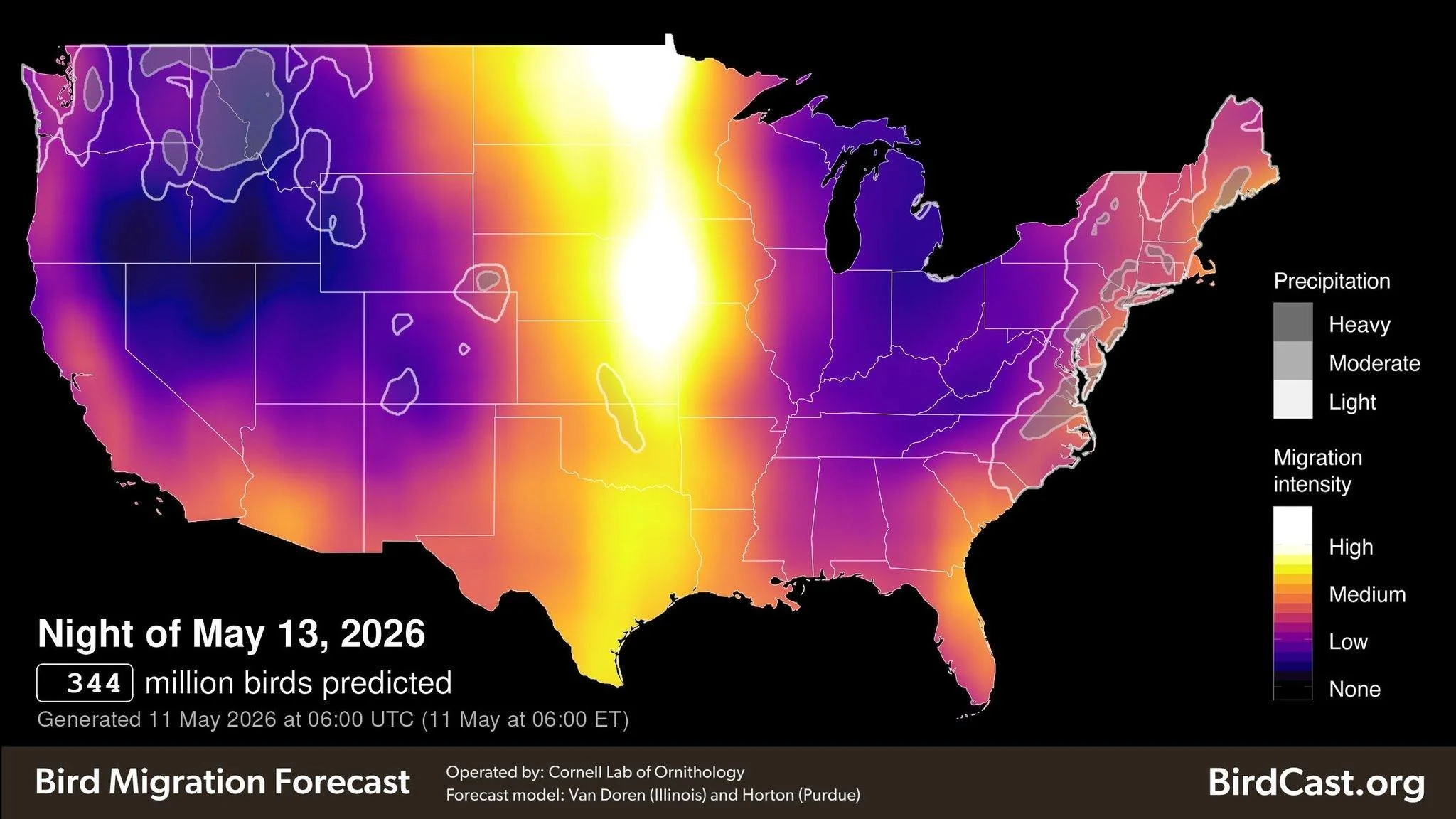
Credit: BirdCast - Cornell Lab Bird Cast and Minnesota State Parks and Trails/Facebook
Published: May 13th, 2026
MINNESOTA: Millions of birds are expected to soar across Minnesota skies overnight as spring migration reaches one of its busiest periods of the season, according to migration forecasts from the Cornell Lab of Ornithology’s BirdCast system.
Minnesota State Parks and Trails shared that an estimated 344 million birds are forecast to take flight overnight across parts of the United States, with Minnesota expected to see especially heavy migration activity. The forecast is powered by BirdCast, a collaborative project that uses weather radar data to estimate and predict bird migration patterns in real time.
Bird enthusiasts and casual observers alike may notice an increase in migratory songbirds throughout the state during the next several days, especially during the early morning and daytime hours after birds land to rest and feed.
Among the species Minnesotans may encounter are the Rose-breasted Grosbeak, Least Flycatcher, and Common Yellowthroat, all of which are common spring migrants moving north toward breeding grounds in Minnesota and Canada.
BirdCast’s migration dashboard notes that spring migration generally peaks from mid-April through mid-May across the Upper Midwest, with birds typically beginning migration flights roughly 30 to 45 minutes after sunset.
Conservation groups are also encouraging residents and businesses to help reduce hazards for migrating birds by turning off non-essential outdoor lighting overnight, particularly between 11 p.m. and 6 a.m. Excessive nighttime lighting can disorient migrating birds, especially during cloudy conditions, increasing the risk of collisions with buildings and windows.
The BirdCast system, developed through partnerships involving the Cornell Lab of Ornithology, Purdue University, the University of Illinois Urbana-Champaign, and the University of Massachusetts Amherst, provides nightly migration forecasts, live migration maps, and regional dashboards across the contiguous United States.
Minnesota’s position along the Mississippi Flyway makes the state one of the country’s most important migration corridors, with millions of birds passing through each spring and fall.
Residents interested in tracking migration activity can monitor live bird migration maps and forecasts on BirdCast.
