
Minnesota House Passes AI Child Exploitation Bill 132–1; Lone Opponent Says It ‘Misses the Mark’
Published: May 1, 2026
TWIN CITIES, MN: The Minnesota House of Representatives has overwhelmingly passed legislation aimed at cracking down on the use of artificial intelligence to create explicit images of minors, as lawmakers move to address growing concerns over digital exploitation.
House File 1606 (HF1606) passed by a 132–1 vote on April 23, 2026, with broad bipartisan support. The bill targets so-called “nudification” technology, tools capable of generating non-consensual, AI-altered explicit images, including those involving children.
The legislation is authored by Jessica Hanson, who warned lawmakers about the technology's real-world impact during debate.
“Nudification technology has empowered and enabled pedophiles and sexual predators around the globe,” Hanson said. “It has harmed children who are made victims by their cruel peers, women who are made victims by men they have trusted for decades. And what’s worse is that these predators are increasingly profiting while wreaking this havoc.”
What the Bill Does
HF1606 would prohibit individuals from accessing, downloading, or using a website, application, software program, or other service designed to “nudify” an image or video.
The bill also bans the advertising of such services and creates a legal pathway for victims to pursue action against those who create or distribute the content.
Supporters say the measure is designed to close gaps in current law as artificial intelligence tools have rapidly evolved between 2024 and 2026, making it easier to generate realistic explicit images without consent.
Lone Vote in Opposition Explained
The only lawmaker to vote against the bill was Drew Roach, a Republican representing Farmington. During the House floor debate, Roach emphasized that he agrees the issue is serious but disagrees with how the bill attempts to address it.
“This is a problem… it’s disgusting and it’s vile, and those victims… should have accountability and should seek justice,” Roach said.
However, he said he believes the legislation does not address the root cause.
“I’m not going to be supporting this bill… not because I don’t stand with the victims… but I don’t think it’s getting to the root cause. I don’t think that it’s actually going to prevent this in the future.”
Roach argued the bill focuses too heavily on software providers rather than those committing the crimes.
“What we’re going to do here is go after a software manufacturer instead of the perpetrators of these crimes,” he said. “If we want to prevent this from happening… we should go after those perpetrators with the full force of the law.”
He also raised concerns about the bill’s effectiveness, suggesting individuals could still create such material independently.
“I’m just worried that this really isn’t going to stop anything,” Roach said. “I think it sets a precedent of going after manufacturers instead of actual suspects.”
Despite his opposition, Roach acknowledged the intent behind the legislation, calling its premise “honorable” but saying it “misses the mark.”
Public Statement Responds to Criticism
Following the vote, Roach issued a public statement pushing back on how his vote has been portrayed. He said claims suggesting he supports child exploitation are “false” and “dangerous,” emphasizing that he does not support “child pornography or any form of child exploitation.”
Roach reiterated his belief that the bill is ineffective against determined offenders, arguing that individuals could bypass restrictions using tools such as VPNs. He also pointed out that the production, possession, and distribution of child sexual abuse material is already illegal under both federal and Minnesota law, with severe penalties already in place.
“My vote was not about supporting harm to children,” Roach said. “It was about refusing to support feel-good legislation that distracts from enforcing and strengthening the real, effective laws we already have on the books.”
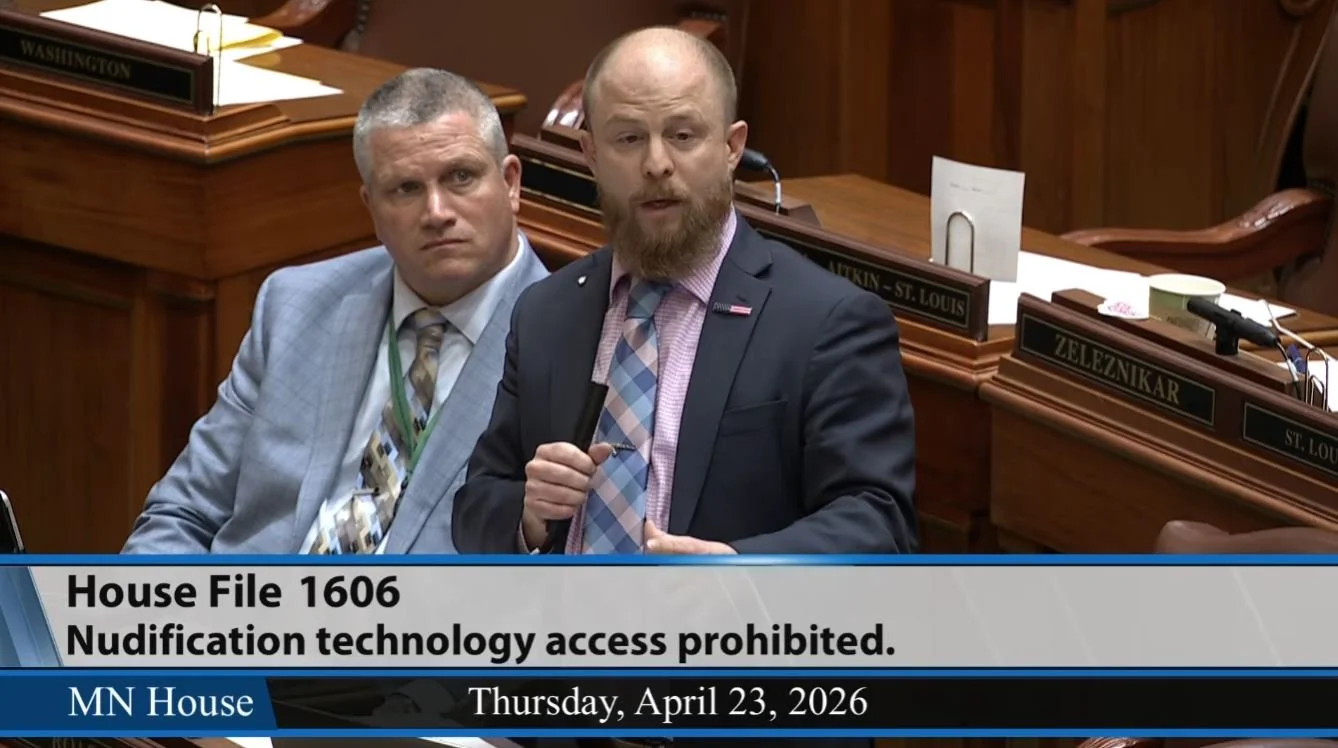
Captured from the Minnesota House passes bill to ban 'nudification technology' 4/23/26 on YouTube/MNHouseInfo of Representative Drew Roach speaking during the debate of the bill.
Supporters Cite Growing AI Threat
Supporters of HF1606 argue that the legislation is necessary as AI-generated content becomes more sophisticated and widely available.
They say newer technologies — including deepfake-style image generation — present unique challenges not fully addressed by existing statutes, particularly when images can be created without direct physical abuse but still cause lasting harm.
Backers contend that restricting access to these tools, along with providing legal recourse for victims, is a critical step in limiting the spread of such content.
What Comes Next
Following its passage in the House on April 23rd, HF1606 now moves to the Minnesota Senate for consideration during the remainder of the 2026 legislative session.
If approved and signed into law, the measure could take effect as early as August 1, 2026, the standard effective date for most Minnesota laws.
You can watch the full session below, provided by MNHouseInfo on YouTube.
Written by: Will Wight
