
State of Minnesota, St. Paul/Minneapolis Sue to Halt ICE “Surge,” Alleging Constitutional Violations
Published: January 12th, 2026
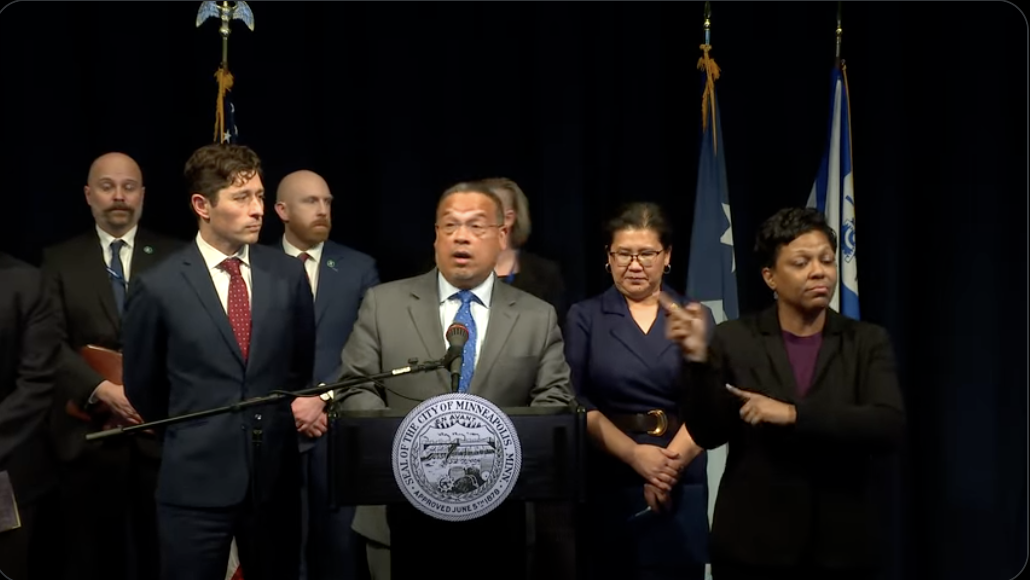
MINNEAPOLIS, MINNESOTA: Minnesota Attorney General Keith Ellison, along with the cities of Minneapolis and Saint Paul, filed a federal lawsuit Monday seeking to halt what they describe as an unprecedented surge of federal immigration enforcement activity in the Twin Cities, alleging the operation is unconstitutional, unlawful, and politically motivated.
The lawsuit, filed against the U.S. Department of Homeland Security and related federal agencies and officials, asks the court to immediately stop “Operation Metro Surge,” a large-scale deployment of Immigration and Customs Enforcement (ICE) and Customs and Border Protection (CBP) agents that began in December. The plaintiffs are also requesting a temporary restraining order, citing ongoing harm to residents, local governments, and public safety systems.
According to the complaint, thousands of armed and masked DHS agents have conducted raids and enforcement actions across Minneapolis and Saint Paul, including in schools, hospitals, churches, and other locations traditionally considered sensitive. State and city officials allege the operation has resulted in excessive use of force, unlawful arrests, racial profiling, and violations of constitutionally protected speech.
The lawsuit argues that the surge violates the First and Tenth Amendments to the U.S. Constitution, the principle of equal sovereignty between states, and the federal Administrative Procedure Act, which prohibits arbitrary and capricious agency actions.
Attorney General Ellison said the federal operation has placed significant strain on Minnesota communities and local governments.
“The deployment of thousands of armed, masked federal agents is harming Minnesotans and undermining public safety,” Ellison said. “Schools have gone into lockdown, businesses have closed, and local police are being forced to divert resources to deal with chaos they did not create.”
Minneapolis Mayor Jacob Frey said the city did not request the federal operation and is now dealing with its consequences.
“When federal actions undermine public safety and violate constitutional rights, local governments have a responsibility to respond,” Frey said.
Saint Paul Mayor Kaohly Her echoed those concerns, stating that residents have reported fear and confusion as federal agents operate throughout neighborhoods.
“Our residents are scared, and our city is bearing the impact of decisions made without local input,” Her said.
The lawsuit outlines a range of alleged harms tied to the operation, including schools entering lockdowns, businesses closing or reporting sharp drops in revenue, and local law enforcement agencies responding to incidents involving federal agents. Minneapolis police began tracking overtime related to the surge on January 7; within days, officers had logged more than 3,000 overtime hours at an estimated cost of over $2 million.
The complaint also references the January 7 shooting death of Renee Good by a DHS agent, an incident cited as evidence of the operation’s risks and consequences. Federal authorities have not publicly released detailed findings related to that shooting.
State and city officials further argue that the operation is not justified by immigration enforcement needs, noting that Minnesota’s population of undocumented immigrants is estimated at roughly 1.5%, below the national average. They contend that other states with higher undocumented populations have not seen similar federal deployments.
The lawsuit alleges the surge is instead part of a broader pattern of federal actions targeting Democratic-led cities and states, and claims it represents retaliation for Minnesota’s political leadership and election outcomes. Officials argue such targeting violates constitutional protections against viewpoint discrimination and retaliation.
In addition to seeking a permanent end to Operation Metro Surge, the plaintiffs are asking the court to prohibit DHS agents from engaging in practices they describe as unlawful, including arrests of bystanders, enforcement actions at sensitive locations, and the use of force against individuals not posing a threat.
The case is expected to be heard in federal court in the coming days as the request for a temporary restraining order moves forward.