
Dense Fog Advisory Issued for Twin Cities, Visibility Could Drop Below Quarter Mile
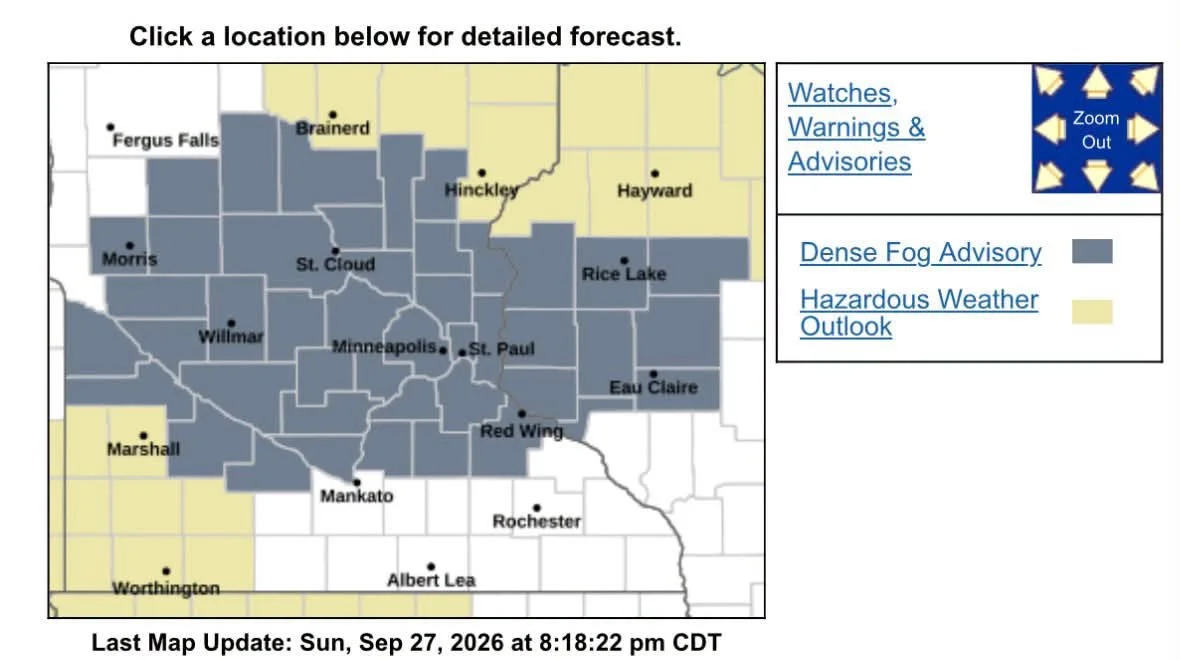
Provided by the NWS Twin Cities.
Published: September 27, 2026
TWIN CITIES, MINNESOTA: Drivers across the Twin Cities metro could encounter significantly reduced visibility overnight and during the Monday morning commute as patchy dense fog develops across much of Minnesota and western Wisconsin.
The National Weather Service Twin Cities/Chanhassen issued a Dense Fog Advisory through 10 a.m. Monday, September 28, 2026, warning that visibility could fall to one-quarter mile or less in areas of dense fog.
The advisory includes much of the Twin Cities metro, including Dakota, Scott, Hennepin, Ramsey, Washington, Anoka, Carver and Wright counties, as well as a large portion of central, southern and western Minnesota. Parts of western Wisconsin are also included. Communities within the advisory include Minneapolis, St. Paul, Hastings, Shakopee, Chaska, Chanhassen, Stillwater, Blaine and numerous surrounding areas.
Monday Morning Commute Could Be Impacted
The primary concern will be hazardous travel conditions caused by rapidly reduced visibility. Dense fog can make it difficult for motorists to see other vehicles, intersections, pedestrians, and roadway hazards, particularly on roads without adequate lighting.
Conditions may also vary considerably over short distances, with visibility potentially dropping quickly when motorists enter thicker pockets of fog.
Because the advisory remains in effect until 10 a.m. Monday, fog could affect much of the morning commute before conditions gradually improve.
The National Weather Service advises motorists traveling through dense fog to slow down, use headlights, and leave plenty of following distance between vehicles.
Drivers should also allow additional travel time Monday morning and be prepared for visibility of a quarter mile or less in areas where the fog becomes particularly dense. The Dense Fog Advisory covers a broad portion of the region, stretching across central, east-central, south-central, southeastern, southwestern and west-central Minnesota, along with portions of northwest and west-central Wisconsin.
Written By: Meteorologist Will Wight
