
Storms Forecast to Return Across Minnesota this Week, Strong to Severe Storms Possible
MINNESOTA - After a brief period of mild weather across the Twin Cities, despite the smoke from Canada, we will see a shift this week to a hotter, humid, and stormier week ahead. It should be no surprise that with an increase in the heat and humidity comes the increased potential for severe thunderstorms, as these are some of the key ingredients. The timeframe for the potential severe weather is poised to begin around midweek through the weekend, with the possibility of damaging winds, large hail, and even a tornado or two.
Early Week Outlook: Scattered Showers and Mild Temperatures
Scattered showers have worked across western and central Minnesota this afternoon, in connection with a low-pressure circulation we like to call a Mesoscale Convective Vortex (MCV) that has stalled over northeastern South Dakota. This MCV is forecast to continue to influence the region into Monday, bringing isolated thunderstorms and a general rainfall accumulation of 0.25 to 0.5 inches to primarily west-central Minnesota. Locally heavier rainfall totals could be possible where a more robust storm sets up and works over an area. Some of this activity could stretch into the Twin Cities Metro on Monday, but it looks to be pretty light if the precipitation even reaches the surface, maybe around a trace to 0.10” could be possible for parts of the Metro.
By Tuesday, this MCV is expected to weaken and lift into the Upper Great Lakes, while an isolated light shower can’t be ruled out across the Metro, a mostly drier and calmer day is expected.
Heat, Humidity, and Storms Return Midweek
Starting Tuesday night, increasing southerly and southwesterly low-level winds will help to transport warm air and moisture from the Southern U.S., bringing a noticeable uptick in both heat and humidity to the Metro and region. This will set the stage for high temperatures that are forecast to climb into the upper 80s and even low 90s by Thursday through Saturday, and dew points that are forecast to increase into the lower to mid-70s. As we had previously mentioned, the combination of these two ingredients is a key part in supporting an unstable atmosphere ripe for thunderstorm development and strong to severe storms.
Starting Wednesday, there is a 40-45% chance of precipitation each day through the weekend due to the potential for weak disturbances riding along the jet stream that is tracking over the region. While the exact timing and location of storms remain uncertain, the atmospheric ingredients are aligning for the potential for organized severe weather later in the week. This is not unheard of for this region at this time of year, as we are at the climatological peak for that word you might have heard a lot about lately, derechos. But we will dive into that more in the next section, and why that word keeps coming up later.
Summary Forecast for the Week Ahead
Wednesday-Thursday: Isolated storms possible, with moderate deep-layer shear supportive of hail and damaging wind gusts.
Friday-Saturday: Stronger potential for organized severe weather, including the risk for supercells and bowing thunderstorm segments capable of producing large hail, damaging winds, and possibly tornadoes.
Sunday: The severe threat is expected to shift southeast into Wisconsin as a cold front pushes through the region. However, forecast confidence decreases due to differing model solutions.
Derecho Discussion: A Pattern to Watch
As we had mentioned before, it’s a word we have seen mentioned a lot over the last couple of weeks, but that is because we are in the peak season for derechos, and the current weather setup could not be more textbook. But first off, what is a derecho? A derecho is a rare but destructive form of thunderstorm complex known for producing widespread, long-lived straight-line wind damage. These systems can move as fast as 50-70 mph, and can produce straight-line wind gusts over 100 mph.
To be classified as a derecho, the storm system must meet the latest revised criteria from the National Oceanic and Atmospheric Administration (NOAA). Similar to a tornado, this is determined after the system has occurred:
Widespread reports of wind gusts of at least 58 miles per hour (26 m/s; 50 kn), all occurring from the same mesoscale convective system (MCS)
The MCS must be at least 60 miles (97 km) long
The MCS must last at least 3 hours
The forward speed of the MCS must be faster than the environmental mean wind speed
No more than one hour may occur between wind reports
Spatial gaps between wind reports may not exceed 124 miles (200 km)
The wind swath must be at least 250 miles (400 km) long
At least three wind reports of at least 75 miles per hour (121 km/h) must be separated by 80 miles (130 km)
Derechos are most common during the late Spring and Summer, from May through August, with the majority of these (75%) occurring from April to August, according to the Storm Prediction Center (SPC).
The setup across the Upper Midwest over the last week or so has featured a large dome of high pressure in the south to southeastern United States that has been bringing record heat, and a strong upper-level jet over the Northern Plains, which has helped track disturbances across the region. This type of setup is historically favorable for producing what is known as progressive derechos. These events form in a hot, moist environment with strong winds aloft and often initiate from subtle disturbances in the mid-levels of the atmosphere or along surface boundaries such as cold fronts.
Another type of derecho is a serial derecho, which is usually part of larger storm systems and often begins along a cold front. These setups tend to feature more rotational shear, increasing the risk of brief tornado spin-ups.
The image below illustrates what a typical setup for a progressive derecho might look like, and similarly, what we have been seeing across the region over the last week or so. Looking ahead to this coming week, and as we have previously mentioned, we will have a hot and moist environment in place with a strong jet stream forecast to work across the region once again. By Wednesday, we will start to see a few weak disturbances work into the region from the west-northwest. The biggest uncertainty at this point is the timing of these disturbances and whether there will be enough forcing to allow the “cap” to break and produce the storms. The “cap” is a layer of warm air aloft that suppresses storm development and can make forecasting these events difficult. If a disturbance is strong enough to break the cap, storms can erupt rapidly if the conditions are favorable.
If we can get the cap to break, the conditions look to be favorable enough to support the potential for strong to severe storms. Once again, damaging straight-line winds and large hail will be the primary threats, but a tornado or two can’t be ruled out. Based on the setup, yes, a derecho could be possible, but that can’t be determined until after it is all said and done. What you need to focus on is the potential threat of straight-line damaging winds.
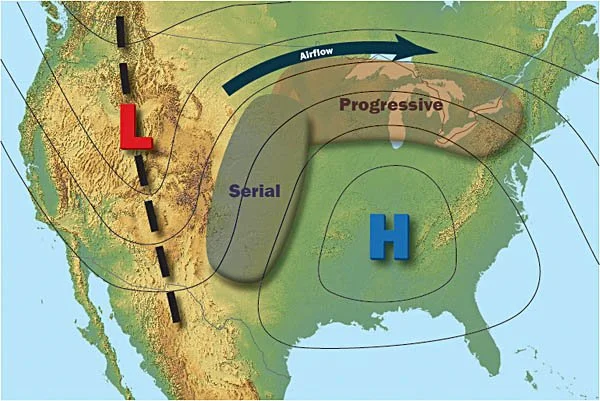
Provided by the NWS in Louisville, KY.
Be Weather Aware
Residents of the Twin Cities and surrounding areas should remain weather-aware this week, especially from Thursday onward. While not every area will see severe storms, the potential for rapidly developing high-impact events cannot be ignored. Weather conditions can evolve quickly during this time of year, which is why we recommend being weather aware, monitoring the latest forecast updates over the coming day, and having a severe weather safety plan ready.
We will provide additional updates over the coming days!
Written by: Will Wight
